21 Blackcap
Names
Common name – Blackcap
Scientific name – Rubus leucodermis
Other names – Whitebark Raspberry; Black Raspberry
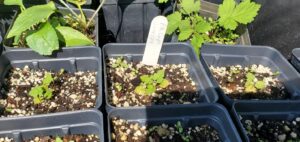
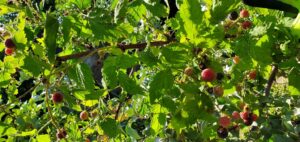
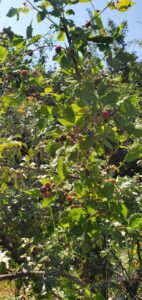
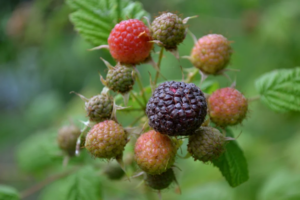
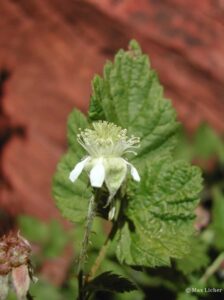
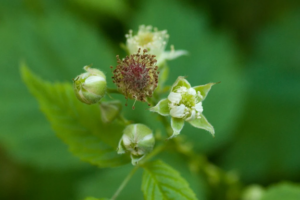
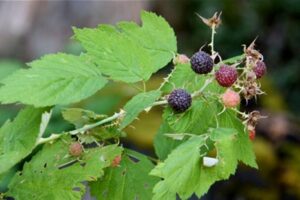
General information
The traditional knowledge of Blackcap’s medicinal properties, particularly for wound healing and pain relief, aligns well with modern scientific findings showing significant anti-inflammatory, antimicrobial, and tissue-protective effects of its anthocyanins and ellagitannins. The round-shaped fruit is a 12–15 mm diameter aggregation of drupelets.
Traditional Indigenous Uses
Blackcap is a healing plant that gave its medicine through both its bark and its berries. The leaves and bark were often chewed and applied directly to wounds or burns to draw out pain and speed healing. When a wound festered or became infected, poultices made from the bark helped to cleanse and close it, while boiled bark teas were used to calm inflammation and ease the aches that lingered in the body.
During childbirth, the bark was sometimes boiled in seawater and drunk to help ease labor pains and support the mother through delivery. The same bark, when pounded and applied to the gums, brought relief from toothaches. The leaves, when steeped into tea, provided strength and nourishment, serving as a source of vitamin C during long winters when fresh food was scarce.
The berries themselves were both food and medicine, eaten to settle the stomach, aid digestion, and restore energy.
Additional Traditional Uses
- Young shoots were harvested in spring, peeled, and eaten raw or cooked like asparagus
- Berries were consumed fresh or dried
- Used to make purple dye for ceremonial and practical purposes
Biochemical Basis of Medicinal Properties
Key Bioactive Compounds
- Anthocyanins
The major anthocyanins in Blackcap berries include:
- Cyanidin-3-O-glucoside (C3G)
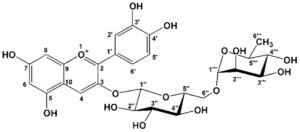
- Cyanidin-3-O-rutinoside (C3R)
- Cyanidin-3-O-sophoroside
- Cyanidin-3-O-(2″-O-glucosyl) rutinoside
- Pelargonidin-3-O-glucoside
Chemical Structure of Cyanidin-3-O-glucoside (C3G)
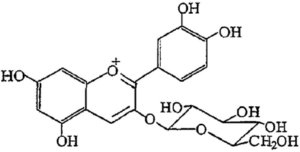
Chemical Structure of Cyanidin-3-O-rutinoside (C3R)
- Ellagitannins
- Sanguiin
- Lambertianin
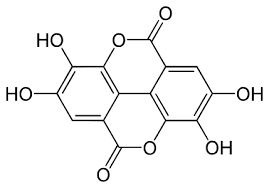
- Ellagic Acid and Derivatives
 Black raspberries also have the ability to improve night vision. Some evidence shows that they may also serve as a shield against macular degeneration.
Mechanisms of Action
- Antioxidant Activity
Even more than wild blueberries, black raspberries have a high level of anthocyanins, which are proven to aid in eye health.
Free radical scavenging reaction:
Anthocyanin-OH + R• → Anthocyanin-O• + R-H
(Antioxidant) + (Free radical) → (Stabilized) + (Neutralized)
- Anti-inflammatory Activity
Nitric oxide production in LPS-stimulated RAW264.7 cells treated with C3G and C3R was reduced by 41.9 and 34.4%, respectively. In addition, LPS-induced prostaglandin E2 production was significantly (p<0.05) inhibited by C3G (51.7%) and C3R (58.6%)
Reaction pathway:
C3G/C3R → ↓ iNOS expression → ↓ NO production → ↓ Inflammation
C3G/C3R → ↓ COX-2 expression → ↓ PGE2 production → ↓ Inflammation
- Wound Healing Activity
The traditional use for wound healing is supported by multiple mechanisms:
- Antimicrobial effects from phenolic compounds
- Anti-inflammatory action reducing tissue damage
- Antioxidant protection of healing tissues
- Collagen synthesis support from vitamin C
- Cardiovascular Protection
C3R induced vasorelaxation concentration-dependently in aortic rings (92% maximum relaxation; EC50: 2.43 ± 0.57 μM) and in perfused-mesenteric arterial bed (61% maximum relaxation; EC50: 25.0 ± 1.26 μM)
Vasorelaxation mechanism:
C3R → ↑ eNOS activity → ↑ NO production → Vasodilation
- Anti-cancer Properties
Animal studies conducted at Ohio State University showed that mice fed a 5 – 10% diet of black raspberries had an impressive 80% reduction in esophageal cancer. Another animal study at the same university showed a 60 – 80% reduction in colon tumors.
References
- Elders and Community members of the Cayoose Creek Band of Sekw’el’was
- Turner, N. J. (1995). Food plants of coastal First Peoples (Royal British Columbia Museum Handbook). UBC Press.
- Gunther, E. (1973). Ethnobotany of Western Washington: The knowledge and use of indigenous plants by Native Americans. University of Washington Press.
- Hummer, K. E. (2010). Rubus pharmacology: Antiquity to the present. HortScience, 45(11), 1587–1591. https://doi.org/10.21273/HORTSCI.45.11.1587
- Moerman, D. E. (2009). Native American medicinal plants: An ethnobotanical dictionary. Timber Press
- Ludwig, I. A., Mena, P., Calani, L., Borges, G., Pereira-Caro, G., Bresciani, L., Del Rio, D., Lean, M. E. J., & Crozier, A. (2015). New insights into the bioavailability of red raspberry anthocyanins and ellagitannins. Free Radical Biology and Medicine, 89, 758–769. https://doi.org/10.1016/j.freeradbiomed.2015.10.400
- Mullen, W., McGinn, J., Lean, M. E. J., MacLean, M. R., Gardner, P., Duthie, G. G., Yokota, T., & Crozier, A. (2002). Ellagitannins, flavonoids, and other phenolics in red raspberries and their contribution to antioxidant capacity and vasorelaxation properties. Journal of Agricultural and Food Chemistry, 50(18), 5191–5196. https://doi.org/10.1021/jf020140n
- Lee, S. G., Kim, B., Yang, Y., Pham, T. X., Park, Y.-K., Manatou, J., Koo, S. I., Chun, O. K., & Lee, J.-Y. (2014). Berry anthocyanins suppress the expression and secretion of proinflammatory mediators in macrophages by inhibiting nuclear translocation of NF-κB independent of NRF2-mediated mechanism. Journal of Nutritional Biochemistry, 25(4), 404–411. https://doi.org/10.1016/j.jnutbio.2013.12.001
- Smeriglio, A., Barreca, D., Bellocco, E., & Trombetta, D. (2017). Proanthocyanidins and hydrolysable tannins: Occurrence, dietary intake and pharmacological effects. British Journal of Pharmacology, 174(11), 1244–1262. https://doi.org/10.1111/bph.13630
- Thilavech, T., & Adisakwattana, S. (2019). Cyanidin-3-rutinoside acts as a natural inhibitor of intestinal lipid digestion and absorption. BMC Complementary and Alternative Medicine, 19, Article 242. https://doi.org/10.1186/s12906-019-2664-8
- Krauze-Baranowska, M., Głód, D., Kula, M., Majdan, M., Hałasa, R., Matkowski, A., Kozłowska, W., & Kawiak, A. (2014). Chemical composition and biological activity of Rubus idaeus shoots – A traditional herbal remedy of Eastern Europe. BMC Complementary and Alternative Medicine, 14, Article 480. https://doi.org/10.1186/1472-6882-14-480