9 Mullein Leaf Tea
Names
Common Name – Mullein Leaf
Scientific Name – Verbascum thaspus
Other Names – Great Mullein, Torches, Flannel Plant, Candlewort, Candlewick, Tabac du diable (demon’s tabacco), Fluffweed, Golden Rod, Velvet Plant and others.
 Image Source: https://www.canr.msu.edu/pestid/uploads/images/common%20mullein.jpg
Botanical Identity: Common mullein (Verbascum thapsus L.) is a tall biennial plant in the Scrophulariaceae family.
Note: Mullein is NOT native to North America—it was introduced from Europe, northern Africa, and Asia. It is native to Europe, northern Africa, and Asia, and introduced in the Americas, Australia and New Zealand.
Historical Context: While mullein has an extensive history of use in European, Mediterranean, and Asian traditional medicine dating back millennia, its use by Indigenous peoples of North America is post-contact (after European colonization). Native American tribes adopted mullein after its introduction, incorporating it into their healing practices, but it was not part of pre-Columbian Indigenous pharmacopeia. This is an important distinction from truly native medicinal plants.
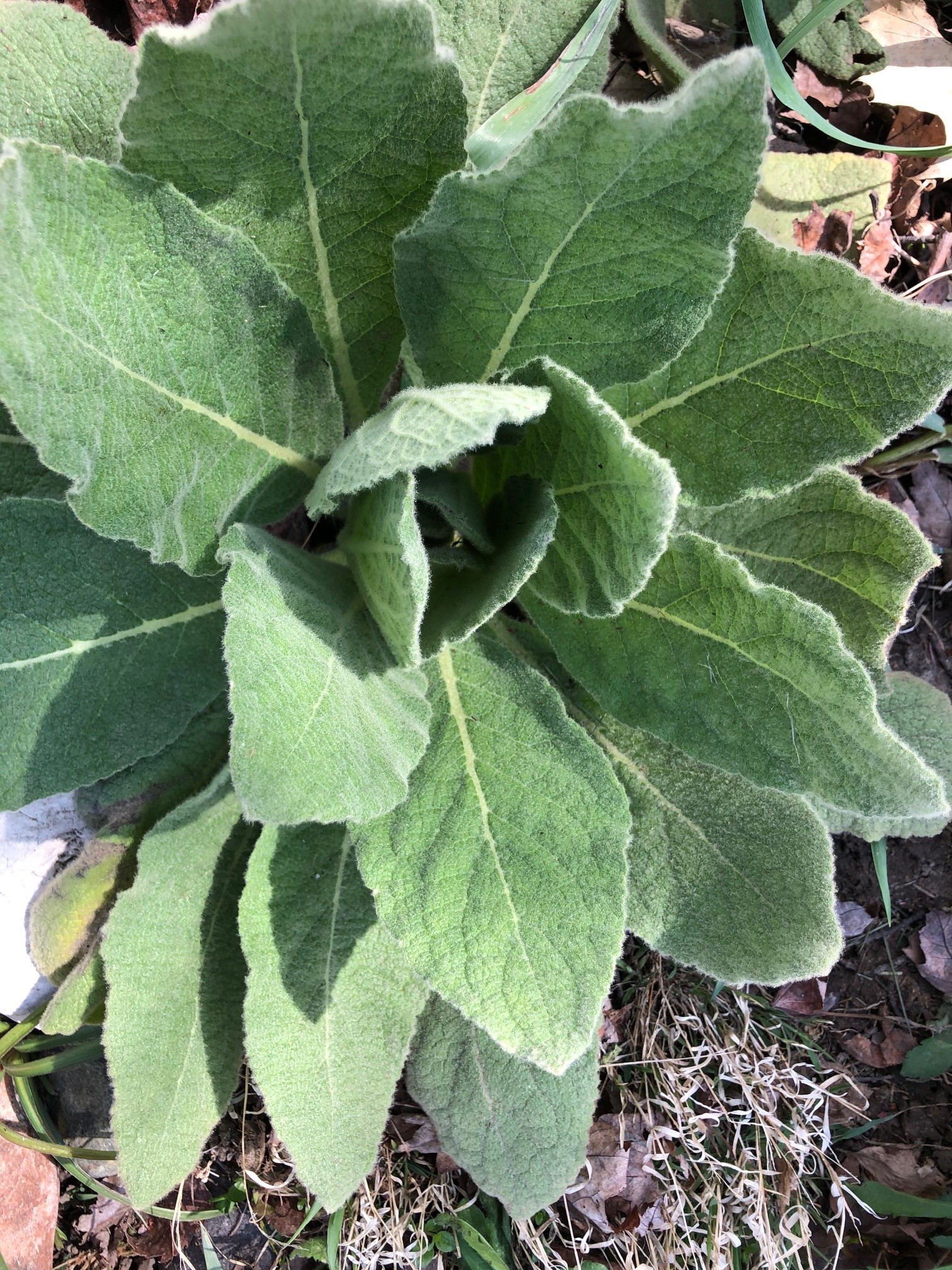
Physical Characteristics: It is a hairy biennial plant that can grow to 2 m tall or more. Its small, yellow flowers are densely grouped on a tall stem, which grows from a large rosette of leaves. In its first year, mullein forms a large basal rosette of soft, velvety, grey-green leaves covered in dense woolly hairs (trichomes). The leaves can reach 12-20 inches long. In the second year, a single tall flower stalk emerges (3-7 feet tall) bearing bright yellow five-petaled flowers arranged in a dense spike. The entire plant is covered in fine, branched hairs giving it a soft, flannel-like texture.
Mullein leaf tea was used to treat respiratory ailments such as bronchitis or asthma. It could be smoked or the leaves could be applied topically. Oil extracted from the leaves was used on earaches and toothache. Extracts from the leaves of the mullein plant have been shown to exhibit antioxidant activity. They also contain constituents such as phenolic compounds, vitamin C and E, carotenoids, and minerals such as zinc all of which have health benefits. The leaves may also posses wound healing and antiviral properties based on the bioactive components present. A particular study also found that mullein leaves exhibited antiviral activity specifically towards the herpes virus type 1, and the hepatitis B virus.
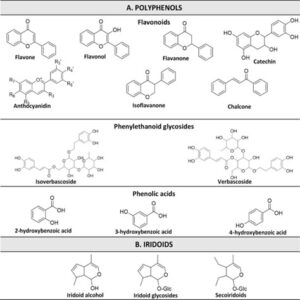 Some of the bioactive components of Verbascum sinuatum, a species of the same genus as Mullein.
Image Source: https://www.mdpi.com/2218-273X/13/3/427
Traditional Indigenous Uses
When the lungs grew tight with coughs, colds, or asthma, the people gathered mullein leaves and flowers to make a soothing tea or to breathe in the healing steam. Some even dried the leaves to smoke gently, clearing the chest and easing deep, dry coughs. For sore throats, hoarseness, and swollen glands, the same tea was used as a gargle to calm the voice and bring relief. The golden flowers, infused in oil, made medicine for earaches and infections.
Mullein was also good for the stomach and bowels, easing cramps, diarrhea, and dysentery. Its tea was taken to cleanse the kidneys and bladder, and to help those who struggled with bedwetting or other urinary troubles. The soft leaves, when crushed and warmed, were laid over wounds, burns, or swollen skin to draw out infection and bring healing. Those who suffered from joint pain or sore muscles found comfort in mullein poultices, while its calming tea helped settle the nerves, ease insomnia, and bring gentle rest. It was used to bring down fever, to clear the lymph when the body was swollen, and even to help the body fight worms or parasites.
Biochemical Basis for Medicinal Properties
Major Bioactive Compounds in Mullein
- Mucilage (Polysaccharides)
Composition: Complex mixture of water-soluble polysaccharides
Concentration: Approximately 3% mucilage
Primary Components:
- Arabinogalactans
- Glucomannans
- Pectins
- Xylogalactans
General Structure:
Branched polysaccharides composed of:
– D-galactose
– L-arabinose
– D-mannose
– D-glucose
– D-xylose
Molecular weight: 10,000-1,000,000 g/mol
Basic repeating units:
-(Gal)-(Ara)-(Gal)-(Ara)-
-(Man)-(Glc)-(Man)-(Glc)-
Highly branched with numerous hydroxyl groups
Key Feature: Forms viscous gel when hydrated due to extensive hydrogen bonding with water molecules.
- Iridoid Glycosides
Aucubin has been studied for its hepatoprotective, anti-inflammatory, and antimicrobial activities. Catalpol is known for its neuroprotective and anti-inflammatory properties.
(i) Aucubin (C₁₅H₂₂O₉)

(ii) Catalpol (C₁₅H₂₂O₁₀)
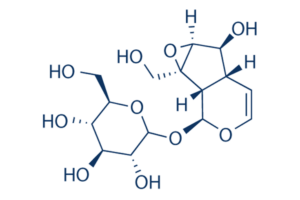
(iii) Harpagide and Harpagide
Related iridoid glycosides with anti-inflammatory properties
- Phenylethanoid Glycosides
Verbascoside (Acteoside, C₂₉H₃₆O₁₅)
Verbascoside has strong antioxidant and anti-inflammatory effects and is responsible for many of the therapeutic properties attributed to mullein.
- Saponins
Small amounts of saponins. The saponins may be responsible for the expectorant actions.
General Structure:
- Triterpene or steroid aglycone (lipophilic)
- One or more sugar chains (hydrophilic)
- Molecular weight: 600-2000 g/mol
- Amphipathic (soap-like) molecules
- Flavonoids e.g. Hesperidin
Structure-Activity Relationships
- Extensive Hydroxyl Groups (Mucilage): Create viscous gel through hydrogen bonding with water; physical protective barrier
- Cyclopentane-Pyran Ring System (Iridoids): Rigid structure for specific receptor binding; antimicrobial and anti-inflammatory activities
- Catechol Groups (Verbascoside): Powerful electron donors for antioxidant activity; enzyme inhibition
- Amphipathic Saponins: Enable membrane disruption for antimicrobial effects; reduce surface tension for expectorant action
- Glycosylation: Enhances water solubility and bioavailability; modulates biological activity
- Ester Linkages (Verbascoside): Provides metabolic lability; releases active components after hydrolysis
Preparation and Safety Considerations
Traditional Tea Preparation:
- Use 1-2 teaspoons dried leaves per cup
- Steep in hot water (not boiling) for 10-15 minutes
- Strain thoroughly through fine cloth (removes irritating hairs)
- IMPORTANT: Must strain well to remove fine hairs that can irritate throat
For Ear Oil:
- Infuse fresh flowers in olive oil for 2-3 weeks
- Strain and use drops in affected ear
- Warm slightly before use
Safety Notes:
- Leaf Hairs: Must be filtered out completely; can irritate mucous membranes if ingested
- Generally safe for most people
- May cause drowsiness (mild sedative effect)
- Seeds contain rotenone (potentially toxic in large amounts); avoid seed consumption
- Rare allergic reactions possible
- Safe during pregnancy based on traditional use, but consult healthcare provider
References
1) Elders and Community members of the Cayoose Creek Band of Sekw’el’was
2) Akdemir, Z. S., Tatli, I. I., Saracoglu, I., & Ismailoglu, U. B. (2001). Polyphenolic compounds from Verbascum lasianthum and Verbascum urticaefolium. Turkish Journal of Chemistry, 25(4), 415–420.
3) Alipieva, K., Korkina, L., Orhan, I. E., & Georgiev, M. I. (2014). Verbascoside—A review of its occurrence, (bio)synthesis and pharmacological significance. Biotechnology Advances, 32(6), 1065–1076. https://doi.org/10.1016/j.biotechadv.2014.07.001
4) Dulger, B., & Gonuz, A. (2004). Antimicrobial activity of some Turkish medicinal plants. Pakistan Journal of Biological Sciences, 7(9), 1559–1562. https://doi.org/10.3923/pjbs.2004.1559.1562
5) Hamill, F. A., Apio, S., Mubiru, N. K., Mosango, M., Bukenya-Ziraba, R., Maganyi, O. W., & Soejarto, D. D. (2000). Traditional herbal drugs of southern Uganda, I. Journal of Ethnopharmacology, 70(3), 281–300. https://doi.org/10.1016/S0378-8741(99)00230-7
6) Kupeli, E., Kosar, M., Yesilada, E., Hüsnu Can Baser, K., & Başer, C. (2005). A comparative study on the anti-inflammatory, antinociceptive and antipyretic effects of isoquinoline alkaloids from the roots of Turkish Berberis Life Sciences, 72(6), 645–657. https://doi.org/10.1016/j.lfs.2003.09.053
7) McCutcheon, A. R., Roberts, T. E., Gibbons, E., Ellis, S. M., Babiuk, L. A., Hancock, R. E., & Towers, G. H. N. (1995). Antiviral screening of British Columbian medicinal plants. Journal of Ethnopharmacology, 49(2), 101–110. https://doi.org/10.1016/0378-8741(95)01321-0
8) Moerman, D. E. (1998). Native American ethnobotany. Timber Press.
9) Riaz, M., Zia-Ul-Haq, M., & Jaafar, H. Z. E. (2013). Common mullein, pharmacological and chemical aspects. Revista Brasileira de Farmacognosia, 23(6), 948–959. https://doi.org/10.1590/S0102-695X2013000600004
10) Sarić-Kundalić, B., Dobeš, C., Klatte-Asselmeyer, V., & Saukel, J. (2010). Ethnobotanical study on medicinal use of wild and cultivated plants in middle, south and west Bosnia and Herzegovina. Journal of Ethnopharmacology, 131(1), 33–55. https://doi.org/10.1016/j.jep.2010.05.061
11) Sarrell, E. M., Mandelberg, A., & Cohen, H. A. (2001). Efficacy of naturopathic extracts in the management of ear pain associated with acute otitis media. Archives of Pediatrics & Adolescent Medicine, 155(7), 796–799. https://doi.org/10.1001/archpedi.155.7.796
12) Tatli, I. I., & Akdemir, Z. S. (2004). Traditional uses and biological activities of Verbascum FABAD Journal of Pharmaceutical Sciences, 29, 85–96.
13) Tatli, I. I., Akdemir, Z., Yesilada, E., & Küpeli, E. (2004). Anti-inflammatory and antinociceptive potential of major phenolics from Verbascum salviifolium Zeitschrift für Naturforschung C, 59(5–6), 609–613. https://doi.org/10.1515/znc-2004-5-622
14) Turker, A. U., & Camper, N. D. (2002). Biological activity of common mullein, a medicinal plant. Journal of Ethnopharmacology, 82(2–3), 117–125. https://doi.org/10.1016/S0378-8741(02)00159-3
15) Zahradnik, H. P., & Goldmeier, S. (2020). Phytotherapy for dysmenorrhea, endometriosis, and premenstrual syndrome. In I. E. Orhan (Ed.), Herbal medicine (pp. 323–342). CRC Press. https://doi.org/10.1201/9780429243730-18
16) Zheleva-Dimitrova, D., Obreshkova, D., & Nedialkov, P. (2013). Antioxidant activity of iridoid glucosides from Veronica chamaedrys. Pharmacognosy Magazine, 9(35), 268–273. https://doi.org/10.4103/0973-1296.113294
17) Jones (2024). Medicinal Herbs of Western Canada. First Edition. Nova Scotia. Nimbus Publishing. p96-97.
18) Riaz M, Zia-Ul-Haq M, Jaafar HZE. (2013). Common Mullein, Pharmacological and Chemical Revista Brasileira de Farmacognosia 23(6). https://doi.org/10.1590/S0102- 695X2013000600012