49 Old Man’s Whiskers
Names
Common name – Old Man’s Whiskers
Scientific name – Geum triflorum
Other names – Prairie Smoke or Three-flowered Avens
General Information
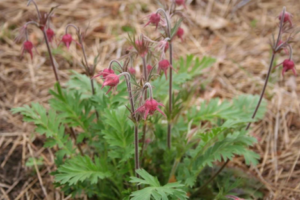
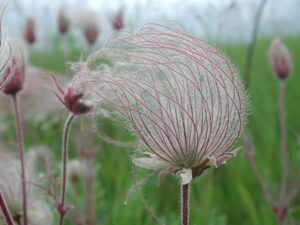
Old Man’s Whiskers is a spring-blooming perennial herbaceous plant in the rose family (Rosaceae) native to North America. This charming low-growing plant reaches 6-16 inches tall, forming attractive clumps from short, spreading rhizomes. The compound leaves are pinnately divided with numerous toothed leaflets, appearing fern-like and remaining semi-evergreen in mild climates. The plant is distinguished by its nodding, urn-shaped flowers that appear in three clusters (hence “triflorum”), with pinkish-purple sepals and cream to yellowish petals hidden inside. Most notably, after flowering, the plant develops spectacular feathery seed plumes that are silvery-pink and 1-2 inches long, resembling smoke rising from the prairie or an old man’s whiskers – the origin of its common name.
Traditional Indigenous Uses
The Elders shared that Old Man’s Whiskers was a trusted medicine, one known for its strength in fighting sickness that weakened the body and the lungs. Its roots were often boiled into a strong tea to help those suffering from tuberculosis and other deep lung infections, easing the cough and helping them breathe more freely. That same root, when made into a gentler infusion, could soothe a sore throat or be used as a gargle to heal pain from pharyngitis or tonsillitis. People also used the root tea as a mouth rinse for canker sores and ulcers, keeping the mouth clean and free from infection. When mixed with grease, the crushed roots became a healing salve, rubbed onto the skin to treat rashes, blisters, and sores. A stronger wash or decoction was applied to wounds to stop bleeding, prevent infection, and speed healing.
Old Man’s Whiskers was also used as a tea for stomach troubles, easing diarrhea and calming an upset belly, while its astringent and anti-inflammatory powers made it helpful for swelling and internal bleeding. The people turned to it when fevers rose, using its tea to cool the body and restore balance during sickness. For those who struggled with chest congestion or shortness of breath, the roots could be brewed or inhaled to clear the lungs and bring relief. Some would take it as a regular tonic, believing it strengthened the whole body and renewed vitality.
Biochemical Compounds and Their Medicinal Properties
- Ellagitannins (Primary Bioactive Compounds)
Three Most Important Compounds:
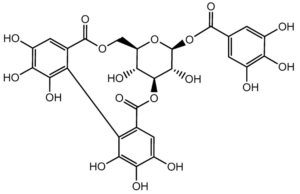
(i) Gemin A (Dimeric ellagitannin C₄₁H₂₈O₂₇)
(ii) Pedunculagin (C₃₄H₂₄O₂₂) – Monomeric ellagitannin

(iii) Corilagin (C₂₇H₂₂O₁₈) – Ellagitannin
Medicinal Properties
- Anti-mycobacterial: Potent activity against Mycobacterium tuberculosis
- Astringent: Strong protein-binding and tissue-contracting effects
- Antimicrobial: Broad-spectrum antibacterial and antiviral activity
- Anti-inflammatory: Reduces inflammatory mediators and oxidative stress
- Triterpenes (Supporting Compounds)
Three Most Important Compounds:
(i) Ursolic Acid (C₃₀H₄₈O₃) – Pentacyclic triterpene
(ii) Oleanolic Acid (C₃₀H₄₈O₃) – Pentacyclic triterpene
(iii) Tormentic Acid (C₃₀H₄₈O₅) – Hydroxylated triterpene
- Flavonoids and Phenolic Compounds
Most Important Compound
Ellagic Acid (C₁₄H₆O₈) – Polyphenolic compound
Proposed Biochemical Mechanisms for Traditional Uses
Anti-Tuberculosis Activity (Root Decoctions)
- Ellagitannins act through:
- Inhibition of mycobacterial cell wall synthesis
- Disruption of M. tuberculosis membrane integrity
- Interference with mycobacterial DNA replication
- Triterpenes contribute:
- Anti-inflammatory effects in infected lungs
- Immune system modulation enhancing host defense
- Antimicrobial synergy with ellagitannins
Wound Healing and Astringent Effects (Topical Applications)
- Ellagitannins provide:
- Protein precipitation forming protective barrier
- Hemostatic action promoting blood clotting
- Antimicrobial protection preventing infection
- Triterpenes facilitate:
- Enhanced collagen synthesis and tissue repair
- Anti-inflammatory effects reducing wound inflammation
- Improved circulation to healing tissues
Oral Health (Root Infusions)
- Ellagitannins act as:
- Astringent compounds tightening oral tissues
- Antimicrobial agents against oral pathogens
- Anti-inflammatory compounds reducing mouth sores
- Ellagic acid contributes:
- Antioxidant protection of oral mucosa
- Antiviral activity against oral herpes viruses
- Enhanced healing of canker sores
Chemical Reactions and Molecular Interactions
Anti-Mycobacterial Mechanism (Ellagitannins)
Ellagitannins → Mycobacterial membrane disruption → Cell lysis → Increased membrane permeability → ATP leakage → Cell death
Gemin compounds → Mycobacterial DNA binding → Replication inhibition → Impaired bacterial division → Growth arrest
Astringent and Hemostatic Action (Ellagitannins)
Ellagitannins → Protein cross-linking → Tissue contraction → Reduced capillary permeability → Decreased bleeding
Tannins + Blood proteins → Coagulation → Hemostasis → Clot formation → Bleeding cessation
Anti-inflammatory Mechanism (Multiple Compounds)
Ellagic acid → NF-κB pathway inhibition → ↓ Pro-inflammatory cytokines → Reduced tissue inflammation → Pain relief
Ursolic acid → COX-2 enzyme inhibition → ↓ Prostaglandin synthesis → Anti-inflammatory and analgesic effects
Antimicrobial Activity (Ellagitannins + Triterpenes)
Pedunculagin → Bacterial membrane disruption → Cell permeability ↑ → Ion leakage + ATP depletion → Cell death
Triterpenes → Bacterial enzyme inhibition → Metabolic disruption → Growth inhibition → Reduced bacterial load
Wound Healing Acceleration (Multiple Compounds)
Triterpenes → Fibroblast proliferation ↑ → Enhanced collagen synthesis → Improved tissue tensile strength → Faster healing
Ellagitannins → Protective barrier formation → Reduced infection risk → Optimal healing environment → Accelerated closure
Traditional Preparation Methods and Biochemical Optimization
Root Decoction (Primary Traditional Method)
- Extended boiling: Maximizes extraction of ellagitannins and triterpenes
- Hot water extraction: Optimizes hydrolysable tannin solubility
- Fresh vs. dried roots: Traditional knowledge distinguishes potency differences
- Dosage timing: Multiple daily doses for serious conditions like tuberculosis
Topical Salve Preparation
- Root infusion + grease: Combines water-soluble and lipid-soluble compounds
- Enhanced penetration: Grease base facilitates transdermal absorption
- Prolonged contact: Salve maintains therapeutic compounds on skin surface
- Protective barrier: Grease prevents moisture loss and infection
Cultural and Ecological Significance
Prairie Ecosystem Indicator
Old man’s whiskers represents healthy native grasslands:
- Early spring bloomer: Provides early nectar for pollinators
- Fire-adapted: Thrives in fire-maintained prairies
- Deep root system: Stabilizes soil and prevents erosion
- Declining populations: Threatened by habitat loss and invasive species
Traditional Ecological Knowledge
Indigenous practices emphasize:
- Sustainable root harvesting: Careful collection preserving plant populations
- Seasonal timing: Spring or fall collection for optimal potency
- Habitat recognition: Understanding prairie ecosystem relationships
- Multi-generational wisdom: Time-tested identification and preparation methods
Safety Considerations and Traditional Wisdom
Traditional Guidelines
Indigenous preparation methods include important safeguards:
- Appropriate dosing: Traditional measurements for different conditions
- Duration of treatment: Typical courses for acute vs. chronic conditions
- Combination therapies: Often used with other medicinal plants
- Individual assessment: Recognition of personal tolerance and response
Modern Safety Notes
- High tannin content: May cause digestive upset if taken internally in excess
- Astringent effects: Can be drying; appropriate for specific conditions
- Quality control: Proper species identification and root preparation
- Professional consultation: Serious conditions like tuberculosis require medical oversight
References
1) Elders and Community members of the Cayoose Creek Band of Sekw’el’was
2) (2025). Old man’s whiskers (Geum triflorum). https://calscape.org/Geum-triflorum-(Old-Man’s-Whiskers)
3) Calgary Horticultural Society. (2021, May 17). Prairie smoke; three-flowered avens; old man’s whiskers. https://www.calhort.org/plants/prairie-smoke-three-flowered-avens-old-mans-whiskers/
4) Fellabees & Nativeseeds. (2025). Prairie smoke (Geum triflorum). https://www.fellabees.com/shop/p/kyuzdmx58mtwmf90xyf36c6b2do7d2
5) He, Y., Zhao, X., Zhang, Y., Liu, L., Zhang, Z., & Chen, X. (2024). A review of the traditional uses, phytochemistry, pharmacology and toxicity for the genus Geum (Rosaceae). Journal of Ethnopharmacology, 337, https://doi.org/10.1016/j.jep.2024.118831
6) Kovalenko, P., Kyslychenko, V., Fedosov, A., Kyslychenko, M., & Tkachova, M. (2017). Antimicrobial and antioxidant potential of different solvent extracts of the medicinal plant Geum urbanum BMC Complementary and Alternative Medicine, 17, 505. https://doi.org/10.1186/s12906-017-2025-0
7) Tripple Brook Farm. (2025). Geum triflorum – Prairie smoke. https://tripplebrookfarm.com/product/geum-triflorum-prairie-smoke/
8) S. Department of Agriculture, Forest Service. (2025a). Geum triflorum (old man’s whiskers). https://www.fs.usda.gov/database/feis/plants/forb/geutri/all.html
9) S. Department of Agriculture, Forest Service. (2025b). Old man’s whiskers – Wildflowers. https://www.fs.usda.gov/wildflowers/plant-of-the-week/geum_triflorum.shtml
10) (2025, July 17). Geum triflorum. https://en.wikipedia.org/wiki/Geum_triflorum
11) University of Wisconsin–Madison Division of Extension. (2025). Prairie smoke (Geum triflorum). https://hort.extension.wisc.edu/articles/prairie-smoke-geum-triflorum/