24 Canada Goldenrod
Names
Common name – Canada Goldenrod
Scientific name – Solidago canadensis
General information
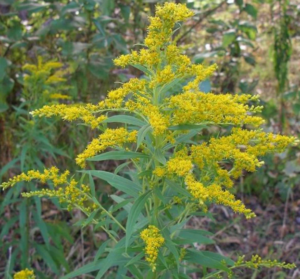
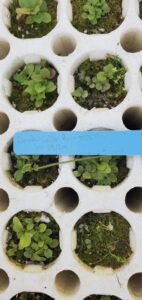
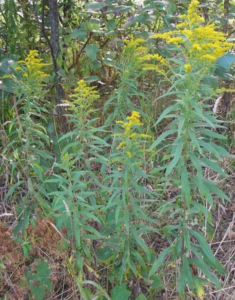
Canada Goldenrod, a native, long-lived perennial forms large, dense patches. Canada Goldenrod is named in honor of the many medicinal uses indigenous tribes found for the plant. Its genus name “Solidago,” originates from the Latin word “solidare” which means “to make whole.” The flowers and roots were widely used. Canadian goldenrod has been used in folk medicine for centuries as urological and antiphlogistical therapy, febrifuge, analgesic, gastro-intestinal tract and liver aids, and in burns and ulcer treatment. Indigenous peoples used Solidago canadensis medicinally for treating colds, fevers, and inflammation. Some preparations were made as teas for respiratory ailments, while poultices were used for wounds and skin conditions.
Traditional Indigenous Uses
Its golden flowers and leaves were gathered and brewed into tea to cleanse the kidneys and bladder, helping to flush away infection and stones. The same tea eased colds, coughs, and breathing troubles, and was said to calm the chest for those suffering from asthma or tuberculosis. When wounds, burns, or sores appeared, poultices and washes made from the leaves and flowers helped draw out infection and close the skin, as the plant was known to be both astringent and healing.
Goldenrod also offered relief for pain and inflammation. The people used its aerial parts as tea or in external applications to ease arthritis, rheumatism, and swelling. The same preparation soothed stomach problems supported the liver and brought strength to the digestive system. Some used it to help regulate the heart and blood pressure, while others found it calmed menstrual discomfort and aided women’s health during menopause. Teas made from its flowers were drunk to reduce fever and pain, and mouth rinses from its leaves helped with sore throats and mouth infections.
Biochemical Basis for Medicinal Properties
Major Bioactive Compound Classes
- Flavonoids (Primary Active Compounds) – S. canadensis is rich in specialized metabolite flavonoids (quercetin, kaempferol, and their glycosides, astragalin, and rutoside)
Key Flavonoid Compounds:
- Rutin (Quercetin-3-O-rutinoside): The largest share of the total pool of flavonoid glycosides in the leaves of the studied plants belonged to quercetin-3-O-beta-rutinoside (rutin)
- Isoquercitrin (Quercetin-3-O-β-glucoside)
- Astragalin (Kaempferol-3-O-β-glucoside)
- Hyperoside (Quercetin-3-O-β-galactoside)
Chemical Structure and Activity:
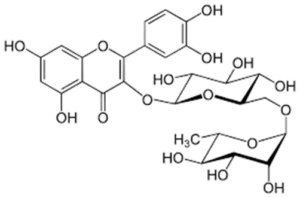
Rutin (C27H30O16):
Quercetin-3-O-α-L-rhamnopyranosyl-(1→6)-β-D-glucopyranoside
Molecular mechanisms:
– Antioxidant activity through hydrogen donation
– Anti-inflammatory via NF-κB pathway inhibition
– Capillary stabilization through collagen cross-linking
- Triterpenoid Saponins
Four new bisdesmosidic saponins each containing eight carbohydrate units were isolated from Solidago canadensis, identified as bayogeninglycosides (canadensissaponins 1-4).
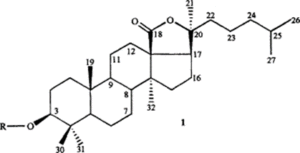
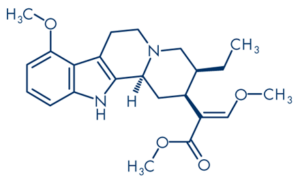
- Canadensissaponin 1-4: Complex bisdesmosidic structures
- Anti-fungal activity: The plant contains saponins that are antifungal and act specifically against the Candida fungus which is the cause of vaginal and oral thrush
- Immunomodulatory effects: Polysaccharide complexes with immune-stimulating properties
- Phenolic Acids
Phenolic acids present include caffeic acid, chlorogenic acid, ferulic acid, synaptic, and vanillin acids.
Major Phenolic Compounds:
- Chlorogenic acid (3-O-caffeoylquinic acid): in the water extract, it is chlorogenic acid (834.50 ± 9.75 mg/g extract)
- Neochlorogenic acid (5-O-caffeoylquinic acid)
- Caffeic acid derivatives
- Essential Oil Components
Essential oils include cadinene, α and β pinene, myrcene, limonene, sabinene, and germacren D
Terpenoid Profile:
- α-Pinene: Bronchodilator, antimicrobial
- β-Pinene: Anti-inflammatory
- Germacrene D: Antimicrobial, insecticidal
- δ-Cadinene: Antimicrobial properties
- Diterpenes
A new labdane diterpene, 9α,16ξ-dihydroxy-6-oxo-7,13-labdadien-15,16-olide (solicanolide, 1) was isolated from S. canadensis flowers.
Pharmacological Mechanisms
Diuretic Activity (Primary Mechanism)
The ethanol extract and its ethyl acetate fraction (EA) showed the highest aquaretic activities (91 and 58% at a dose of 400 mg/Kg b.wt., respectively) compared to 100% of furosemide at 20 mg/Kg b.wt.
Mechanism of Action:
- Increased glomerular filtration rate
- Enhanced sodium and chloride excretion
- Vasodilation of renal blood vessels
- Inhibition of sodium reabsorption in distal tubules
Anti-inflammatory Pathways
Its main chemical constituents are flavonoids (mainly derived from quercetin and kaempferol), C6-C1 and C6-C3 compounds, terpenes (mostly from the essential oil), and a large number of saponin molecules
Molecular Mechanisms:
- COX-2 inhibition by flavonoids
- Lipoxygenase pathway suppression
- NF-κB transcription factor inhibition
- Cytokine production reduction
Antimicrobial Activity
- canadensis and S. gigantea showed greater antibacterial over S. virgaurea for gram-positive bacteria
Antimicrobial Mechanisms:
- Cell membrane disruption by saponins
- Protein synthesis inhibition
- DNA replication interference
- Biofilm formation prevention
Chemical Reactions and Molecular Interactions
Flavonoid Antioxidant Mechanism
Quercetin + Free Radical• → Quercetin Radical• + H•
(Stable resonance structure prevents chain propagation)
Rutin + DPPH• → Rutin-DPPH Complex (stable, colored)
(DPPH radical scavenging assay principle)
Saponin-Membrane Interaction
Saponin + Cell Membrane Cholesterol → Saponin-Cholesterol Complex
(Membrane destabilization leading to cell lysis)
Canadensissaponin + Candida Cell Wall → Pore Formation
(Antifungal mechanism through membrane permeabilization)
Diuretic Compound Activity
A strong correlation existed between the total phenolic and flavonoid contents and the investigated aquaretic activity of the different extracts and fractions
Phenolic Compounds + Renal Transporters → Modified Ion Transport
Flavonoids + Aquaporin Channels → Enhanced Water Excretion
Modern Scientific Validation
Quantitative Analysis
EA showed the highest total phenolic and flavonoid contents among the tested fractions of the ethanol and aqueous extracts (9.38 ± 0.004 g GAE and 39.75 ± 0.005 g RE/100 g dried extract, respectively)
Bioactive Compound Isolation
Eight flavonoids, 2 phenolic acids and 1 nucleoside were isolated from EA. This is the first report of a comparative study between the aquaretic activities of the different extracts, fractions and essential oil of S. canadensis, as well as isolation of thyimidine (1), isorhamnetin-3-O-β-ᴅ-glucopyranoside (2), kaempferol-3-O-(6″-O-acetyl)-β-ᴅ-glucopyranoside (4), quercetin-3-O-(6″-O-acetyl)-β-ᴅ-glucopyranoside (5), and kaempferol-3-O-β-ᴅ-apiofuranoside (7) from genus Solidago
Therapeutic Applications
It does seem to act like a diuretic, and is used in Europe to treat urinary tract inflammation and to prevent or treat kidney stones. In fact, goldenrod is often found in teas to help “flush out” kidney stones and stop inflammatory diseases of the urinary tract
Safety and Traditional Preparation
Traditional Safety Profile
Safety in pregnancy is unknown
Optimal Extraction Methods
The maximum free radical scavenging activity was greatest in a standard infusion. In other words, drink your tea!
Ethanol (70%) was the best solvent for extracting phenolic compounds from Solidago canadensis L., while water was the best solvent for the extraction of its saponins
References
1) Elders and Community members of the Cayoose Creek Band of Sekw’el’was
2) Abdel Baki, P. M., El-Sherei, M. M., Khaleel, A. E., Abdel Motaal, A. A., & Ibrahim Abdallah, H. M. (2019). Aquaretic activity of Solidago canadensis cultivated in Egypt and determination of the most bioactive fraction. Iranian Journal of Pharmaceutical Research, 18(2), 922–937. https://doi.org/10.22037/ijpr.2019.2390
3) Moerman, D. E. (1998). Native American ethnobotany. Timber Press.
4) Reznicek, G., Jurenitsch, J., Plasun, M., Korhammer, S., Haslinger, E., Hiller, K., & Kubelka, W. (1991). Four major saponins from Solidago canadensis. Phytochemistry, 30(5), 1629–1633. https://doi.org/10.1016/0031-9422(91)84222-E
5) Apáti, P., Houghton, P. J., Kite, G., Steventon, G. B., & Kéry, Á. (2006). In-vitro effect of flavonoids from Solidago canadensis extract on glutathione S-transferase. Journal of Pharmacy and Pharmacology, 58(2), 251–256. https://doi.org/10.1211/jpp.58.2.0013
6) Kołodziej, B., Kowalski, R., & Kędzia, B. (2011). Antibacterial and antimutagenic activity of extracts of above-ground parts of three Solidago Journal of Medicinal Plants Research, 5(31), 6770–6779. https://doi.org/10.5897/JMPR11.1098
7) Smith, H. H. (1933). Ethnobotany of the Forest Potawatomi Indians (Bulletin of the Public Museum of the City of Milwaukee, Vol. 7, No. 1). Milwaukee Public Museum
8) Rousseau, J. (1945). Études ethnobotaniques québécoises: Le folklore botanique de Caughnawaga. Contributions de l’Institut botanique de l’Université de Montréal, 55, 7–72.https://www2.ville.montreal.qc.ca/jardin/archives/rousseau/publi/Etudes_ethnobotaniques_quebecoises.pdf
9) Turner, N. J., Bouchard, R., & Kennedy, D. I. D. (1980). Ethnobotany of the Okanagan-Colville Indians of British Columbia and Washington (Occasional Paper No. 21). British Columbia Provincial Museum
10) Apáti, P., Szentmihályi, K., Kristó, T. S., Papp, I., Vinkler, P., Szőke, É., & Kéry, Á. (2003). Herbal remedies of Solidago—Correlation of phytochemical characteristics and antioxidative properties. Journal of Pharmaceutical and Biomedical Analysis, 32(4–5), 1045–1053. https://doi.org/10.1016/S0731-7085(03)00207-3