33 Edible Thistle
Names
Common name – Edible Thistle
Scientific name – Cirsium edule
Other names – ts’k’lawsxn; Indian Thistle
General information
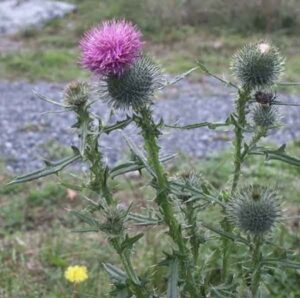
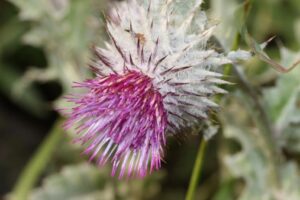
Edible Thistle (Cirsium edule) is a tall perennial plant native to North America. Edible Thistle represents a significant traditional medicine with well-documented Indigenous uses and validated pharmacological properties. Its rich phytochemical profile, including flavonoids, phenolic compounds, triterpenoids, and polyacetylenes, provides the biochemical foundation for its traditional applications in treating inflammation, supporting liver health, and promoting wound healing. The traditional knowledge of Indigenous peoples regarding this plant’s medicinal properties aligns closely with modern scientific understanding of its bioactive compounds and their mechanisms of action. This convergence of traditional wisdom and scientific validation underscores the importance of preserving and respecting Indigenous botanical knowledge.
Physical Characteristics:
- Height: 1-2 meters tall
- Spread: 25-50 cm
- Flowers: Pinkish-purple, prominent
- Features: Tall perennial with prominent spines and hairy bracts
- Habitat: Common in wet meadows and forest openings
Traditional Indigenous Uses
The people used its roots and leaves to treat swollen joints and stiffness in the body. Decoctions made from the roots and poultices of the leaves brought relief to those burdened by arthritis or long days of labour. The thistle’s medicine worked by drawing out the heat and swelling.
When the body was wounded or burned, the green parts of the thistle were crushed or pressed to release their juice, which was applied directly to the skin. This helped cuts and burns to close and heal cleanly. The plant was also known to quiet the liver and ease digestion. Teas made from the roots supported the inner organs, helping the body cleanse itself after times of illness or scarcity. The same infusions could help with kidney troubles and fluid retention, its mild diuretic action allowing the body to release what it no longer needed. When bleeding occurred, crushed thistle was pressed to the wound to stop the flow.
The roots and young shoots were cooked and eaten as food in early spring, providing strength and vitamins when the winter stores were nearly gone. Some said its energy supported the heart, improving circulation and vitality.
Phytochemical Composition
Primary Bioactive Compound Classes
- Flavonoids
The genus Cirsium contains significant flavonoid compounds that contribute to its medicinal properties.
Major Flavonoids Identified:
- Cirsimaritin (4′,5,6-trihydroxy-7-methoxyflavone)
- Hispidulin (4′,5-dihydroxy-7,8-dimethoxyflavone)
- Cirsimarin (flavonoid glycoside)
- Linarin (acacetin-7-O-β-D-glucoside)
Chemical Structure of Hispidulin:
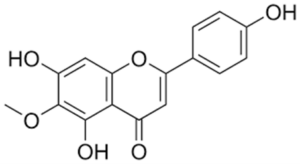 Molecular Formula: C16H12O6
Structure: 4′,5-dihydroxy-7,8-dimethoxyflavone
- Phenolic Compounds
Phenolic acids and their derivatives provide antioxidant and anti-inflammatory properties.
Key Phenolic Compounds:
- 5-O-E-p-coumaroylquinic acid methyl ester
- Caffeic acid derivatives
- Chlorogenic acid compounds
General Phenolic Structure:
Basic Structure: C₆-C₃ (phenylpropanoid)
R-C₆H₄-CH=CH-COOH (cinnamic acid derivatives)
Where R = OH, OCH₃, or other substituents
- Triterpenoids
Triterpene compounds contribute to anti-inflammatory and hepatoprotective activities.
Triterpenoid Structure:
Basic Skeleton: C₃₀H₄₈O₃
Six-membered ring systems with various functional groups
Steroid-like structure with multiple hydroxyl groups
- Polyacetylenes
Unique compounds with antimicrobial and cytotoxic properties.
Polyacetylene Structure:
Linear carbon chains with alternating triple bonds
R-C≡C-C≡C-R’
Often containing 8-18 carbon atoms
- Alkaloids and Tannins
Contributing to therapeutic potential through various mechanisms.
Biochemical Mechanisms of Action
- Anti-inflammatory Activity
Primary Mechanism:
- Inhibition of cyclooxygenase (COX-1 and COX-2) enzymes
- Reduction of prostaglandin synthesis
- Modulation of inflammatory cytokines (TNF-α, IL-1β, IL-6)
Chemical Reaction Pathway:
Arachidonic Acid + COX-1/COX-2 → Prostaglandin H₂ → Inflammatory Prostaglandins ↑ (Inhibited by flavonoids)
Flavonoid-OH + •OH → Flavonoid-O• + H₂O
(Free radical scavenging reaction)
- Antioxidant Activity
Mechanism:
- Free radical scavenging through phenolic hydroxyl groups
- Metal ion chelation preventing oxidative damage
- Enhancement of endogenous antioxidant systems
Antioxidant Reactions:
DPPH• + Phenolic-OH → DPPH-H + Phenolic-O•
(Stable radical formation)
Fe³⁺ + Flavonoid → Fe²⁺-Flavonoid Complex
(Metal chelation reaction)
- Hepatoprotective Activity
Mechanism:
- Protection against oxidative liver damage
- Enhancement of liver detoxification enzymes
- Maintenance of hepatocyte membrane integrity
Biochemical Pathway:
Hepatotoxin → Oxidative Stress → Lipid Peroxidation ↑ (Blocked by antioxidants)
GSH + ROS → GSSG + H₂O
(Glutathione-mediated protection enhanced by plant compounds)
- Antimicrobial Activity
Mechanism:
- Disruption of microbial cell membranes
- Inhibition of microbial enzymes
- DNA binding and replication interference
Antimicrobial Reaction:
Polyacetylene + Bacterial Membrane → Membrane Disruption
Phenolic Compounds + Bacterial Proteins → Protein Denaturation
Pharmacological Validation
- Anti-inflammatory: Confirmed through COX inhibition assays
- Antioxidant: DPPH and ABTS radical scavenging validated
- Hepatoprotective: Demonstrated in liver injury models
- Antimicrobial: Active against various bacterial and fungal strains
- Cytotoxic: Selective activity against cancer cell lines
Research Evidence: Several Cirsium species are known for their uses in traditional medicine and are studied for their phytochemical content and biological activities, showing cytotoxic activity with selectivity indices favoring cancer cells over normal cells.
Chemical Structure Analysis
Key Bioactive Molecules
Cirsimaritin Structure:
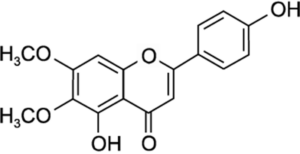 Molecular Formula: C16H12O6
MW: 300.26 g/mol
Traditional Preparation Methods
- Root Preparations:
- Fresh roots harvested in fall
- Boiled or roasted for consumption
- Dried and powdered for medicine
- Leaf Applications:
- Fresh leaves crushed for poultices
- Dried leaves for teas and infusions
- Steam preparations for respiratory conditions
- Whole Plant Extracts:
- Water extractions for general medicine
- Alcohol tinctures for concentrated preparations
Safety Profile and Contraindications
Safety Considerations:
- Generally recognized as safe when used traditionally
- High fiber content may cause digestive upset in large quantities
- Spines require careful handling during harvesting
Potential Interactions:
- May enhance effects of anti-inflammatory medications
- Possible interaction with blood-thinning agents
- Monitor blood sugar levels due to aldose reductase inhibition
Conservation and Sustainable Use
- Collect roots in late fall when nutrients are concentrated
- Harvest only mature plants (2+ years old)
- Leave adequate population for regeneration
- Rotate harvesting areas to prevent overexploitation
Habitat Requirements:
- Wet meadows and forest openings
- Rich, moist soils
- Partial shade to full sun tolerance
References
- 1) Elders and Community members of the Cayoose Creek Band of Sekw’el’was
- 2) Splitrock Environmental. (n.d.). Edible thistle (ts’k’lawsxn). Retrieved September 24, 2025, from https://splitrockenvironmental.ca/products/edible-thistle-ts-k-lawsxn Splitrock Environmental
- 3) Adamant, A. (2018, August 15). Foraging thistle for food and medicine. Practical Self Reliance. https://practicalselfreliance.com/edible-thistle/ Practical Self Reliance
- 4) Sahli, R., Rivière, C., Dufloer, C., Beaufay, C., Neut, C., Bero, J., Hennebelle, T., Roumy, V., Ksouri, R., Quetin-Leclercq, J., & Sahpaz, S. (2017). Antiproliferative and antibacterial activities of Cirsium scabrum from Tunisia. Evidence-Based Complementary and Alternative Medicine, 2017, 7247016. https://doi.org/10.1155/2017/7247016
- 5) Aggarwal, G., Kaur, G., Bhardwaj, G., Mutreja, V., Sohal, H. S., Nayik, G. A., Bhardwaj, A., & Sharma, A. (2022). Traditional uses, phytochemical composition, pharmacological properties, and the biodiscovery potential of the genus Cirsium. Chemistry, 4(4), 1161–1192. https://doi.org/10.3390/chemistry4040079
- 6) Ma, Q.-G., Wen, R.-R., Liu, W.-M., Sang, Z.-P., Zhang, S., Wang, Q.-Q., Feng, Z.-W., Li, L.-J., & Li, Y.-P. (2016). [Studies on flavonoids from Cirsium setosum]. Zhongguo Zhong Yao Za Zhi, 41(5), 868–873. https://doi.org/10.4268/cjcmm20160518
- 7) Lee, J., Rodriguez, J. P., Lee, K. H., Park, J. Y., Kang, K. S., Hahm, D.-H., Huh, C. K., Lee, S. C., & Lee, S. (2017). Determination of flavonoids from Cirsium japonicum maackii and their inhibitory activities against aldose reductase. Applied Biological Chemistry, 60, 487–496. https://doi.org/10.1007/s13765-017-0302-z
- 8) (n.d.). Cirsium—An overview. Topics in Pharmacology, Toxicology and Pharmaceutical Science. Retrieved September 24, 2025, from https://www.sciencedirect.com/topics/pharmacology-toxicology-and-pharmaceutical-science/cirsium
- 9) Balkrishna, A., Sharma, H., Kukreti, A., Kumari, A., Saini, P., Arya, V., & Kumar, A. (2024). Traditional uses and phytopharmacology of Cirsium arvense: Bioprospecting potential of a weed from temperate biome. Journal of Applied Pharmaceutical Science, 14(5), 30–37. https://doi.org/10.7324/JAPS.2024.168589