51 Pacific Willow
Names
Common name – Pacific Willow
Scientific name – Salix lucida, subspecies lasiandra
Other names – Shining Willow, txálhpaz’
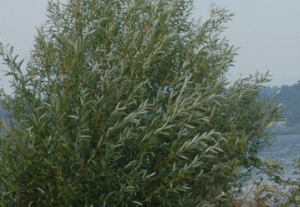
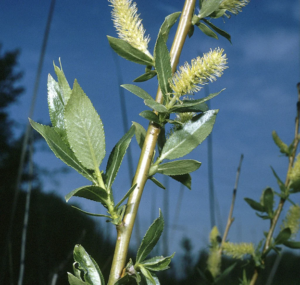
General Information
Pacific Willow is a deciduous tree or large shrub of the Salicaceae (Willow) family, native to western North America. This species has been extensively used by Indigenous peoples for medicinal purposes, particularly for pain relief and anti-inflammatory treatments. The Pacific Willow is one of several willow species traditionally utilized, all containing the bioactive compound salicin.
Traditional Medicinal Uses by Indigenous Peoples
The Elders spoke of Pacific Willow as one of the old medicines of the land – a tree whose spirit carried both strength and comfort. Its bark, when chewed or brewed into tea, was known to ease pain throughout the body, calming headaches, joint aches, and the soreness that came after hard work. Those suffering from arthritis would boil the bark or make poultices to lay over swollen joints, feeling the pain ease as the medicine drew out the inflammation. The leaves, too, could be chewed to quiet everyday pains and bring relief when the body was tired. When fevers came, a tea made from the bark helped to cool the body and restore balance, its medicine working gently but surely.
The people also used Pacific Willow for back pain and stiffness, drinking the decoction or applying it to sore muscles after long days of travel or work. Its bark carried strong healing power – an anti-inflammatory gift that reached deep into the body to settle discomfort and bring rest. Beyond its medicine, the bark had other uses: when stripped and prepared carefully, it could be made into strong twine, used for weaving or binding.
Biochemical Basis for Medicinal Properties
Primary Bioactive Compounds
Pacific Willow contains several classes of bioactive compounds, with phenolic glycosides being the most therapeutically significant:
- Primary Active Compounds
- Salicin (β-D-salicin) – Primary bioactive compound (1-10% in bark)
- Salicortin – Secondary salicylate glycoside
- Tremulacin – Related phenolic glycoside
- Populin – Supporting glycoside compound
- Salicyl alcohol (Saligenin) – Metabolite of salicin
- Supporting Compounds
- Tannins – Astringent and anti-inflammatory properties
- Flavonoids – Antioxidant and anti-inflammatory effects
- Catechins – Polyphenolic compounds with bioactivity
- Other phenolic acids – Supporting therapeutic compounds
Chemical Structure and Properties of Key Compounds
Salicin (β-D-Salicin) – Primary Active Compound
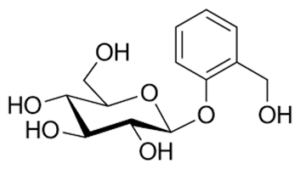
Chemical Name: 2-(Hydroxymethyl)phenyl β-D-glucopyranoside
Molecular Formula: C13H18O7
Molecular Weight: 286.28 g/mol
Classification: Phenolic glycoside (salicylate glycoside)
Structural Features:
Salicin Structure:
– Glucose moiety (β-D-glucopyranoside)
– Phenolic aglycone (salicyl alcohol/saligenin)
– Glycosidic bond linking sugar to phenol
– Hydroxyl groups providing water solubility
– Aromatic benzene ring with ortho-hydroxymethyl substitution
Key Structural Components:
- Sugar Unit: β-D-glucose providing water solubility and stability
- Aglycone: Salicyl alcohol (2-hydroxybenzyl alcohol)
- Glycosidic Bond: β-1 linkage between glucose C1 and phenolic oxygen
- Functional Groups: Primary alcohol, phenolic OH, multiple secondary OH groups
Salicylic Acid – Active Metabolite
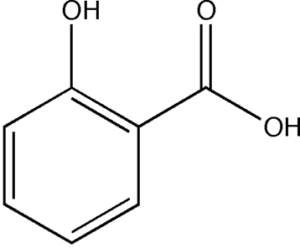
Molecular Formula: C7H6O3 Molecular Weight: 138.12 g/mol
- Structure: Benzoic acid with ortho-hydroxyl substitution
- Key feature: Carboxyl group (-COOH) and phenolic hydroxyl (-OH)
Metabolic Pathway and Bioactivation
Salicin to Salicylic Acid Conversion
Step 1: Hydrolysis of Salicin
Salicin + H2O → β-D-Glucose + Salicyl alcohol (Saligenin)
Enzyme: β-glucosidase (intestinal or bacterial)
Location: Small intestine and colon
Mechanism: Cleavage of β-glycosidic bond
Step 2: Oxidation of Saligenin
Salicyl alcohol → Salicylaldehyde → Salicylic acid
Enzymes: Alcohol dehydrogenase, Aldehyde dehydrogenase
Location: Liver, intestinal mucosa
Mechanism: Two-step oxidation via aldehyde intermediate
Overall Conversion:
Salicin → [Hydrolysis] → Saligenin → [Oxidation] → Salicylic Acid
Molecular Mechanisms of Action
- Anti-inflammatory Mechanisms
Cyclooxygenase (COX) Inhibition:
Salicylic Acid → COX-1/COX-2 inhibition → Reduced prostaglandin synthesis
– Competitive inhibition of COX active site
– Decreased PGE2, PGF2α, PGI2 production
– Reduced inflammation, pain, and fever
– Non-selective COX inhibition (unlike aspirin)
Nuclear Factor κB (NF-κB) Suppression:
Salicylic Acid → NF-κB pathway inhibition → Reduced inflammatory gene expression
– Prevents NF-κB nuclear translocation
– Decreased TNF-α, IL-1β, IL-6 production
– Reduced inflammatory cytokine synthesis
– Anti-inflammatory gene regulation
- Analgesic (Pain Relief) Mechanisms
Peripheral Pain Reduction:
Salicylic Acid → Prostaglandin inhibition → Reduced nociceptor sensitization
– Decreased PGE2 at nociceptors
– Reduced peripheral pain sensation
– Lower inflammatory pain signals
– Tissue-level analgesia
Central Pain Modulation:
Salicylic Acid → CNS effects → Central pain pathway modulation
– Spinal cord anti-nociceptive effects
– Modulation of pain transmission
– Central analgesic mechanisms
– Enhanced pain threshold
- Antipyretic (Fever Reduction) Mechanisms
Hypothalamic Thermoregulation:
Salicylic Acid → Hypothalamic PGE2 reduction → Temperature set-point normalization
– Inhibition of COX in thermoregulatory center
– Reduced hypothalamic PGE2 levels
– Restoration of normal temperature set-point
– Enhanced heat loss mechanisms
Safety Considerations and Traditional Wisdom
Traditional Preparation Methods:
- Slow extraction (tea preparation) provides gradual salicin release
- Lower gastric irritation compared to synthetic salicylates
- Whole plant matrix effects enhance tolerance
- Traditional dosing based on empirical knowledge
Modern Safety Profile:
- Generally well-tolerated in traditional preparations
- Lower incidence of gastric side effects vs. aspirin
- Contraindicated in salicylate sensitivity
- Drug interactions similar to other salicylates
References
1) Elders and Community members of the Cayoose Creek Band of Sekw’el’was
2) Art of Manliness. (2021, June 1). Using willow bark as natural aspirin. https://www.artofmanliness.com/skills/outdoor-survival/how-to-harvest-and-use-natures-aspirin/
3) (2024, September 30). Willow bark: Nature’s aspirin. https://www.healthline.com/health/willow-bark-natures-aspirin
4) McGill University Office for Science and Society. (2024, April 5). Sordid medicine shows exploited Indigenous cures. https://www.mcgill.ca/oss/article/medical-history/sordid-medicine-shows-exploited-indigenous-cures
5) Native Languages of the Americas. (n.d.). Native American Indian willow medicine, meaning and symbolism. http://www.native-languages.org/legends-willow.htm
6) Portland State University. (n.d.). Salix lucida (ssp. lasiandra) – Pacific willow. https://web.pdx.edu/~maserj/ESR410/SalixLucida.htm
7) Split Rock Environmental. (2025). Pacific willow (txálhpaz’). https://splitrockenvironmental.ca/products/pacific-willow-txalhpaz
8) The Pipettepen. (n.d.). The ample pharmacopeia of Indigenous medicine. https://www.thepipettepen.com/the-florid-pharmacopeia-of-indigenous-medicine/
9) S. Embassy & Consulates in Italy. (2021, November 19). Native Americans’ many contributions to medicine. https://it.usembassy.gov/native-americans-many-contributions-to-medicine/
10) (2025, June 2). Salicin. https://en.wikipedia.org/wiki/Salicin
11) Wölfle, U., Strobach, D., & Schempp, C. M. (2023). Willow bark (Salix) used for pain relief in arthritis: A meta-analysis of randomized controlled trials. Phytotherapy Research, 37(11), 5142–5155. https://doi.org/10.1002/ptr.8097
12) Xie, Y., Zhang, Y., & Xu, J. (2017). Biosynthesis and metabolism of β-D-salicin: A novel molecule that exerts biological function in humans and plants. Frontiers in Plant Science, 8, https://doi.org/10.3389/fpls.2017.00925