35 Golden-Aster
Names
Common name – Golden-Aster
Scientific name – Heterotheca villosa
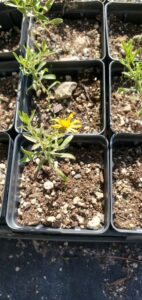
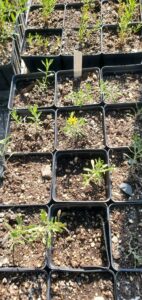
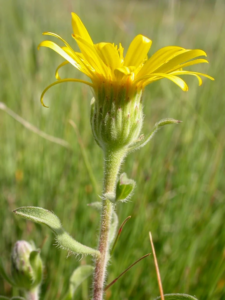
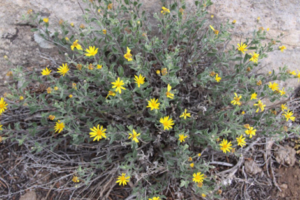
General information
Golden-Aster (Heterotheca species), particularly Heterotheca villosa (Hairy Golden Aster) and related species like Heterotheca inuloides (Mexican Arnica), has been traditionally used by various Indigenous groups across North America for medicinal purposes. The traditional use of Golden-Aster by Indigenous peoples demonstrates sophisticated understanding of plant medicine, with scientific research now validating many of these traditional applications through identification of specific bioactive compounds and their mechanisms of action.
Traditional Indigenous Uses
Its leaves and aerial parts were gathered and made into poultices or teas to ease the pain in joints and bones. Those who suffered from arthritis or rheumatism found comfort in its healing touch.
For wounds and skin troubles, the fresh leaves were pressed gently against cuts, bruises, or irritated skin. They cooled and soothed, helping the body to close and cleanse itself. The same plant offered medicine for the lungs and breath. When coughs or bronchitis took hold, its leaves and flowers were boiled into a tea or used for steam inhalation to clear the chest. When the stomach was troubled, the roots and upper parts of the plant were brewed into a mild decoction to ease pain and help with digestion, bringing balance back to the body.
Whole plants were used in washes for eczema, insect bites, and other irritations, while oils drawn from its essence were used to cleanse wounds and prevent infection. Sometimes the leaves and stems were infused into oil and rubbed on sore muscles or temples to relieve pain and headaches.
Biochemical Basis for Medicinal Properties
Key Bioactive Compounds
Golden-Aster contains several classes of bioactive compounds responsible for its medicinal properties:
- Sesquiterpene Lactones
Structure and Function:
- Primary compounds: 7-hydroxyfrullanolide, inulin, and various germacranolide derivatives
- Chemical Structure: These are 15-carbon compounds with a characteristic lactone ring
- Mechanism: Anti-inflammatory action through inhibition of NF-κB pathway and cyclooxygenase enzymes
- Flavonoids
Key Compounds:
- Quercetin, kaempferol, and their glycosides
- Apigenin and luteolin derivatives
- Antioxidant Activity: Free radical scavenging through electron donation
- Chemical Reaction: R-OH + R’• → R-O• + R’H (radical scavenging)
- Essential Oils
Volatile Compounds:
- Monoterpenes: α-pinene, β-pinene, limonene
- Sesquiterpenes: β-caryophyllene, germacrene D
- Mechanism: Antimicrobial activity through membrane disruption
- Phenolic Compounds
- Caffeic acid, chlorogenic acid, and ferulic acid derivatives
- Function: Antioxidant and anti-inflammatory properties through enzyme inhibition
Biochemical Mechanisms
Anti-inflammatory Pathway:
Tissue Injury → Arachidonic Acid Release → COX-1/COX-2 Activation ↓ (Inhibited by sesquiterpene lactones) Prostaglandin/Leukotriene Production → Inflammation
Antioxidant Mechanism:
ROS Formation → Cellular Damage ↓ (Neutralized by flavonoids)
Flavonoid + ROS → Stable Quinone + H₂O
Wound Healing Process:
- Hemostasis: Tannins promote blood clotting
- Inflammation Control: Sesquiterpenes reduce inflammatory response
- Proliferation: Growth factors enhanced by plant compounds
- Remodeling: Antioxidants protect new tissue formation
Chemical Structures of Key Biomolecules
Quercetin (Major Flavonoid)
- Molecular Formula: C₁₅H₁₀O₇
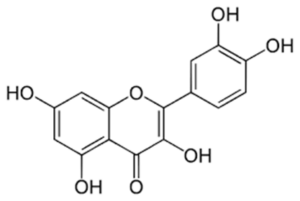
- Structure: Pentahydroxyflavone with hydroxyl groups at positions 3, 5, 7, 3′, and 4′
- Function: Potent antioxidant and anti-inflammatory agent
7-Hydroxyfrullanolide (Sesquiterpene Lactone)
- Molecular Formula: C₁₅H₂₀O₄
- Structure: Germacranolide skeleton with hydroxyl and lactone functional groups
- Function: Primary anti-inflammatory compound
β-Caryophyllene (Essential Oil Component)
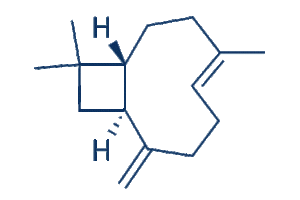
- Molecular Formula: C₁₅H₂₄
- Structure: Bicyclic sesquiterpene with CB2 receptor binding capability
- Function: Anti-inflammatory and analgesic properties
References
1) Elders and Community members of the Cayoose Creek Band of Sekw’el’was
2) Moerman, D. E. (1998). Native American ethnobotany. Timber Press.
3) Arnason, T., Hebda, R. J., & Johns, T. (1981). Use of plants for food and medicine by Native Peoples of eastern Canada. Canadian Journal of Botany, 59(11), 2189–2325. https://doi.org/10.1139/b81-287 com
4) Millspaugh, C. F. (1974). American medicinal plants: An illustrated and descriptive guide to plants indigenous to and naturalized in the United States which are used in medicine. Dover Publications. (Original work published 1892)
5) Turner, N. J., & Hebda, R. J. (1990). Contemporary use of bark for medicine by two Salishan Native elders of southeast Vancouver Island, Canada. Journal of Ethnopharmacology, 29(1), 59–72. https://doi.org/10.1016/0378-8741(90)90098-E
6) Heinrich, M., Robles, M., West, J. E., Ortiz de Montellano, B. R., & Rodríguez, E. (1998). Ethnopharmacology of Mexican Asteraceae (Compositae). Annual Review of Pharmacology and Toxicology, 38, 539–565. https://doi.org/10.1146/annurev.pharmtox.38.1.539
7) Klaassen, C. D. (Ed.). (2013). Casarett & Doull’s toxicology: The basic science of poisons (8th ed.). McGraw-Hill Education.
8) Foster, S., & Duke, J. A. (2000). A field guide to medicinal plants and herbs of eastern and central North America (2nd ed.). Houghton Mifflin Harcourt.
9) Vandebroek, I., Balick, M. J., Ososki, A., Kronenberg, F., Yukes, J., Wade, C., Jiménez, F., Peguero, B., & Castillo, D. (2010). The importance of botellas and other plant mixtures in Dominican traditional medicine. Journal of Ethnopharmacology, 128(1), 20–41. https://doi.org/10.1016/j.jep.2009.12.013