50 Oregon Grape
Names
Common name – Oregon Grape
Scientific name – Mahonia aquifolium
Other names – ts’óltś’el
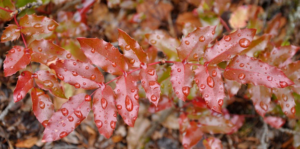
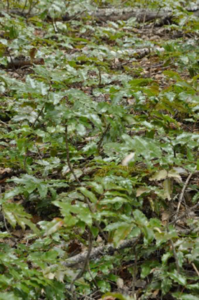
General information
Oregon Grape is a perennial evergreen shrub of the Berberidaceae (Barberry) family, native to western North America. This medicinal plant has been extensively used by Indigenous peoples of the Pacific Northwest for centuries and contains potent bioactive compounds, particularly isoquinoline alkaloids.
Traditional Medicinal Uses by Indigenous Peoples
The Elders speak of Oregon Grape as a powerful root medicine, known for cleansing the blood and restoring balance to the body. Its roots held strong healing power and were used in many ways e.g. boiled into teas or decoctions to soothe stomach troubles, calm digestive upsets, and bring relief from dysentery or diarrhea. When the body grew weak or appetite was lost, a tea made from the root helped to awaken hunger and renew strength. The same root preparations were trusted to treat hemorrhages and bleeding deep within the body, and they eased the pain and swelling of arthritis, bringing comfort to sore joints and tired limbs. For those suffering from tuberculosis or lung infections, the people would brew the roots into a medicine that helped clear the lungs and ease breathing.
Oregon Grape’s yellow roots were also known to fight infection and was used both inside and out to treat fungal and bacterial ailments, purify the blood, and clear the skin of rashes and sores. The bark and roots were chewed or made into a wash to heal sore gums and mouth infections, keeping the teeth strong and the mouth healthy. When fevers came with stomach troubles, the root medicine was used to bring down the heat and steady the body. For general weakness or times when illness had left the spirit low, a tonic made from Oregon Grape’s roots brought renewed energy and resilience. Beyond medicine, its yellow inner bark offered a bright dye that connected people to the beauty and spirit of the plant.
Biochemical Basis for Medicinal Properties
Primary Bioactive Compounds
Oregon Grape contains a complex array of bioactive compounds, with isoquinoline alkaloids being the most pharmacologically significant:
- Primary Alkaloids
- Berberine (primary active compound, 0.5-4.2% in roots)
- Palmatine
- Berbamine
- Jatrorrhizine
- Columbamine
- Oxyacanthine
- Secondary Compounds
- Tannins: Astringent and antimicrobial properties
- Resins: Protective and healing compounds
- Polysaccharides: Immune-modulating properties
- 5′-Methoxyhydnocarpin (5′-MHC): Weak acid with bioactivity
Chemical Structure and Properties of Key Compounds
Berberine – Primary Active Alkaloid
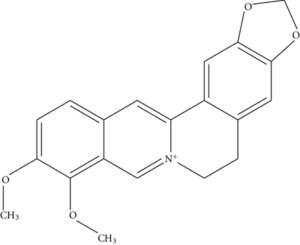
Chemical Name: 5,6-dihydro-9,10-dimethoxybenzo[g]-1,3-benzodioxolo[5,6-a]quinolizinium
Molecular Formula: C20H18NO4+
Molecular Weight: 336.361 g/mol Classification: Quaternary benzylisoquinoline alkaloid
Structural Features
Berberine Structure:
– Tetracyclic skeleton derived from benzyltetrahydroisoquinoline
– Quaternary nitrogen atom (positively charged)
– Methoxy groups at positions 9 and 10
– Methylenedioxy bridge
– Phenolic hydroxyl groups
– Planar aromatic ring system
Key Structural Elements
- Ring A: Contains phenolic hydroxyl groups
- Ring B: Methylenedioxy bridge providing electron density
- Ring C: Tetrahydroisoquinoline core
- Ring D: Quaternary nitrogen-containing heterocycle
Palmatine Structure

Molecular Formula: C21H22NO4+ Molecular Weight: 352.4 g/mol
- Similar isoquinoline structure to berberine
- Additional methyl group on nitrogen
- Dimethoxy substitution pattern
Molecular Mechanisms of Action
- Antimicrobial Mechanisms
DNA Intercalation:
Berberine + Bacterial DNA → Berberine-DNA Complex
(Planar structure allows insertion between base pairs)
Result:
– Inhibition of DNA replication
– Disruption of RNA synthesis
– Cell cycle arrest
– Bacterial cell death
Cell Membrane Disruption:
Berberine → Cell membrane interaction → Membrane permeabilization
– Quaternary ammonium structure disrupts phospholipid bilayer
– Increased membrane permeability
– Cellular content leakage
– Cell death
- Anti-inflammatory Pathways
NF-κB Inhibition:
Berberine → NF-κB inhibition → Reduced inflammatory gene transcription
– Decreased TNF-α production
– Reduced IL-1β synthesis
– Lower IL-6 levels
– Diminished inflammatory response
COX-2 Suppression:
Berberine → COX-2 enzyme inhibition → Reduced prostaglandin synthesis
– Decreased PGE2 production
– Reduced inflammation
– Pain relief
– Tissue protection
- Digestive System Effects
Gut Microbiome Modulation:
Berberine → Selective antimicrobial action → Microbiome rebalancing
– Inhibits pathogenic bacteria (E. coli, Salmonella)
– Preserves beneficial bacteria (Lactobacillus, Bifidobacterium)
– Improves intestinal barrier function
– Enhanced digestive health
Cholinergic Stimulation:
Berberine → Acetylcholine release → Enhanced digestive function
– Increased gastric motility
– Stimulated digestive enzyme secretion
– Improved bile flow
– Better nutrient absorption
- Hepatoprotective Mechanisms
Phase II Detoxification Enhancement:
Berberine → Nrf2 pathway activation → Antioxidant enzyme upregulation
– Increased glutathione S-transferase
– Enhanced UDP-glucuronosyltransferase
– Improved toxin elimination
– Liver protection
Synergistic Effects of Whole Plant
While berberine is the primary active compound, the therapeutic effectiveness of Oregon Grape results from synergistic interactions:
Berberine (primary alkaloid) + Palmatine (antimicrobial support) + Tannins (astringent/antimicrobial) + 5′-MHC (additional bioactivity) + Polysaccharides (immune support) + Other alkaloids (berbamine, jatrorrhizine) = Enhanced therapeutic effect > individual components
Chemical Reactions and Bioavailability
Absorption and Metabolism:
Oral Berberine → Intestinal metabolism → Active metabolites
– First-pass metabolism creates dihydroberberine
– Gut bacteria convert to active forms
– Low systemic bioavailability (< 1%) but high local activity
– Extensive tissue distribution
Hepatic Processing:
Berberine → Cytochrome P450 metabolism → Demethylberberine + other metabolites
– Phase I: Demethylation, hydroxylation
– Phase II: Glucuronidation, sulfation
– Biliary excretion maintains enterohepatic circulation
References
1) Elders and Community members of the Cayoose Creek Band of Sekw’el’was
2) S. National Park Service. (2025). Oregon grape. https://www.nps.gov/articles/000/oregon-grape.htm
3) Health Benefits Times. (2018, October 7). Oregon grape facts and health benefits. https://www.healthbenefitstimes.com/oregon-grape/
4) Natural Medicinal Herbs. (2025). Oregon grape – Mahonia aquifolium. http://www.naturalmedicinalherbs.net/herbs/m/mahonia-aquifolium=oregon-grape.php
5) Herbal Supplement Resource. (2019, September 2). Oregon grape herb uses and medicinal properties. https://www.herbal-supplement-resource.com/oregon-grape.html
6) Zhi Herbals. (2024, April 17). Oregon grape root benefits and berberine. https://zhiherbals.com/oregon-grape-root-benefits-and-berberine/
7) (2025). Oregon grape monograph. https://www.herbrally.com/monographs/oregon-grape
8) Imenshcheva, M. V., Moshkina, E. V., & Kolesnik, I. A. (2018). Berberine: Botanical occurrence, traditional uses, extraction methods, and relevance in cardiovascular, metabolic, hepatic, and renal disorders. Frontiers in Pharmacology, 9, 557. https://doi.org/10.3389/fphar.2018.00557
9) (2025, October 9). Berberine. https://en.wikipedia.org/wiki/Berberine