20 Black Hawthorn
Names
Common name – Black Hawthorn
Scientific name – Crataegus douglasii
Other names – k’an
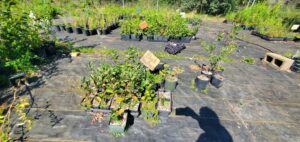
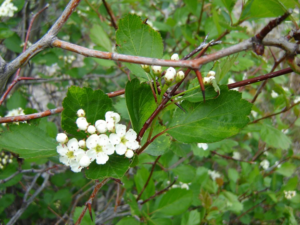
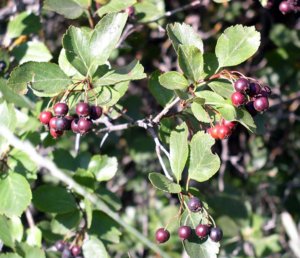 General information
The traditional knowledge of Black Hawthorn’s medicinal properties, particularly for heart health, aligns remarkably well with modern scientific findings. The presence of oligomeric procyanidins, flavonoids, and other bioactive compounds supports the traditional uses for cardiovascular support, emotional well-being, and anti-aging effects that Indigenous peoples have recognized for millennia.
Traditional Indigenous Uses
The berries, leaves, and flowers were gathered carefully and made into teas, tinctures, and decoctions to strengthen the heart and improve circulation. These same preparations were used to ease the strain on blood vessels and to bring steadiness to the pulse, helping the heart to work with balance and strength.
Beyond its physical medicine, Black Hawthorn was known to comfort the spirit. Teas made from the berries and flowers were shared with those who carried grief or sadness, offering calm and healing to the emotional heart. The people said that the plant’s gentle strength helped release sorrow, reminding one that the heart could mend just as the land renews itself after a long winter.
The berries were also eaten as food and added to other medicines to support digestion, slow aging, and maintain overall wellness. The bark and berries were used in decoctions to ease the pain of arthritis and stiffness in the joints.
The addition of these berries, flowers, or sometimes leaves to food prevented or at least forestalled the signs and symptoms of old age, from heart failure and arthritis to digestive problems and blindness (macular degeneration).
Additional Traditional Uses
- The thorns were used as needles and fishhooks
- Berries were consumed fresh or made into jams and jellies
- Used as a prebiotic and probiotic for digestive health
- Employed for dealing with emotional distress and loss
Biochemical Basis of Medicinal Properties
Key Bioactive Compounds
- Oligomeric Proanthocyanidins (OPCs)
The primary medicinal compounds in Black Hawthorn are oligomeric procyanidins, particularly:
- Procyanidin B-2: Epicatechin-(4β→8)-epicatechin
- Procyanidin B-4: Catechin-(4β→8)-epicatechin
- Procyanidin B-5: Epicatechin-(4β→6)-epicatechin
- Procyanidin C-1: Epicatechin-(4β→8)-epicatechin-(4β→8)-epicatechin
Chemical Structure of Procyanidin B-2
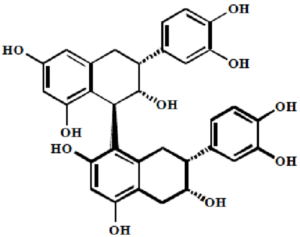 A trimer, epicatechin-(4β→8)-epicatechin-(4β→6)-epicatechin, and a pentamer consisting of (-)-epicatechin units linked through C-4β/C-8 bonds have been isolated from hawthorn, in addition to known procyanidins including dimers B-2, B-4 and B-5, trimers C-1 and epicatechin-(4β→6)-epicatechin-(4β→8)-epicatechin, and tetramer D-1.
- Flavonoids
Major flavonoid compounds include:
- Vitexin (apigenin-8-C-glucoside)
- Vitexin-2″-O-rhamnoside
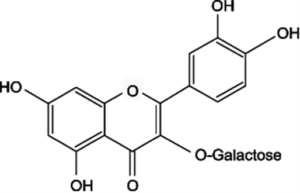
- Hyperoside (quercetin-3-O-galactoside)
- Rutin (quercetin-3-O-rutinoside)
- Quercetin
- Isoquercetin
Chemical Structure of Hyperoside
- Phenolic Acids
- Chlorogenic acid (3-caffeoylquinic acid)
- Caffeic acid
- Ferulic acid
- Triterpenes
- Ursolic acid
- Oleanolic acid
- Crataegolic acid
Mechanisms of Action
- Cardiovascular Effects
The cardiovascular benefits occur through multiple pathways:
- a) Vasodilation:
OPCs → ↑ eNOS activity → ↑ NO production → Vasodilation
- b) Antioxidant Protection:
Flavonoids + Vitamin C → Scavenging of ROS → Protection of endothelial cells
- c) Positive Inotropic Effect:
OPCs → Inhibition of PDE3 → ↑ cAMP → ↑ Ca²⁺ influx → ↑ Cardiac contractility
Animal studies show that hawthorn can act as a vasodilator, meaning it can relax constricted blood vessels, ultimately lowering blood pressure
- Anti-inflammatory Activity
- Inhibition of NF-κB pathway
- Reduction of pro-inflammatory cytokines (TNF-α, IL-6)
- Suppression of COX-2 expression
Reaction pathway:
Procyanidins → Inhibition of IκB kinase → ↓ NF-κB activation → ↓ Inflammatory gene expression
- Antioxidant Properties
Modern medicine has caught up with this ancient knowledge and identified a unique assemblage of antioxidants, principally OPC (oligomeric proanthocyanidin) which improves the integrity of the heart and circulatory system while also suppressing tumor growth
Free radical scavenging reaction:
R• + Procyanidin-OH → R-H + Procyanidin-O•
(Free radical) → (Stabilized radical)
- Prebiotic and Digestive Effects
- Modulation of gut microbiota
- Enhancement of beneficial bacteria growth
- Improved nutrient absorption
Nutritional Components
Hawthorne Berries are high in trace minerals such as selenium and chromium. Selenium is important for proper immune function, while chromium helps enhance the function of insulin – a hormone that helps regulate blood sugar levels
References
- 1) Elders and Community members of the Cayoose Creek Band of Sekw’el’was
- 2) Turner, N. J. (1995). Food plants of coastal First Peoples (Royal BC Museum Handbook). UBC Press; Royal British Columbia Museum.
- 3) Moerman, D. E. (2009). Native American medicinal plants: An ethnobotanical dictionary. Timber Press.
- 4) Kuhnlein, H. V., & Turner, N. J. (1991). Traditional plant foods of Canadian Indigenous peoples: Nutrition, botany and use. Gordon and Breach Science Publishers.
- 5) Svedström, U., Vuorela, H., Kostiainen, R., Tuominen, J., Kokkonen, J., Rauha, J.-P., Laakso, I., & Hiltunen, R. (2002). Isolation and identification of oligomeric procyanidins from Crataegus leaves and flowers. Phytochemistry, 60(8), 821–825. https://doi.org/10.1016/S0031-9422(02)00172-3
- 6) Dahmer, S., & Scott, E. (2010). Health effects of hawthorn. American Family Physician, 81(4), 465–468.
- 7) Yang, B., & Liu, P. (2012). Composition and health effects of phenolic compounds in hawthorn (Crataegus) of different origins. Journal of the Science of Food and Agriculture, 92(8), 1578–1590. https://doi.org/10.1002/jsfa.5671
- 8) Edwards, J. E., Brown, P. N., Talent, N., Dickinson, T. A., & Shipley, P. R. (2012). A review of the chemistry of the genus Crataegus. Phytochemistry, 79, 5–26. https://doi.org/10.1016/j.phytochem.2012.04.006
- 9) Alirezalu, A., Salehi, P., Ahmadi, N., Sonboli, A., Aceto, S., Hatami Maleki, H., & Ayyari, M. (2018). Flavonoids profile and antioxidant activity in flowers and leaves of hawthorn species (Crataegus) from different regions of Iran. International Journal of Food Properties, 21(1), 452–470. https://doi.org/10.1080/10942912.2018.1446146
- 10) Nabavi, S. F., Habtemariam, S., Ahmed, T., Sureda, A., Daglia, M., Sobarzo-Sánchez, E., & Nabavi, S. M. (2015). Polyphenolic composition of Crataegus monogyna: From chemistry to medical applications. Nutrients, 7(9), 7708–7728. https://doi.org/10.3390/nu7095361
- 11) Holubarsch, C. J. F., Colucci, W. S., Meinertz, T., Gaus, W., & Tendera, M. (2008). The efficacy and safety of Crataegus extract WS 1442 in patients with heart failure: The SPICE trial. European Journal of Heart Failure, 10(12), 1255–1263. https://doi.org/10.1016/j.ejheart.2008.10.004