5 Arnica Salve/Rub
Names
Common name – Arnica
Scientific Name: Arnica chamissonis
Other Names: Wolfsbane, mountain tobacco
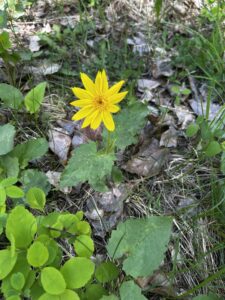
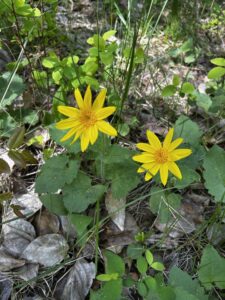 Figure 1 – Flowers of the arnica plant.
Physical Characteristics: Arnica species are perennial herbaceous plants in the Asteraceae (sunflower) family. They typically grow 6-24 inches tall with opposite leaves (unusual for Asteraceae) and bright yellow daisy-like flowers with 10-15 ray petals. The flower heads are 2-3 inches across. Plants have a rhizomatous root system and grow in mountain meadows, open forests, and subalpine zones.
IMPORTANT: Arnica is toxic when taken internally and should ONLY be used topically on intact skin.
Conservation Status: Several native arnica species are threatened by over-harvesting, climate change, and habitat loss.
Traditional Indigenous Uses
The bright yellow flowers were gathered and made into oils, poultices, or salves that soothed the body after hard work or injury. When muscles ached from long days on the land, or when someone was bruised or sore from a fall, the arnica salve was gently rubbed onto the skin to draw out the pain and swelling. For those with stiff joints or arthritis, the same medicine helped to ease movement and bring warmth back to cold or swollen places.
Arnica was often used after physical strain or trauma, when the body needed to recover from bruising or soreness, but they warned that it should never be applied to broken skin. The flowers held powerful healing energy, but also strength that could harm if used without understanding. People prepared the blossoms into salves or infusions for rheumatism and joint pain, while the roots were sometimes used for deeper aches. When the back seized up or muscles cramped, a thin layer of the salve was rubbed in to calm the pain and loosen the tension.
The plant also helped to reduce swelling and inflammation from injuries, and its soothing touch brought relief from insect bites or irritation along the skin. In colder regions, the salve was used as a protection against frostbite and was rubbed into the hands and face before heading out into the snow.
Biochemical Basis for Medicinal Properties
Major Bioactive Compounds in Arnica
The active ingredients mediating the pharmacological effect are mainly sesquiterpene lactones, such as helenalin, 11α,13-dihydrohelenalin, chamissonolid and their ester derivatives. Sesquiterpene lactones, flavonoids, fatty acids, thymol derivatives, and chlorogenic acid are the main bioactive phytochemicals.
Arnica leaves are used to treat muscle injuries as well as arthritis and joint pains. It can be applied topically to treat sprains, soreness, spasms and bruising. To these ends, the plant can be turned into a balm or salve which can be applied to the affected areas. The flower heads also contain a number of phenolic compounds and other bioactive components. Both the leaves and flower contain flavonoids, and both exhibit antioxidant activity as well.
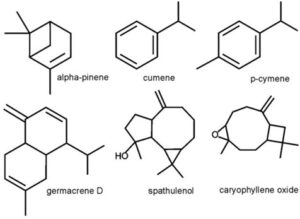
Figure 2. Some of the chemical constituents identified in arnica flower heads.
Image Source: https://pmc.ncbi.nlm.nih.gov/articles/PMC6943594/
It has also been found that the composition of soil in which Arnica chamissonis is grown can affect the bioactive constituents present in the plant and flowers. Plants grown in soil with a higher water content had a higher flavonoid content and exhibited greater antioxidant activity than samples taken from plants grown in dry soil.
Much of the research that has been done on bioactive component in the Arnica genus has been done on the species Arnica Montana which is primarily found in Europe. There is very limited research available on North American plants in this genus.
Structure-Activity Relationships
Why Helenalin’s Structure Makes It So Active:
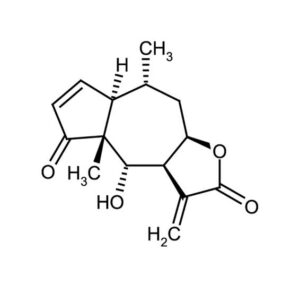
- α-Methylene-γ-Lactone: Creates highly electrophilic carbon (Michael acceptor) for covalent protein modification
- α,β-Unsaturated Ketone: Secondary electrophilic site; some helenalin derivatives have two alkylating centers
- Lipophilicity: Enables skin penetration and cellular membrane crossing
- Rigid Bicyclic Structure: Positions reactive groups for optimal protein binding
- Small Size: Molecular weight ~260; can access protein crevices
Why Flavonoids Support Activity
- Multiple Hydroxyl Groups: Antioxidant and anti-inflammatory synergy
- Catechol Groups: Metal chelation and free radical scavenging
- Vascular Strengthening: Complement helenalin’s anti-inflammatory effects
Preparation and Safety Considerations
Traditional Salve Preparation
- Infuse dried arnica flowers in carrier oil (olive, coconut) for 4-6 weeks
- Strain and mix with beeswax to create salve consistency
- Apply to intact skin only
Modern Preparations
- Ointments: 15-25% tincture or up to 25% oil
- Gels: Various concentrations
- Creams: Standardized to sesquiterpene lactone content
Critical Safety Warnings
- NEVER take internally – Causes severe toxicity including:
- Vomiting, diarrhea, gastroenteritis
- Cardiac arrhythmias
- Liver damage
- Muscle weakness, collapse
- Death in severe cases
- NEVER apply to:
- Open wounds
- Broken skin
- Mucous membranes
- Eyes
- Discontinue if:
- Skin irritation develops
- Rash or eczema appears
- Blistering occurs
- Contraindications:
- Allergy to Asteraceae family (ragweed, chrysanthemums, marigolds)
- Pregnancy and breastfeeding (insufficient safety data)
- Duration: Do not use for more than 2 weeks continuously
References
1) Elders and Community members of the Cayoose Creek Band of Sekw’el’was
2) Moerman, D. E. (1998). Native American ethnobotany. Timber Press.
3) Hall, I. H., Lee, K. H., Starnes, C. O., Sumida, Y., Wu, R. Y., Waddell, T. G., & Cochran, J. W. (1979). Anti-inflammatory activity of sesquiterpene lactones and related compounds. Journal of Pharmaceutical Sciences, 68(5), 537–542. https://doi.org/10.1002/jps.2600680505
4) Willuhn, G. (1998). Arnica montana L.—Portrait of a medicinal plant. Zeitschrift für Phytotherapie, 19, 131–143.
5) Lyss, G., Schmidt, T. J., Merfort, I., & Pahl, H. L. (1997). Helenalin, an anti-inflammatory sesquiterpene lactone from Arnica, selectively inhibits transcription factor NF-κB. Biological Chemistry, 378(9), 951–961. https://doi.org/10.1515/bchm.1997.378.9.951
6) Merfort, I. (2003). Arnica: New insights on the molecular mode of action of a traditional medicinal plant. Forschende Komplementärmedizin und Klassische Naturheilkunde, 10(Suppl 1), 45–48. https://doi.org/10.1159/000073438
7) Ganzera, M., Egger, C., Zidorn, C., & Stuppner, H. (2008). Quantitative analysis of flavonoids and phenolic acids in Arnica montana L. by micellar electrokinetic capillary chromatography. Analytica Chimica Acta, 614(2), 196–200. https://doi.org/10.1016/j.aca.2008.03.009
8) Schmidt, T. J., Lyß, G., Pahl, H. L., & Merfort, I. (1999). Helenanolide-type sesquiterpene lactones. Part 5: The role of glutathione addition under physiological conditions. Bioorganic & Medicinal Chemistry, 7(10), 2849–2855. https://doi.org/10.1016/S0968-0896(99)00235-0
9) Klaas, C. A., Wagner, G., Laufer, S., Sosa, S., Della Loggia, R., Bomme, U., & Merfort, I. (2002). Studies on the anti-inflammatory activity of phytopharmaceuticals prepared from Arnica flowers. Planta Medica, 68(5), 385–391. https://doi.org/10.1055/s-2002-26747
10) Iannitti, T., Morales-Medina, J. C., Bellavite, P., Rottigni, V., & Palmieri, B. (2016). Effectiveness and safety of Arnica montana in post-surgical setting, pain and inflammation. American Journal of Therapeutics, 23(1), e184–e197. https://doi.org/10.1097/MJT.0b013e318295df3d
11) Kriplani, P., Guarve, K., & Baghael, U. S. (2017). Arnica montana L.—A plant of healing: Review. Journal of Pharmacy and Pharmacology, 69(8), 925–945. https://doi.org/10.1111/jphp.12735
12) Widrig, R., Suter, A., Saller, R., & Melzer, J. (2007). Choosing between NSAID and arnica for topical treatment of hand osteoarthritis in a randomised, double-blind study. Rheumatology International, 27(6), 585–591. https://doi.org/10.1007/s00296-006-0260-5
13) Alonso, J. (2004). Tratado de fitofármacos y nutracéuticos. Corpus Libros.
14) Wagner, S., Merfort, I., & Schmidt, T. J. (2004). Helenanolide-type sesquiterpene lactones. Part 6: Reaction of helenalin and related helenanolides with sulfhydryl-containing biomolecules. Pharmazie, 59(3), 236–238.
15) United Plant Savers. (2025). *Arnica (*Arnica spp.). At-risk medicinal plant list. https://unitedplantsavers.org
16) Pumpa, K. L., Fallon, K. E., Bensoussan, A., & Papalia, S. (2014). The effects of topical Arnica on performance, pain and muscle damage after intense eccentric exercise. European Journal of Sport Science, 14(3), 294–300. https://doi.org/10.1080/17461391.2013.808251
17) Sugier D, Olesinska K, Sugier P, Wojcik (2019). Chemical Composition of Essential Oil from Flower Heads of Arnica Chamissonis Less. Under a Nitrogen Impact. Molecules 24(24). [Accessed October 10 2024]. https://pmc.ncbi.nlm.nih.gov/articles/PMC6943594/
18) Splitrock Environmental [Internet]. Arnica Salve. Lillooet (BC). [Accessed November 2 2024]. https://splitrockenvironmental.ca/products/arnica-salve?variant=33785190383675
19) Olesinska K. 2020. Antioxidant properties of Chamisso arnica (Arnica Chamissonis Less.) water Agronomy Science 25(2). https://czasopisma.up.lublin.pl/as/article/view/1464