52 Paper Birch
Names
Common name – Paper Birch
Scientific name – Betula papyrifera
Other names – White Birch or Canoe Birch
General Information
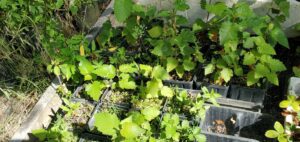
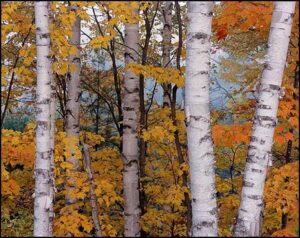
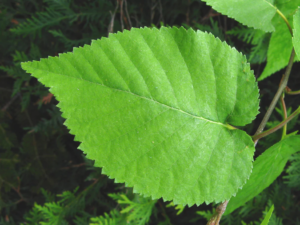
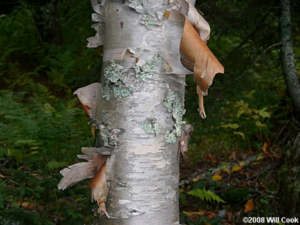
Paper Birch (Betula papyrifera), also known as White Birch or Canoe Birch, is a deciduous tree of the Betulaceae (Birch) family, native to northern North America. This iconic tree has been extensively used by Indigenous peoples throughout its range for medicinal purposes, particularly for treating skin conditions and various inflammatory disorders. The bark contains unique triterpene compounds, primarily betulin and betulinic acid, which provide its therapeutic properties.
Traditional Medicinal Uses by Indigenous Peoples
The Elders speak of Paper Birch as a medicine of great versatility and strength, a tree that offered healing for both the body and the spirit. Its bark was used for many ailments e.g. boiled into teas or made into poultices to ease pain, soothe wounds, and heal the skin. When the bark was prepared as a tea, it cleansed the digestive tract, fighting infections and calming disorders of the stomach and intestines. People relied on it when their bodies ached; its pain-relieving and blood-thinning powers helped those troubled by rheumatism, arthritis, or general soreness. For fevers, a decoction from the bark brought down heat and restored balance, while its cleansing properties helped dissolve kidney stones and flush toxins from the body.
The inner bark was prized for treating frostbite and burns, applied gently to draw out the pain and promote healing. The leaves and twigs, when boiled, created a medicine that reduced swelling and inflammation, bringing comfort to weary joints and sore muscles. Some also used the bark to clean and strengthen the blood, believing it carried a cool, purifying energy from the tree’s white skin.
Biochemical Basis for Medicinal Properties
Primary Bioactive Compounds
Paper Birch bark contains several classes of bioactive compounds, with pentacyclic triterpenes being the most therapeutically significant:
- Primary Active Compounds
- Betulin (Birch Camphor) – Primary triterpene compound (10-25% in outer bark)
- Betulinic Acid – Oxidized derivative of betulin with enhanced bioactivity
- Lupeol – Supporting triterpene compound
- Oleanolic Acid – Secondary triterpene with therapeutic properties
- β-Sitosterol – Plant sterol with multiple bioactivities
- Supporting Compounds
- Flavonoids – Antioxidant and anti-inflammatory compounds
- Tannins – Astringent and antimicrobial properties
- Phenolic acids – Supporting antioxidant compounds
- Essential oils – Volatile compounds with antimicrobial effects
- Suberin – Protective waxy compound in bark
Chemical Structure and Properties of Key Compounds
Betulin – Primary Active Compound
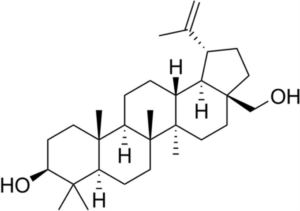
Key Structural Components:
- Ring System: Lupane-type pentacyclic framework
- Hydroxyl Groups: C3 secondary OH and C28 primary alcohol
- Double Bond: C20=C29 exocyclic methylene group
- Methyl Groups: Six methyl substituents providing rigidity
- Stereochemistry: Defined 3β configuration
Betulinic Acid – Active Metabolite

- Structure: Betulin with C28 oxidized to carboxylic acid (-COOH)
- Enhanced Activity: More potent biological effects than betulin
- Improved Solubility: Carboxylic acid group increases water solubility
Molecular Mechanisms of Action
- Anti-inflammatory Mechanisms
NF-κB Pathway Inhibition:
Betulin/Betulinic Acid → NF-κB suppression → Reduced inflammatory gene expression
– Prevents IκBα degradation
– Blocks NF-κB nuclear translocation
– Decreases TNF-α, IL-1β, IL-6 production
– Reduces cyclooxygenase-2 (COX-2) expression
– Anti-inflammatory cytokine regulation
MAPK Pathway Modulation:
Betulinic Acid → MAPK inhibition → Reduced inflammatory signaling
– p38 MAPK suppression
– ERK1/2 pathway modulation
– JNK signaling inhibition
– Downstream anti-inflammatory effects
- Antimicrobial Mechanisms
Cell Membrane Disruption:
Betulin → Bacterial membrane interaction → Membrane permeabilization
– Lipophilic triterpene inserts into membrane
– Disrupts membrane integrity
– Increases permeability
– Cellular content leakage
– Bacterial cell death
Antifungal Activity:
Betulin → Fungal cell wall/membrane targeting → Growth inhibition
– Ergosterol biosynthesis interference
– Cell membrane disruption
– Inhibition of fungal growth
– Broad-spectrum antifungal effects
- Wound Healing and Tissue Repair
Collagen Synthesis Stimulation:
Betulinic Acid → Fibroblast activation → Enhanced collagen production
– Increased Type I collagen synthesis
– Enhanced wound tensile strength
– Accelerated healing process
– Reduced scar formation
Angiogenesis Promotion:
Betulin → VEGF upregulation → New blood vessel formation
– Vascular endothelial growth factor increase
– Enhanced tissue perfusion
– Improved nutrient delivery
– Faster healing rates
- Hepatoprotective Mechanisms
Antioxidant Defense Enhancement:
Betulinic Acid → Nrf2 activation → Antioxidant enzyme upregulation
– Glutathione S-transferase increase
– Catalase and SOD enhancement
– Reduced oxidative stress
– Liver protection
Extraction and Concentration in Bark
Seasonal Variation:
- Highest betulin content in late spring/early summer
- Outer bark contains 15-25% betulin by dry weight
- Inner bark has lower but significant concentrations
- Age of tree affects compound concentration
Traditional Extraction Methods:
- Hot water extraction (tea preparation)
- Alcohol-based tinctures
- Direct bark chewing
- Poultice preparations
- Steam distillation for essential oils
Safety and Traditional Wisdom
Traditional Safety Profile:
- Extensive historical use without significant toxicity
- Topical applications generally well-tolerated
- Internal use in traditional dosages appears safe
- Pregnancy/lactation: Traditional caution advised
References
1) Elders and Community members of the Cayoose Creek Band of Sekw’el’was
2) American Chemical Society. (n.d.). Betulinic acid. https://www.acs.org/molecule-of-the-week/archive/b/betulinic-acid.html
3) Garden Guides. (n.d.). Medicinal uses for paper birch trees. https://www.gardenguides.com/115425-medicinal-uses-paper-birch-trees.html
4) Minnesota Public Radio. (2005, March 10). Birch bark promises better health. http://news.minnesota.publicradio.org/features/2005/03/10_hemphills_birchbark/
5) Natural Medicinal Herbs. (n.d.). Paper birch – Betula papyrifera. http://www.naturalmedicinalherbs.net/herbs/b/betula-papyrifera=paper-birch.php
6) Song of the Woods. (2025, February 7). White birch syn. paper birch – Betula papyrifera. https://www.songofthewoods.com/white-birch-betula-papyrifera/
7) (2025, October 9). Birch bark. https://en.wikipedia.org/wiki/Birch_bark
8) Yoon, J., Kim, J., Lee, H., & Choi, S. (2013). Study of the betulin enriched birch bark extracts effects on human carcinoma cells and ear inflammation. Phytotherapy Research, 27(12), 1814–1821. https://doi.org/10.1002/ptr.4958
9) Shanmugam, M. K., Nguyen, A. H., Kumar, A. P., & Sethi, G. (2013). Anti-inflammatory and anticancer properties of birch bark-derived betulin: Recent developments. Frontiers in Pharmacology, 13, https://doi.org/10.3389/fphar.2022.8705846
10) Zhao, W., Zhang, H., Chen, H., & Xu, L. (2012). Betulinic acid regulates generation of neuroinflammatory mediators responsible for tissue destruction in multiple sclerosis in vitro. Acta Pharmacologica Sinica, 33(10), 1241–1249. https://doi.org/10.1038/aps.2012.181