55 Prairie Rose
Names
Common name – Prairie Rose
Scientific name – Rosa arkansana
Other names – Rose woodsia, qel’q
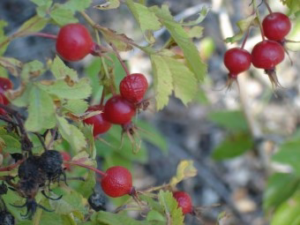
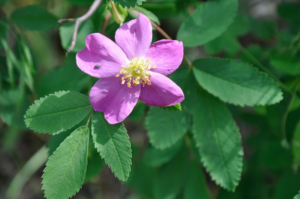
General Information
Prairie Rose is used for medicinal purposes. The plant’s different parts – roots, petals, and hips (fruits) – each serve specific therapeutic applications.
Traditional Indigenous Uses
The roots are powerful healers. When prepared as an infusion or decoction, they have been used to calm the body during seizures and convulsions, easing distress when the body shakes uncontrollably. The same roots, when steeped longer, can be used to stop bleeding and close wounds, drawing out pain and helping the body heal cleanly. Taken as a tonic, they were believed to bring back strength and vitality to those who were weak or weary, and when prepared for the eyes, they could soothe irritation or clouded vision, restoring clarity.
The petals, soft and fragrant, were more than decoration. Women would steep them in oil to make a delicate hair perfume, carrying the scent of the land wherever they went. Tea made from the flowers was also used to wash and soothe the eyes, especially when someone had pink eye or other redness.
Rose hips were often gathered in late summer, eaten raw or cooked into food, and brewed into tea to strengthen the stomach and ease digestive troubles. The people also prized them as a rich source of nourishment, especially for their high content of vitamin C, which helped prevent weakness during the long winters.
Finally, the whole plant was sometimes used together – its leaves, flowers, and hips – in teas or steam treatments to ease coughs and sore throats. Applied to the skin, it could calm rashes or draw the sting from small wounds.
Biochemical Basis of Medicinal Properties
Major Bioactive Compounds
Prairie Rose contains numerous bioactive compounds that provide the scientific basis for its traditional medicinal uses. While specific analysis of Rosa arkansana is limited, closely related Rosa species share similar chemical profiles.
1. Vitamin C (Ascorbic Acid)
Structure: C₆H₈O₆
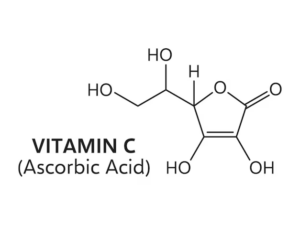
Concentration: Rose hips contain exceptionally high levels of vitamin C (up to 1,000-3,000 mg/100g)
Medicinal Properties:
- Antioxidant activity
- Immune system support
- Wound healing promotion
- Collagen synthesis enhancement
2. Tannins
Primary Types: Ellagitannins, gallotannins, condensed tannins
Key Compounds:
- Ellagic acid derivatives
- Gallic acid esters
- Proanthocyanidins
Medicinal Properties:
- Astringent effects
- Anti-inflammatory activity
- Antimicrobial properties
- Wound healing acceleration
3. Flavonoids
Major Compounds:
- Quercetin
- Kaempferol
- Rutin
- Catechins
Quercetin Structure: C₁₅H₁₀O₇
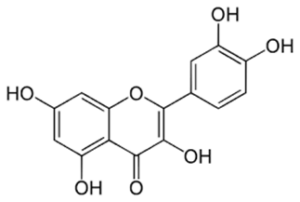
Medicinal Properties:
- Anti-inflammatory
- Antioxidant
- Antihistamine
- Cardiovascular protection
4. Organic Acids
Primary Acids:
- Malic acid (C₄H₆O₅)
- Citric acid (C₆H₈O₇)
- Ascorbic acid (vitamin C)
Medicinal Properties:
- pH balancing
- Antimicrobial activity
- Digestive aid
- Metal chelation
5. Carotenoids
Major Compounds:
- β-carotene
- Lycopene
- Lutein
- Zeaxanthin
β-carotene Structure: C₄₀H₅₆
Medicinal Properties:
- Antioxidant activity
- Vision support
- Immune system enhancement
- Skin protection
Biochemical Mechanisms of Action
Antioxidant Pathways
The high concentration of vitamin C, flavonoids, and carotenoids provides multiple antioxidant mechanisms:
- Direct Radical Scavenging:
- Vitamin C donates electrons to neutralize free radicals
- Flavonoids chelate metal ions that catalyze oxidation
- Enzyme System Support:
- Ascorbic acid regenerates vitamin E
- Flavonoids enhance glutathione peroxidase activity
Anti-inflammatory Mechanisms
Tannin Activity:
- Inhibition of cyclooxygenase (COX) enzymes
- Reduction of prostaglandin synthesis
- Stabilization of cell membranes
Flavonoid Pathways:
- Nuclear factor-κB (NF-κB) pathway inhibition
- Reduction of inflammatory cytokine production
- Histamine release suppression
Antimicrobial Activity
Tannin Mechanisms:
- Protein precipitation in bacterial cell walls
- Disruption of bacterial enzyme systems
- Biofilm formation inhibition
Organic Acid Effects:
- pH reduction creating hostile environment for pathogens
- Direct antimicrobial activity
References
1) Elders and Community members of the Cayoose Creek Band of Sekw’el’was
2) Moerman, D. E. (1998). Native American ethnobotany. Timber Press.
3) Flora of North America Editorial Committee. (n.d.). Rosa arkansana. Flora of North America. Retrieved from https://floranorthamerica.org/Rosa_arkansana
4) Nadpal, J. D., Lesjak, M. M., Šibul, F. S., Anačkov, G. T., Četojević-Simin, D. D., Mimica-Dukić, N. M., & Beara, I. N. (2013). Bioactive compounds and antioxidant activity of Rosa canina biotypes. BMC Chemistry, 7, 73. https://doi.org/10.1186/1752-153X-7-73
5) com. (2024). The wild rose plant: Healing properties and Indigenous medicinal uses. https://windspeaker.com/news/wild-rose-plant-healing-properties
6) American Gardener. (2025). Wild prairie rose (Rosa arkansana): History, characteristics & cultivation. https://www.americangardener.org/wild-prairie-rose
7) Li, Y., Zhang, J., & Xu, L. (2024). Chemical diversity, traditional uses, and bioactivities of Rosa roxburghii Pharmacology & Therapeutics, 250, 108779. https://doi.org/10.1016/j.pharmthera.2024.108779
8) Turner, N. J., & Hebda, R. J. (1990). Contemporary use of bark for medicine by two Salishan Native elders of southeast Vancouver Island, Canada. Journal of Ethnopharmacology, 29(1), 59–72. https://doi.org/10.1016/0378-8741(90)90038-Q