42 Large-Fruited Desert-Parsley
Names
Common name – Large-Fruited Desert-Parsley
Scientific name – Lomatium macrocarpum
Other names – bigseed lomatium, bigseed biscuitroot, or biscuit root
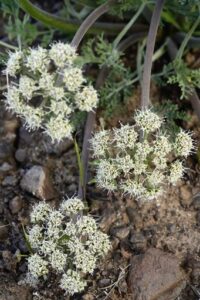
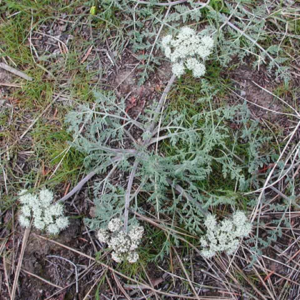
General Information
Large-Fruited Desert-Parsley is a perennial flowering plant in the carrot family (Apiaceae) native to much of western North America. This robust herb grows up to about half a meter (20 inches) tall with hairy, gray-green herbage and a thick, deep taproot that can extend several feet into the ground. The plant is characterized by its finely divided, fern-like leaves and large, conspicuous clusters of small, off-white to yellowish flowers arranged in compound umbels typical of the carrot family. The “large-fruited” designation comes from its relatively large, winged seeds compared to other Lomatium species. Large-fruited desert-parsley has been a crucial plant for Indigenous peoples across its range, serving as both an important food source and powerful medicinal plant.
Traditional Indigenous Uses
Its roots were dug in early spring, carefully cleaned, and brewed into a strong tea to treat coughs, colds, and lung troubles such as pneumonia and bronchitis. The same root was used as an antiviral, known to fight infections and strengthen the body during outbreaks of influenza. When breathing became labored or the lungs felt heavy, the steam from its tea was inhaled to open the chest and ease conditions like asthma or even tuberculosis. Its roots were used to soothe sore throats through gargles or warm teas, and to bring down fevers when the body burned with sickness.
The roots were mashed into poultices or washes to draw out infection from cuts, sores, and boils, and were sometimes placed over bruises or sprains to ease swelling. It was said to even help in the mending of broken bones, used externally to strengthen the body’s natural healing. The same medicine could be applied to skin conditions such as rashes, sores, or even infections such as smallpox, showing the deep versatility of the root. A mild tea also aided digestion, restoring the body’s balance after sickness or weakness.
When burned, its smoke was used in ceremonies of purification and protection, cleansing both space and spirit. Some preparations were made especially for women, helping with postpartum recovery and strengthening reproductive health. Taken regularly in small doses, it was also said to fortify the immune system, keeping illness away.
Biochemical Compounds and Their Medicinal Properties
- Coumarins (Primary Bioactive Compounds)
Three Most Important Compounds:
(i) Osthol (C₁₅H₁₆O₃) – Major coumarin compound
 (ii) Oxypeucedanin (C₁₆H₁₄O₅) – Furanocoumarin
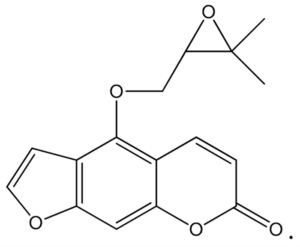 (iii) Imperatorin (C₁₆H₁₄O₄) – Linear furanocoumarin

Medicinal Properties
- Antiviral: Potent activity against respiratory viruses
- Antimicrobial: Broad-spectrum antibacterial and antifungal effects
- Anti-inflammatory: Reduces inflammation in respiratory and other tissues
- Immune-modulating: Enhances immune system response
- Chromones (Supporting Compounds)
Three Most Important Compounds
(i) 2-Methyl-5-hydroxy-6-(3-methyl-2-butenyl)-7-methoxychromone
(ii) Methoxychromone derivatives
(iii) Hydroxychromone compounds
- Essential Oil Components
Most Important Compound
α-Pinene (C₁₀H₁₆) – Major monoterpene
Proposed Biochemical Mechanisms for Traditional Uses
Antiviral Activity (Root Preparations)
- Coumarins (osthol, imperatorin) act through:
- Inhibition of viral RNA polymerase enzymes
- Disruption of viral protein synthesis
- Prevention of viral entry into host cells
- Chromones contribute:
- Direct viral inactivation
- Enhancement of interferon production
- Immune system stimulation
Respiratory Support (Root Decoctions)
- Furanocoumarin compounds provide:
- Bronchodilation through smooth muscle relaxation
- Anti-inflammatory effects in respiratory tract
- Antimicrobial activity against respiratory pathogens
- Essential oil components facilitate:
- Expectorant action promoting mucus clearance
- Antimicrobial protection in lungs
- Improved oxygen exchange
Anti-inflammatory and Wound Healing (Topical Applications)
- Coumarin derivatives act as:
- Cyclooxygenase (COX) enzyme inhibitors
- Nuclear factor-κB (NF-κB) pathway modulators
- Antioxidant compounds protecting tissues
- Chromones provide:
- Enhanced collagen synthesis
- Improved circulation to healing tissues
- Antimicrobial protection of wounds
Chemical Reactions and Molecular Interactions
Antiviral Mechanism (Coumarins)
Osthol → Viral RNA polymerase binding → Enzyme inactivation → Inhibited viral replication → Reduced viral load
Imperatorin → Viral envelope disruption → Loss of infectivity → Prevention of viral entry → Host cell protection
Anti-inflammatory Pathway (Multiple Compounds)
Coumarins → COX-2 enzyme inhibition → ↓ Prostaglandin E₂ synthesis → Reduced inflammation and pain → Tissue healing
Chromones → NF-κB pathway inhibition → ↓ Pro-inflammatory cytokines → Reduced inflammatory response → Pain relief
Antimicrobial Action (Furanocoumarin System)
Oxypeucedanin → Bacterial cell membrane disruption → Cell lysis → Increased membrane permeability → ATP leakage → Cell death
UV activation: Furanocoumarin + UV light → DNA cross-linking → Bacterial/fungal DNA damage → Growth inhibition
Respiratory Relief Mechanism (Essential Oils + Coumarins)
α-Pinene → β₂-adrenergic receptor activation → Bronchodilation → Relaxed airway smooth muscle → Improved breathing
Coumarins → Histamine release inhibition → Reduced airway inflammation → Decreased respiratory tract swelling → Better airflow
Immune Enhancement (Multiple Compounds)
Chromones → Macrophage activation → ↑ Phagocytosis → Enhanced pathogen clearance → Improved immune response
Coumarins → Interferon production ↑ → Antiviral state induction → Enhanced cellular immunity → Viral resistance
Traditional Medicine Applications
Modern validation supports traditional uses:
- Desert parsley roots are used for asthma, colds, cough, flu, lung injuries, pneumonia, tuberculosis, and viral infections
- Lomatium can be used externally for smallpox, skin rashes, cuts, and sores
Cultural and Historical Significance
Indigenous Food and Medicine Systems
Large-fruited desert-parsley holds special significance:
- Several species including L. macrocarpum are known as biscuit roots for their starchy edible roots – eaten cooked or dried and ground into flour
- It was an important food source for many interior First Nations peoples, who ate the root in spring either raw or cooked
Traditional Ecological Knowledge
Indigenous practices emphasize:
- Deep root harvesting: Specialized digging techniques for accessing taproots
- Sustainable collection: Careful harvesting preserving plant populations
- Seasonal timing: Spring collection when roots are most potent
- Multi-generational knowledge: Time-tested preparation methods
Safety Considerations and Traditional Wisdom
Traditional Preparation Guidelines
Indigenous knowledge emphasizes:
- Proper identification: Distinguishing from potentially toxic umbellifers
- Root processing: Traditional methods reducing potential irritation
- Dosage management: Appropriate amounts for different conditions
- Preparation timing: Fresh vs. dried root applications
Modern Safety Notes
Contemporary considerations include:
- Photosensitivity: Furanocoumarin content may increase UV sensitivity
- Individual sensitivity: Some people may experience skin reactions
- Quality control: Proper species identification and preparation standards
- Professional guidance: Consultation for serious respiratory conditions
References
1) Elders and Community members of the Cayoose Creek Band of Sekw’el’was
2) Friends of Edgewood. (2025, May 8). Large-fruited Lomatium. https://friendsofedgewood.org/large-fruited-lomatium
3) Gaïan EthnoBotany. (2017, June 28). Lomatium macrocarpum. https://gaianethnobotany.com/2017/06/01/lomatium-macrocarpum/
4) Healthy Planet Canada. (2025, May 26). A powerful antiviral herb: Desert parsley. https://www.healthyplanetcanada.com/blog/a-powerful-antiviral-herb-desert-parsley/
5) (2025). Large-fruited desert parsley (Lomatium macrocarpum). Retrieved September 28, 2025, from https://www.inaturalist.org/guide_taxa/618478
6) (2021, June 11). Desert parsley: Health benefits, side effects, uses, dose & precautions. Retrieved September 28, 2025, from https://www.rxlist.com/supplements/desert_parsley.htm
7) Asuming, W. A., Beauchamp, P. S., & Descalzo, J. T. (2005). Essential oil composition of four Lomatium species and their chemotaxonomy. Biochemical Systematics and Ecology, 33(1), 17–26. https://doi.org/10.1016/j.bse.2004.06.005
8) ScienceDirect Topics. (2025). Lomatium—An overview. Retrieved September 28, 2025, from https://www.sciencedirect.com/topics/pharmacology-toxicology-and-pharmaceutical-science/lomatium
9) Secrets of the Tribe. (2023, April 7). 5 surprising but less-known Lomatium benefits everyone should know. https://secrets.shop/blogs/learn-the-herbs/lomatium-benefits
10) Splitrock Environmental. (2025). Large-fruited desert-parsley. https://splitrockenvironmental.ca/products/large-fruited-desert-parsley
11) (2025). Desert parsley: Overview, uses, side effects, precautions, interactions, dosing and reviews. Retrieved September 28, 2025, from https://www.webmd.com/vitamins/ai/ingredientmono-1275/desert-parsley
12) White Rabbit Institute of Healing. (2025, March 13). Lomatium (Lomatium). https://www.whiterabbitinstituteofhealing.com/herbs/lomatium/
13) Lomatium. Retrieved September 28, 2025, from https://en.wikipedia.org/wiki/Lomatium