56 Rabbit-Brush
Names
Common name – Rabbit-brush
Scientific name – Ericameria nauseosa, formerly Chrysothamnus nauseosus
Other names – p’u7tn’álhp, chamisa, rubber rabbitbrush, or gray rabbitbrush
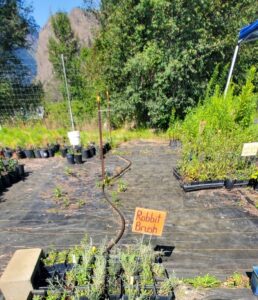
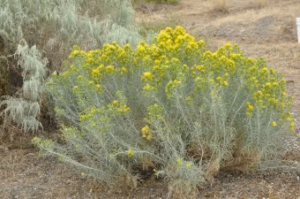
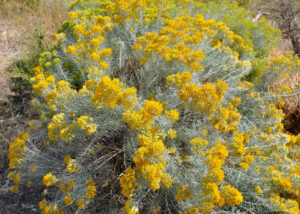
General Information
Rabbit-brush is a member of the sunflower family (Asteraceae) and contains rubber-like latex that gives it distinctive properties.
Traditional Indigenous Uses
The galls that grow where insects make their homes were once gathered and ground into a fine powder, then mixed with water to create a soothing medicine. This mixture was used for toothaches, easing pain, and taken for stomach troubles, helping to calm discomfort and restore balance to the digestive system.
The leaves and flowers, when dried and boiled into tea, offered gentle healing for a range of common ailments – a medicine that could be shared among all who needed comfort or cleansing. The steam from the stems and leaves was also used to open the chest and ease the breath when coughs or congestion took hold. The plant’s sap, when applied directly to the skin, could draw out infection from wounds and soothe irritations. The bright yellow flowers, crushed and used as a poultice, helped to reduce swelling and inflammation.
The roots, too, carried medicine. The decoction of the bark was used for stomach ailments and diarrhea, while the young shoots were sometimes eaten fresh as a light nutritional supplement.
Rabbit-Brush was also a ceremonial plant. Its branches were burned slowly to create a cleansing smoke, used to purify spaces and the spirit.
Beyond healing, Rabbit-Brush gave color and utility to daily life. Its yellow flowers produced vibrant dye that colored wool, leather, and baskets after being boiled for many hours with alum. Its strong stems were carved into arrows for hunting, and its fibers woven into wedding belts – garments of ceremony and meaning. The smoke from its slow-burning branches was valued for preserving hides.
Biochemical Basis of Medicinal Properties
Rabbit-brush contains a diverse array of bioactive compounds that provide the scientific basis for its traditional medicinal uses. The plant’s unique chemistry is characterized by rubber-like latex and aromatic terpenoids.
Here are the bioactive compounds and their structures from rubber/latex-producing plants:
1. Rubber Latex (Polyisoprene)
Chemical Structure: (C₅H₈)ₙ
Polyisoprene repeating unit
Molecular Weight: Variable (high molecular weight polymer)
Medicinal Properties:
- Wound sealing and protection
- Antimicrobial barrier formation
- Moisture retention
- Anti-inflammatory effects
2. Terpenoid Compounds
Primary Classes:
- Monoterpenes (C₁₀H₁₆)
- Sesquiterpenes (C₁₅H₂₄)
- Diterpenes (C₂₀H₃₂)
Key Compounds:
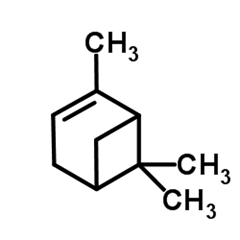
- α-Pinene (monoterpene)
- β-Caryophyllene (sesquiterpene)
- Camphor derivatives
- Borneol derivatives
α-Pinene Structure: C₁₀H₁₆
Medicinal Properties:
- Anti-inflammatory activity
- Antimicrobial effects
- Respiratory decongestant
- Analgesic properties
- Insecticidal activity
3. Flavonoid Compounds
Major Flavonoids:
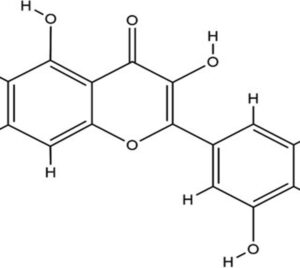
- Quercetin (C₁₅H₁₀O₇)
- Kaempferol (C₁₅H₁₀O₆)
- Apigenin (C₁₅H₁₀O₅)
- Luteolin (C₁₅H₁₀O₆)
Quercetin Structure
Medicinal Properties:
- Potent antioxidant activity
- Anti-inflammatory effects
- Antihistamine properties
- Antimicrobial activity
- Vascular protection
4. Phenolic Acids
Primary Compounds:
- Caffeic acid (C₉H₈O₄)
- Ferulic acid (C₁₀H₁₀O₄)
- Chlorogenic acid (C₁₆H₁₈O₉)
- Gallic acid (C₇H₆O₅)
Caffeic Acid Structure: C₉H₈O₄
Medicinal Properties:
- Antioxidant protection
- Anti-inflammatory activity
- Antimicrobial effects
- Wound healing promotion
- Hepatoprotective properties
5. Essential Oil Components
Major Volatile Compounds:
- Camphor (C₁₀H₁₆O)
- 1,8-Cineole (Eucalyptol) (C₁₀H₁₈O)
- Borneol (C₁₀H₁₈O)
- Camphene (C₁₀H₁₆)
Camphor Structure: C₁₀H₁₆O
Medicinal Properties:
- Analgesic effects
- Anti-inflammatory activity
- Respiratory stimulant
- Antimicrobial properties
- Counterirritant effects
- Alkaloids (Minor Components)
Potential Compounds:
- Pyrrolizidine alkaloids (trace amounts)
- Quaternary ammonium compounds
Medicinal Properties:
- Variable biological activity
- Potential antimicrobial effects
- Central nervous system effects (at higher concentrations)
Biochemical Mechanisms of Action
Anti-inflammatory Pathways
Terpenoid-Mediated Inhibition:
Cyclooxygenase (COX) Inhibition
(i) Arachidonic acid + O₂ [COX-1/COX-2] → PGG₂ [Peroxidase] → PGH₂
Terpenoids inhibit this pathway
Lipoxygenase (LOX) Inhibition:
Arachidonic acid [5-LOX] → 5-HPETE → Leukotrienes
Flavonoids block this pathway
Nuclear Factor-κB (NF-κB) Pathway Modulation:
- Flavonoids prevent NF-κB nuclear translocation
- Reduced inflammatory gene expression
- Decreased cytokine production (TNF-α, IL-1β, IL-6)
Antimicrobial Mechanisms
Terpenoid Activity:
- Cell Membrane Disruption:
- Lipophilic terpenoids integrate into bacterial membranes
- Disruption of membrane integrity and function
- Leakage of cellular contents
- Enzyme Inhibition:
- Interference with bacterial respiratory enzymes
- Disruption of protein synthesis
- Inhibition of DNA replication
Phenolic Compound Activity:
- Protein precipitation and denaturation
- Metal chelation (removal of essential metal cofactors)
- Reactive oxygen species generation
Wound Healing Enhancement
Latex Polymer Mechanism:
Physical Barrier Formation
Liquid latex → Polymerization → Protective film
Upon exposure to air and moisture
Growth Factor Protection:
Latex matrix protects endogenous growth factors
Maintains moist wound environment
Prevents bacterial contamination
Flavonoid-Enhanced Healing:
- Stimulation of fibroblast proliferation
- Enhanced collagen synthesis
- Improved angiogenesis (new blood vessel formation)
Respiratory Decongestant Activity
Volatile Compound Mechanisms:
- Mucociliary Clearance Enhancement:
- Terpenes stimulate ciliary beating
- Increased mucus production and clearance
- Reduced viscosity of respiratory secretions
- Bronchodilation:
- Smooth muscle relaxation in airways
- β₂-adrenergic receptor activation
- Reduced airway resistance
Chemical Reactions in Therapeutic Applications
1. Latex Polymerization for Wound Protection
Polymerization Reaction:
n(C₅H₈) + O₂ + H₂O → [-C₅H₈-]ₙ + H₂O₂
Mechanism:
- Isoprene monomers undergo free radical polymerization
- Cross-linking creates a three-dimensional polymer network
- Forms a protective barrier over wounds
- Prevents microbial infiltration and maintains moisture balance
2. Terpenoid Antioxidant Mechanism
Radical Scavenging Cascade:
Step 1: Primary antioxidant action
Terpenoid-OH + •OH → Terpenoid-O• + H₂O
Step 2: Regeneration by ascorbate
Terpenoid-O• + Ascorbate → Terpenoid-OH + Ascorbyl•
Step 3: Ascorbyl radical disproportionation
Ascorbyl• + Ascorbyl• → Ascorbate + Dehydroascorbate
Mechanism:
- Terpenoids donate hydrogen atoms to neutralize hydroxyl radicals
- Terpenoid radicals are relatively stable and can be regenerated
- Ascorbate (Vitamin C) acts as a co-antioxidant to restore terpenoids
- Creates a synergistic antioxidant network
3. Flavonoid Metal Chelation
Chelation Reaction:
Quercetin + Fe³⁺ → [Quercetin-Fe³⁺] complex
Prevention of Fenton Reaction:
Fe³⁺ + H₂O₂ → Fe²⁺ + •OH + OH⁻ (PREVENTED)
Mechanism:
- Quercetin binds Fe³⁺ through its catechol and carbonyl groups
- Chelation prevents iron from participating in the Fenton reaction
- Blocks generation of highly reactive hydroxyl radicals (•OH)
- Reduces oxidative stress and cellular damage
- Protects lipids, proteins, and DNA from oxidation
Safety and Toxicological Considerations
Traditional Safety Profile:
- Generally considered safe when used traditionally
- No major toxicity reports in ethnobotanical literature
- Topical applications well-tolerated
Potential Concerns:
- Allergic reactions in sensitive individuals (latex sensitivity)
- Possible pyrrolizidine alkaloid content (requires analysis)
- Essential oil concentration-dependent effects
- Potential drug interactions (theoretical)
Contraindications:
- Known latex allergies
- Pregnancy/lactation (insufficient safety data)
- Internal use of high concentrations
References
1) Elders and Community members of the Cayoose Creek Band of Sekw’el’was
2) Dunmire, W. W., & Tierney, G. D. (1997). Wild plants and native peoples of the Four Corners. Museum of New Mexico Press.
3) Finley, I., & Nieland, C. (2000). Traditional plant uses.S. Department of Agriculture, Forest Service.
4) Native Memory Project. (2024). Rubber rabbitbrush traditional uses. https://nativememoryproject.org/rubber-rabbitbrush-traditional-uses
5) S. Department of Agriculture, Forest Service. (2025). Compounds in rubber rabbitbrush are being evaluated for nematocidal, anti-malarial, and insect-repellent properties. https://www.fs.usda.gov/wildflowers/plant-of-the-week/ericameria_nauseosa.shtml
6) House of Aromatics. (2025). Rabbit brush plant profile – Traditional uses and applications. https://houseofaromatics.com/rabbit-brush-plant-profile
7) Eldorado Windy Farm. (2024). SFBG rabbitbush (chamisa) – Chrysothamnus nauseosus ethnobotany. https://eldoradowindyfarm.com/sfbg-rabbitbush-chrysothamnus-nauseosus-ethnobotany
8) Mojave Desert Network. (2024). Ethnobotanical uses of Chrysothamnus viscidiflorus in Native American traditions. https://mojavedesert.net/plants/chrysothamnus-viscidiflorus-ethnobotany
9) Oregon State University College of Agricultural Sciences. (2023). Ethnobotany in Native American cultures. https://agsci.oregonstate.edu/ethnobotany
10) S. Department of Agriculture, Forest Service. (2025). Species: Ericameria nauseosa – Fire effects information. Fire Effects Information System (FEIS). https://www.fs.usda.gov/database/feis/plants/shrub/erinau/all.html
11) California Native Plant Society. (2025). Ericameria nauseosa: Chemical composition and properties. https://www.cnps.org/ericameria-nauseosa
12) Zheng, X., Zhang, M., Li, Y., & Wang, Q. (2023). Phytochemical composition, antimicrobial activity, and anti-inflammatory potential of Ericameria nauseosa essential oils. Phytochemistry Letters, 56, 213–220. https://doi.org/10.1016/j.phytol.2023.08.014
13) Salehi, B., Sharifi-Rad, J., & Martorell, M. (2019). Therapeutic potential of sesquiterpene lactones: Anti-inflammatory and antimicrobial mechanisms. Phytotherapy Research, 33(12), 3011–3030. https://doi.org/10.1002/ptr.6465