19 Black Gooseberry
Names
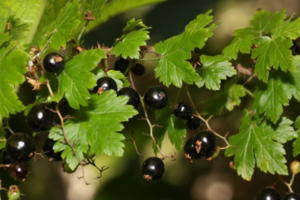
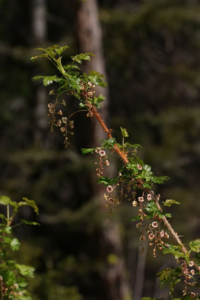
Common name – Black Gooseberry
Scientific name – Ribes lacustre
Other names – sxniz’; Prickly Currant; Swamp Gooseberry
Traditional Indigenous Uses
Black Gooseberry was used to bring relief to the body and support to women during childbirth. The inner bark was steeped into a tea and given to mothers in labor to ease the pain and help the body through delivery. The same bark, when made into a decoction, was used as an eyewash to treat soreness and irritation, restoring comfort and clarity to tired eyes.
When the body ached from hard work or illness, teas made from the bark or leaves were used to relieve pain and inflammation. Poultices and decoctions prepared from the berries and bark also helped reduce swelling and bring down inflammation. The berries themselves, whether eaten fresh or brewed into tea, were known to strengthen the stomach and ease digestion.
Additional Traditional Uses
- The berries have been consumed fresh or processed into jams
- The plant was used as part of traditional healing systems that integrated multiple plant medicines
Biochemical Basis of Medicinal Properties
Key Bioactive Compounds
- Anthocyanins
Black Gooseberry berries contain four main anthocyanins:
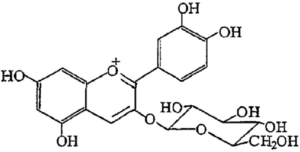
- Cyanidin-3-O-glucoside
- Cyanidin-3-O-rutinoside
- Delphinidin-3-O-glucoside
- Delphinidin-3-O-rutinoside
Chemical Structure of Cyanidin-3-O-glucoside
- Vitamin C (Ascorbic Acid)
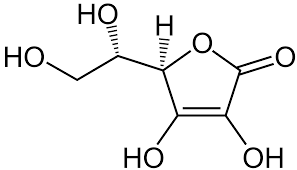
One gram dry weight contained on average 3.19 milligrams calcium, 0.05 milligram iron, 0.94 milligram magnesium, 0.02 milligram zinc, and 3.33 milligrams ascorbic acid
Chemical Structure of Ascorbic Acid
- Phenolic Acids
- Caffeic acid derivatives
- Chlorogenic acid
- Ellagic acid
- Flavonoids
- Quercetin glycosides
- Kaempferol derivatives
- Myricetin compounds
Mechanisms of Action
- Anti-inflammatory Activity
- Anthocyanins inhibit cyclooxygenase (COX) enzymes
- Reduction of pro-inflammatory cytokines (IL-6, TNF-α)
- Modulation of NF-κB signaling pathway
Reaction pathway:
Anthocyanins → COX inhibition → ↓ Prostaglandin synthesis → ↓ Inflammation
- Antioxidant Properties
- Direct free radical scavenging
- Chelation of metal ions
- Upregulation of endogenous antioxidant enzymes
Antioxidant reaction example:
R• + Anthocyanin-OH → R-H + Anthocyanin-O•
(Free radical) → (Stabilized radical)
- Antimicrobial Activity
- Disruption of bacterial cell membranes
- Inhibition of bacterial enzyme systems
- Interference with bacterial biofilm formation
- Analgesic Effects
- Modulation of pain receptors
- Anti-inflammatory cascade effects
- Potential interaction with opioid receptors
References
1) Elders and Community members of the Cayoose Creek Band of Sekw’el’was
2) Washington Native Plant Society. (n.d.). Ribes lacustre (Black Gooseberry) – ethnobotany (Skagit & Lummi uses). https://www.wnps.org/native-plant-directory/339%3Aribes-lacustre
3) Sun, Q., Wang, N., Xu, W., & Zhou, H. (2021). Genus Ribes (Grossulariaceae): A comprehensive review of traditional uses, phytochemistry, pharmacology and clinical applications. Journal of Ethnopharmacology, 276, 114166. https://doi.org/10.1016/j.jep.2021.114166
4) Moyer, R. A., Hummer, K. E., Finn, C. E., Frei, B., & Wrolstad, R. E. (2002). Anthocyanins, phenolics, and antioxidant capacity in diverse small fruits: Vaccinium, Rubus, and Ribes. Journal of Agricultural and Food Chemistry, 50(3), 519–525. https://doi.org/10.1021/jf011062r
5) Lhotská, I., Kaplan, J., Křenová, A., & Šatínský, D. (2021). Evaluation of anthocyanin profiles in various blackcurrant cultivars over a three-year period using a fast HPLC-DAD method. Foods, 10(8), 1745. https://doi.org/10.3390/foods10081745
6) Li, S., Wu, B., Fu, W., & Reddivari, L. (2019). The anti-inflammatory effects of dietary anthocyanins against ulcerative colitis. International Journal of Molecular Sciences, 20(10), 2588. https://doi.org/10.3390/ijms20102588
7) Nohynek, L. J., Alakomi, H.-L., Kähkönen, M. P., Heinonen, M., Helander, I. M., Oksman-Caldentey, K.-M., & Puupponen-Pimiä, R. H. (2006). Berry phenolics: Antimicrobial properties and mechanisms of action against severe human pathogens. Nutrition and Cancer, 54(1), 18–32. https://doi.org/10.1207/s15327914nc5401_4
8) Kuhnlein, H. V. (1989). Nutrient values in indigenous wild berries used by the Nuxalk people of Bella Coola, British Columbia. Journal of Food Composition and Analysis, 2(1), 28–36. https://doi.org/10.1016/0889-1575(89)90059-8