71 Tufted Prairie Aster
Names
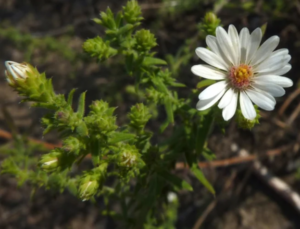
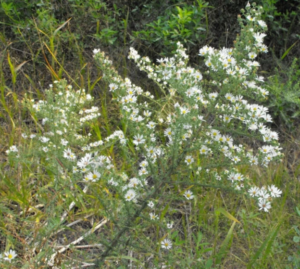
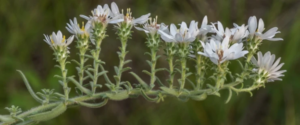
Common name – Tufted Prairie Aster
Scientific name – Symphyotrichum caespitosum
Other names – White Heather Aster
Traditional Indigenous Uses
The roots were carefully dug, dried, and pounded into a soft powder to stop bleeding from cuts and scrapes. This medicine was applied directly to the skin, helping to close wounds and prevent infection.
The whole plant was often prepared in infusions or decoctions. When combined with other medicinal herbs, a tea made from the Aster helped to bring down fevers and cool the body during sickness. The same decoction could be used to wash wounds, keeping them clean and speeding healing. Dried and powdered, the plant was mixed into a salve or paste to soothe abrasions and skin irritations. Its crushed leaves and flowers were also placed directly on burns, insect bites, or sores, easing pain and calming inflammation.
The crushed blossoms of Tufted Prairie Aster were burned, and the smoke gently inhaled to clear the chest and aid breathing.
Biochemical Basis for Medicinal Properties
Key Bioactive Compounds in Aster Species
Saponin compounds, responsible for many pharmacological activities, are quite abundant in Aster plants. The phytochemical constituents identified in medicinal plants include flavonoids, alkaloids, glycosides, phenols, saponins, steroids, and terpenoids, with flavonoids, alkaloids, and phenols being the most abundant.
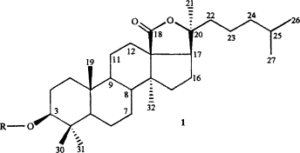
- Triterpenoid Saponins
General Triterpenoid Saponin Structure
 Mechanisms of Action
- Hemostatic effects: Saponins can cause protein precipitation and vasoconstriction
- Anti-inflammatory: Modulation of inflammatory mediators
- Antimicrobial: Membrane disruption in pathogens
Chemical Reaction (Protein precipitation for wound healing):
Saponin + Blood proteins → Saponin-protein complex (clot formation)
- Flavonoids
Compounds isolated from Aster species include quercetin and kaempferol.
Quercetin Structure
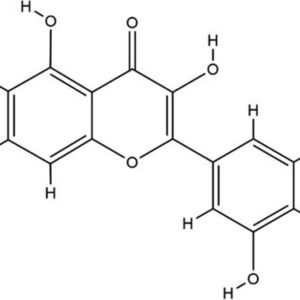 Mechanisms
- Antioxidant activity: Free radical scavenging
- Anti-inflammatory: COX and LOX enzyme inhibition
- Wound healing: Collagen synthesis promotion
Chemical Reaction (Antioxidant mechanism):
Quercetin-OH + R• → Quercetin-O• + RH
(Free radical neutralization)
- Phenolic Compounds
Phenolic compounds are among the most important phytochemicals in medicinal plants.
General Mechanism
- Astringent effects: Tannin-like protein precipitation
- Antimicrobial: Cell membrane disruption
- Hemostatic: Vasoconstriction and clotting promotion
Chemical Reaction (Astringent mechanism):
Phenolic-OH + Protein-NH2 → H-bonded complex
(Tissue tightening and bleeding control)
- Phenylpropanoids
Aster species contain phenylpropanoids including lignans.
Basic Phenylpropanoid Structure:
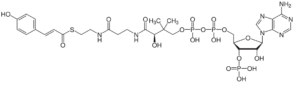 Mechanisms
- Antimicrobial: Cell wall disruption
- Anti-inflammatory: Enzyme inhibition
- Wound healing: Tissue repair promotion
Specific Mechanisms for Traditional Uses
Hemostatic (Bleeding Control) Activity
Active Components: Tannins, saponins, flavonoids
Mechanism:
- Vasoconstriction: Smooth muscle contraction in blood vessels
- Platelet aggregation: Enhanced clotting cascade
- Protein precipitation: Formation of protective barriers
Chemical Process:
Tannins + Damaged tissue proteins → Cross-linked protein matrix
(Physical barrier formation)
Anti-inflammatory Activity
Active Components: Flavonoids (quercetin, kaempferol), phenolic acids
Mechanism:
- Enzyme inhibition: COX-1, COX-2, and 5-LOX inhibition
- Cytokine modulation: Reduced IL-1β, TNF-α production
- Free radical scavenging: Oxidative stress reduction
Chemical Reaction:
Flavonoid + Cyclooxygenase → Flavonoid-enzyme complex (inactive)
Antimicrobial Activity
Active Components: Saponins, phenolic compounds, essential oils
Mechanism:
- Membrane disruption: Cholesterol interaction in bacterial membranes
- Protein denaturation: Disruption of cellular enzymes
- DNA binding: Interference with replication
Important Considerations
- Limited specific research on Symphyotrichum caespitosum phytochemistry
- Extrapolation from related species – biochemical data primarily from other Aster species
- No clinical validation of traditional uses
- Potential variability in bioactive compound concentrations based on geographic location and harvest time
Note: While traditional uses are documented, modern clinical studies validating the efficacy and safety of Tufted Prairie Aster for medicinal purposes are lacking. Traditional plant medicines should only be used under qualified guidance.
References
1) Elders and Community members of the Cayoose Creek Band of Sekw’el’was
2) United States Department of Agriculture, Natural Resources Conservation Service. (2006). White panicle aster (Symphyotrichum lanceolatum) – Plant Fact Sheet. USDA NRCS.
3) United States Department of Agriculture, Natural Resources Conservation Service. (2006). White heath aster (Symphyotrichum ericoides) — Plant Guide. USDA NRCS.
4) Shao, Y., Zhou, B. N., Lin, L. Z., & Cordell, G. A. (1995). Triterpene saponins from Aster yunnanensis. Phytochemistry, 38(6), 1487–1492. https://doi.org/10.1016/0031-9422(94)00794-T
5) Jan, R., Khan, M., Asaf, S., Lubna, Asif, S., & Kim, K.-M. (2022). Bioactivity and therapeutic potential of kaempferol and quercetin: New insights for plant and human health. Plants, 11(19), 2623. https://doi.org/10.3390/plants11192623
6) Marcińczyk, N., Gromotowicz-Popławska, A., Tomczyk, M., & Chabielska, E. (2022). Tannins as hemostasis modulators. Frontiers in Pharmacology, 12, 806891. https://doi.org/10.3389/fphar.2021.806891