29 Coyote Willow
Names
Common name – Coyote Willow
Scientific name – Salix exigua L.
Other names – Narrowleaf Willow, Sandbar Willow
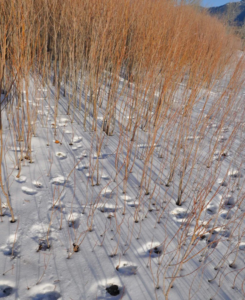
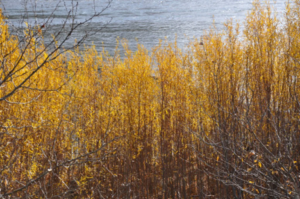
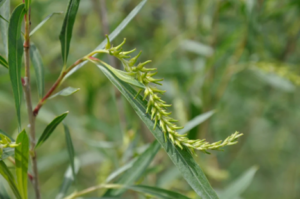
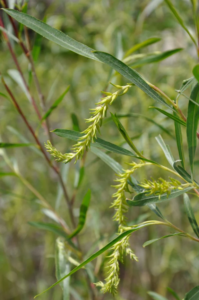
General Information
Coyote Willow (Salix exigua) represents one of the most significant contributions of Indigenous traditional medicine to modern pharmacology. The traditional use of willow bark by numerous North American Indigenous groups led directly to the development of aspirin, one of the world’s most important medications. The scientific validation of traditional uses demonstrates the profound botanical knowledge of Indigenous peoples and the importance of preserving traditional ecological knowledge.
Traditional Indigenous Uses
When coughs or sore throats lingered, the inner bark was stripped and boiled into a soothing tea. The same infusion could bring down fever, cooling the body. For pain of the muscles and bones, the people turned again to the bark and leaves. They made teas and poultices to draw pain away from aching joints and relieve headaches after long days of work or travel. Coyote Willow held importance for women’s health and the well-being of families. The bark was prepared to ease the discomfort of menstruation and to help women regain strength after childbirth.
Traditional Preparations
Bark Decoction (Most Common)
- Method: Inner bark stripped and boiled in water
- Ratio: Typically 1:10 (bark:water)
- Duration: Simmered 15-30 minutes
- Administration: Consumed as tea, 1-3 cups daily
Poultice Preparation
- Method: Fresh or dried bark pounded into paste
- Application: Applied directly to affected areas
- Usage: For external wounds and inflammation
Biochemical Basis of Medicinal Properties
Primary Bioactive Compounds
The medicinal properties of Salix exigua are primarily attributed to phenolic glycosides, particularly salicin and related salicinoids. These compounds represent the original source of modern aspirin.
Key Bioactive Compounds:
- Salicin (primary active compound)
- Populin (benzoyl salicin)
- Tremulacin
- Salicortin
- Fragilin
- Catechins and proanthocyanidins
- Flavonoids (quercetin derivatives)
Chemical Structures and Properties
Salicin Structure and Properties:
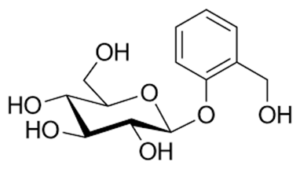
Molecular Formula: C₁₃H₁₈O₇
Molecular Weight: 286.28 g/mol
IUPAC Name: (2R,3S,4S,5R,6S)-2-(hydroxymethyl)-6-[2-(hydroxymethyl)phenoxy]oxane-3,4,5-triol
Salicylic Acid (Active Metabolite):
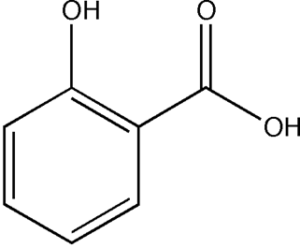
Molecular Formula: C₇H₆O₃
Molecular Weight: 138.12 g/mol
Biosynthetic Pathway
The biosynthesis of salicin follows the phenylpropanoid pathway:
Step 1: Phenylalanine → Cinnamic acid (PAL enzyme)
Step 2: Cinnamic acid → 2-Hydroxycinnamic acid
Step 3: 2-Hydroxycinnamic acid → Salicyl alcohol
Step 4: Salicyl alcohol + UDP-glucose → Salicin (via glucosyltransferase)
Pharmacological Mechanisms
- Anti-inflammatory Activity
Primary Mechanism: Cyclooxygenase (COX) inhibition
Arachidonic Acid + COX-1/COX-2 → PGG₂ → PGH₂ → Prostaglandins ↑ Salicylic acid (inhibits)
Molecular Target: COX enzymes
- COX-1 inhibition: Reduces baseline prostaglandin production
- COX-2 inhibition: Reduces inflammatory prostaglandin synthesis
- IC₅₀ values: COX-1 (~160 μM), COX-2 (~210 μM) for salicylic acid
- Analgesic (Pain Relief) Mechanism
Peripheral Action:
- Inhibition of prostaglandin E₂ (PGE₂) synthesis
- Reduced sensitization of pain receptors (nociceptors)
Central Action:
- Modulation of pain perception in spinal cord
- Possible interaction with endogenous opioid systems
- Antipyretic (Fever Reduction) Mechanism
Hypothalamic Action:
Infection/Inflammation → IL-1, TNF-α → PGE₂ synthesis in hypothalamus ↓ Set-point elevation (fever) ↑ Salicylic acid blocks PGE₂ synthesis
- Antiplatelet Activity
Mechanism: Irreversible acetylation of COX-1 in platelets
- Prevents thromboxane A₂ synthesis
- Reduces platelet aggregation
- Cardiovascular protective effects
Pharmacokinetics
- Absorption: Good oral bioavailability (~80-90%)
- Distribution: Widely distributed, crosses blood-brain barrier
- Metabolism: Hepatic conjugation (glucuronidation, glycine conjugation)
- Elimination: Renal excretion, half-life 2-15 hours (dose-dependent)
Safety and Toxicology
Contraindications:
- Aspirin allergy/sensitivity
- Bleeding disorders
- Pregnancy (third trimester)
- Children with viral infections (Reye’s syndrome risk)
Drug Interactions:
- Anticoagulants (warfarin)
- NSAIDs (additive effects)
- Methotrexate (reduced clearance)
Environmental and Sustainable Harvesting
Traditional Harvesting Practices:
- Timing: Early spring before leaf emergence
- Method: Selective bark stripping, not ring-barking
- Sustainability: Rotation systems, allowing regeneration
- Age selection: Mature branches, avoiding young growth
References
1) Elders and Community members of the Cayoose Creek Band of Sekw’el’was
2) Moerman, D. E. (1998). Native American ethnobotany. Timber Press.
3) Turner, N. J. (1998). Plant technology of First Peoples in British Columbia. Royal BC Museum.
4) Kindscher, K. (1992). Medicinal wild plants of the prairie: An ethnobotanical guide. University Press of Kansas.
5) Gilmore, M. R. (1977). Uses of plants by the Indians of the Missouri River region. University of Nebraska Press.
6) Turner, N. J. (1995). Food plants of coastal First Peoples. Royal BC Museum.
7) Nahrstedt, A., & Schmidt, M. (1995). The analysis of salicin in Salix species by HPLC. Phytochemical Analysis, 6(5), 251–254.
8) Shara, M., & Stohs, S. J. (2015). Efficacy and safety of white willow bark (Salix alba) extracts. Phytotherapy Research, 29(8), 1112–1116. https://doi.org/10.1002/ptr.5377
9) Pobłocka-Olech, L., Krauze-Baranowska, M., Głód, D., & Kawiak, A. (2010). Chromatographic analysis of simple phenols in some species from the genus Salix. Phytochemical Analysis, 21(5), 463–469. https://doi.org/10.1002/pca.1220
10) Julkunen-Tiitto, R. (1986). A chemotaxonomic survey of phenolics in leaves of northern Salix species. Phytochemistry, 25(3), 663–667. https://doi.org/10.1016/0031-9422(86)88020-7
11) Vlachojannis, C., Zimmermann, B. F., & Chrubasik-Hausmann, S. (2011). Quantification of salicin in willow bark tea: A comparison of HPLC and capillary electrophoresis. Phytotherapy Research, 25(8), 1185–1191.