28 Cow-Parsnip
Names
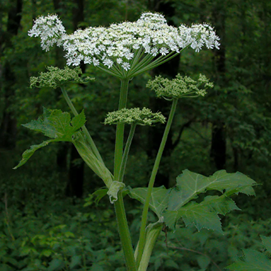
Common name – Cow-Parsnip
Scientific name – Heracleum nigrum
Other names – hákwa7
 Traditional Indigenous Uses
When the body ached or the feet swelled from long days of travel or work, they would dig the roots and make poultices to draw out the soreness. These same roots were dried and ground to make a soothing paste for bruises, sores, and inflamed skin.
For deeper pain, the kind that settled in the joints and bones, the roots were once again called upon. Ground finely and applied as a powder or mixed into warm water, they brought relief to those burdened by arthritis or body aches. When a cough lingered or the chest grew tight, the roots could be chewed raw or brewed into a tea to ease the lungs. Even the seeds and roots together helped the stomach, calming nausea, gas, and indigestion.
Biochemical Basis of Medicinal Properties
Primary Bioactive Compounds
The medicinal properties of Heracleum species are primarily attributed to their rich furanocoumarin content. These compounds belong to the phenylpropanoid biosynthetic pathway and exhibit diverse pharmacological activities.
Key Furanocoumarins Identified:
- Bergapten (5-methoxypsoralen)
- Isopimpinellin (5,8-dimethoxypsoralen)
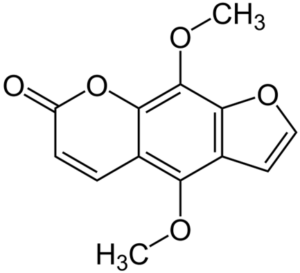
- Xanthotoxin (8-methoxypsoralen)
- Imperatorin
- Phellopterin
- Byakangelicol
Chemical Structures and Molecular Mechanisms
Basic Furanocoumarin Structure:
Coumarin backbone: C₆H₄-2-O-CO-CH=CH-
Furan ring fusion creates two main types:
- Linear furanocoumarins (psoralens)
- Angular furanocoumarins (angelicins)
Bergapten (5-methoxypsoralen) Structure:
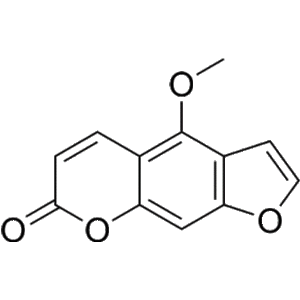 Molecular Formula: C₁₂H₈O₄ MW: 216.19 g/mol
Pharmacological Mechanisms
- Anti-inflammatory Activity
Mechanism: Inhibition of cyclooxygenase (COX) and lipoxygenase (LOX) pathways
- Bergapten inhibits COX-2 expression
- Reduces pro-inflammatory cytokines (TNF-α, IL-1β, IL-6)
- Modulates NF-κB signaling pathway
- Antimicrobial Properties
Mechanism: Multiple targets
- Cell membrane disruption
- DNA intercalation and crosslinking (under UV activation)
- Inhibition of essential enzymes
- Protein synthesis interference
- Photochemotherapy
Mechanism: DNA interaction
- Furanocoumarins intercalate between DNA base pairs
- UV-A activation creates covalent DNA adducts
- Forms interstrand crosslinks
- Used therapeutically in PUVA treatment for psoriasis and vitiligo
- Analgesic Effects
Proposed mechanisms:
- Anti-inflammatory reduction of prostaglandin synthesis
- Possible interaction with pain receptors
- Modulation of nerve signal transmission
Chemical Reactions
DNA Intercalation Reaction (Photochemical):
Furanocoumarin + DNA → Intercalated complex ↓ UV-A (320-400 nm) Covalent DNA adducts + Crosslinks
Cyclooxygenase Inhibition:
Arachidonic acid + COX-2 → Prostaglandins (inflammation) ↑ Bergapten (inhibits)
Safety Considerations
Phototoxicity Warning: All Heracleum species contain phototoxic furanocoumarins that can cause severe burns when skin is exposed to sunlight after plant contact. Traditional preparation methods likely included specific protocols to minimize these risks.
References
- Elders and Community members of the Cayoose Creek Band of Sekw’el’was
- Kuhnlein, H. V., & Turner, N. J. (1991). Traditional plant foods of Canadian Indigenous peoples: Nutrition, botany and use. Gordon and Breach Science Publishers.
- Turner, N. J. (1995). Food plants of coastal First Peoples. Royal BC Museum.
- Moerman, D. E. (1998). Native American ethnobotany. Timber Press.
- Pojar, J., & MacKinnon, A. (2016). Plants of coastal British Columbia: Including Washington, Oregon and Alaska (Rev. ed.). Lone Pine Publishing.
- Felter, H. W., & Lloyd, J. U. (1898). King’s American dispensatory (18th ed., 3rd rev.). Ohio Valley Co.
- Bahadori, M. B., Dinparast, L., & Zengin, G. (2016). The genus Heracleum: A comprehensive review on its phytochemistry, pharmacology, and ethnobotanical values as a useful herb. Comprehensive Reviews in Food Science and Food Safety, 15(6), 1018–1039. https://doi.org/10.1111/1541-4337.12222
- Ojala, T., Remes, S., Haansuu, P., Vuorela, H., Hiltunen, R., Haahtela, K., & Vuorela, P. (2000). Antimicrobial activity of some coumarin-containing herbal plants growing in Finland. Journal of Ethnopharmacology, 73(1–2), 299–305. https://doi.org/10.1016/S0378-8741(00)00279-8
- Pathak, M. A., & Fitzpatrick, T. B. (1992). The evolution of photochemotherapy with psoralens and UVA (PUVA): 2000 BC to 1992 AD. Journal of Photochemistry and Photobiology B: Biology, 14(1–2), 3–22. https://doi.org/10.1016/1011-1344(92)85080-E
- Innocenti, G., Dall’Acqua, S., Minesso, P., Budriesi, R., Micucci, M., Chiarini, A., & Carrara, M. (2010). Biological activity and phytochemical investigation of Heracleum sphondylium L. ssp. elegans. Natural Product Communications, 5(9), 1443–1448.
- Céspedes, C. L., Avila, J. G., Martínez, A., Serrato, B., Calderón-Mugica, J. C., & Salgado-Garciglia, R. (2006). Antifungal and antibacterial activities of Mexican tarragon (Tagetes lucida). Journal of Agricultural and Food Chemistry, 54(10), 3521–3527. https://doi.org/10.1021/jf053071w