30 Cut-leaf Anemone
Names
Common name – Cut-leaf Anemone
Scientific name – Anemone multifida Poir
Other names – Cut-leaf Wind-flower
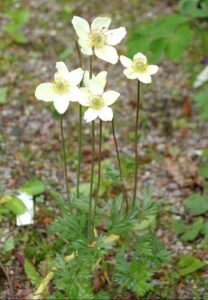
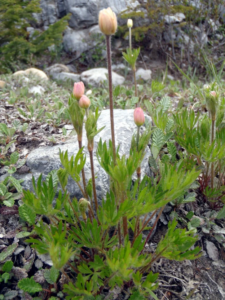
General information:
Cut-leaf Anemone represents a complex example of traditional medicine where Indigenous knowledge systems developed sophisticated protocols to safely utilize a potentially toxic plant. The biochemical understanding of ranunculin → protoanemonin → anemonin transformations validates traditional processing methods, particularly the emphasis on drying and careful preparation. Modern research confirms both the therapeutic potential and the toxicological concerns that Indigenous healers understood through generations of careful observation and use.
Traditional Medicinal Uses by Indigenous Peoples
Historical Context and Cautions
Cut-leaf Anemone belongs to the Ranunculaceae family, which is noted for its combination of poison and medicine. Many members are simply poisonous, and most of the medicinal members possess toxicity in larger doses. Traditional use required extensive knowledge of proper preparation and dosing.
Traditional Indigenous Uses
The plant’s dried leaves and roots were gathered when its energy had settled, never fresh, for the living plant could burn the skin and cause harm. Once properly dried, it became a powerful medicine. For coughs and congestion of the lungs, small amounts of the aerial parts or roots were steeped into a tea, bringing warmth to the chest and clearing the breath.
The dried roots, prepared as a poultice or decoction, it eased the pain of arthritis and rheumatism. Its roots, though strong, carried medicine that reached deep into the muscles and bones. The same dried leaves could be applied to sores or wounds, drawing out infection and calming inflamed skin. The Elder described this as “pulling out the heat”, a way of restoring balance to what had become angry or unsettled within the body.
CRITICAL SAFETY NOTE: All parts of the cutleaf anemone plant are mildly toxic when eaten raw. Damaged cutleaf anemone plants release protoanemonin, causing blisters, rashes, and itching on contact
Traditional Processing Methods
Detoxification Process:
- Drying: Plant material must be thoroughly dried to reduce toxicity
- Heat treatment: Some preparations involved brief boiling to denature harmful compounds
- Dilution: Always used in very small quantities with other herbs
- Seasonal timing: Harvested at specific times when toxicity is lowest
Biochemical Basis of Medicinal Properties
Primary Bioactive Compounds
Anemone contains ranunculin, anemonin, and protoanemonin, which are characteristic constituents of Pulsatilla and illustrate the close relationship between these two genera. Anemone also contains coumarins and flavonoids
Key Bioactive Compounds:
- Ranunculin (glycoside precursor)
- Protoanemonin (active irritant compound)
- Anemonin (dimeric form)
- Triterpenoid saponins
- Coumarins
- Flavonoids
- Oleanolic acid derivatives
Chemical Structures and Transformations
Ranunculin Structure:

Molecular Formula: C₁₂H₁₆O₉
IUPAC Name: (1S,4aR,7S,7aS)-1-hydroxy-7-methyl-1,4a,5,6,7,7a-hexahydrocyclopenta[c]pyran-4-carboxylic acid β-D-glucopyranoside
Protoanemonin Structure:
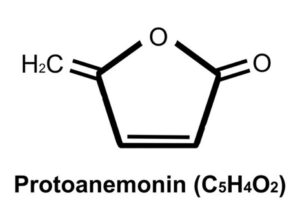
Molecular Formula: C₅H₄O₂
Molecular Weight: 96.08 g/mol
IUPAC Name: 4-methylenetetrahydrofuran-2-one
Anemonin Structure:
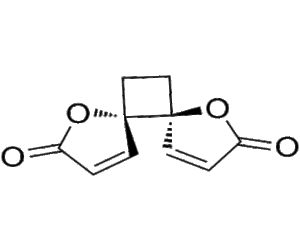
Molecular Formula: C₁₀H₈O₄
Molecular Weight: 192.17 g/mol
Biochemical Transformation Pathway
When these plants are damaged, an enzyme β−glucosidase triggers the conversion of ranunculin into protoanemonin through hydrolysis. Subsequently, protoanemonin undergoes cyclodimerization to form anemonin
Enzymatic Conversion Process:
Step 1: Plant tissue damage activates β-glucosidase
Ranunculin + H₂O → Glucose + γ-hydroxy-α,β-butenoic acid γ-lactone ↓ (spontaneous cyclization) Protoanemonin
Step 2: Spontaneous dimerization
2 Protoanemonin → Anemonin (stable dimer)
Complete Reaction Sequence:
Ranunculin (C₁₂H₁₆O₉) –β-glucosidase–> Protoanemonin (C₅H₄O₂) –dimerization–> Anemonin (C₁₀H₈O₄)
(stable) (unstable, irritant) (stable, less toxic)
Pharmacological Mechanisms
- Anti-inflammatory Activity
Primary Mechanism: anemonin stands out as the optimal molecule for bioassays and demonstrates diverse biological properties, including anti-inflammatory, anti-infective, and anti-ox
Molecular Targets:
- Inhibition of pro-inflammatory cytokines (TNF-α, IL-1β, IL-6)
- Modulation of NF-κB signaling pathway
- Reduction of prostaglandin synthesis
- Antimicrobial Properties
Mechanism: Multiple antimicrobial pathways
- Cell membrane disruption
- Protein denaturation
- Enzyme inactivation through sulfhydryl group binding
Protoanemonin is stated to have a marked ability to combine with sulfhydryl (-SH) groups and it is thought that the toxic subdermal properties of protoanemonin may depend on the inactivation of enzymes containing -SH groups
- Toxicological Mechanisms
Irritant Properties:
- Protoanemonin is an irritant oil glycoside that is not readily absorbed from the gastrointestinal tract or metabolized in it, with the result that irritation is likely to occur in the oral cavity and throughout the gastrointestinal tract
- Contact dermatitis through protein alkylation
- Vesicant (blister-forming) properties
Saponin Components
Oleanolic acid triterpene saponin is abundant in Anemone species
Traditional vs. Modern Safety Understanding
Traditional Safety Protocols:
- Never used fresh – always dried thoroughly
- Minimal quantities – used in tiny amounts
- Combined with other herbs – never used alone
- External use preferred – limited internal applications
- Seasonal restrictions – not harvested during peak toxicity periods
Modern Toxicological Data:
- An LD₅₀ value (mice, intraperitoneal injection) for anemonin has been reported as 150 mg/kg body weight
- Fresh plant material significantly more toxic than dried
- Ingesting small quantities of cutleaf anemone results in mild symptoms and is unlikely to cause serious illness
Conservation and Ethical Considerations
Sustainable Practices:
- Limited harvesting due to toxicity concerns
- Focus on cultivated sources for research
- Protection of wild populations
- Respect for Indigenous knowledge systems
References
- Elders and Community members of the Cayoose Creek Band of Sekw’el’was
- Hao, D.-C., Gu, X., & Xiao, P.-G. (2017). Anemone medicinal plants: Ethnopharmacology, phytochemistry and biology. Acta Pharmaceutica Sinica B, 7(2), 146–158. https://doi.org/10.1016/j.apsb.2016.12.001
- Wichtl, M. (Ed.). (1994). Herbal drugs and phytopharmaceuticals: A handbook for practice on a scientific basis (N. G. Bisset, Trans.). CRC Press/Medpharm Scientific Publishers.
- Hill, R. A., & Connolly, J. D. (2017). Triterpenoids. Natural Product Reports, 34(1), 90–122. https://doi.org/10.1039/C6NP00094K
- Yeşilada, E., & Küpeli, E. (2007). Clematis vitalba L. aerial part exhibits potent anti-inflammatory, antinociceptive and antipyretic effects. Journal of Ethnopharmacology, 110(3), 504–515. https://doi.org/10.1016/j.jep.2006.10.016
- Shikov, A. N., Pozharitskaya, O. N., Makarov, V. G., Wagner, H., Verpoorte, R., & Heinrich, M. (2014). Medicinal plants of the Russian Pharmacopoeia; their history and applications. Journal of Ethnopharmacology, 154(3), 481–536. https://doi.org/10.1016/j.jep.2014.04.007