40 Kinnikinnick
Names
Common name – Kinnikinnick
Scientific name – Arctostaphylos uva-ursi
Other names – kemús , bearberry
General Information
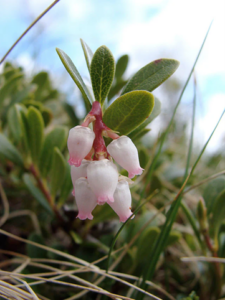
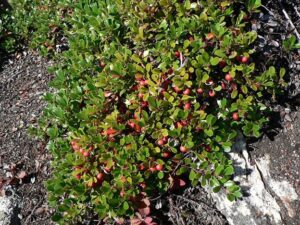
Kinnikinnick (Arctostaphylos uva-ursi), also known as bearberry, is a low-growing, evergreen shrub in the heath family (Ericaceae) that forms extensive mats across circumboreal regions of the Northern Hemisphere. This hardy plant typically grows 5-30 cm (2-12 inches) in height with a spreading habit that can extend several feet wide, featuring small, leathery, spatulate leaves that are bright green and glossy. The plant produces small, white to pink, urn-shaped flowers in terminal clusters from May to July, followed by bright red, berry-like drupes that persist through winter. The name “kinnikinnick” derives from the Unami Delaware word meaning “smoking mixture,” while “uva-ursi” means “grape of the bear” in Latin, reflecting its importance to both humans and wildlife. Native to acidic, sandy, or rocky soils in open woodlands, slopes, and alpine areas, kinnikinnick ranges from northern California to Alaska and across Canada to Newfoundland, extending south through the Rocky Mountains to New Mexico and in the Appalachians to Virginia. This exceptionally hardy plant thrives in poor soils and harsh conditions where few other plants can survive, making it an important medicinal resource for Indigenous peoples across its vast range.
Traditional Indigenous Uses
Its small, leathery leaves carried great healing power. When brewed into tea, they were used to cleanse the bladder and kidneys, easing the pain of urinary troubles such as stones. A stronger tea helped break down gravel in the kidneys, while lighter infusions acted as a gentle diuretic to remove excess water from the body. The same leaves, when taken as a mild tea, also soothed the stomach and helped calm diarrhea, supporting the digestive system in times of distress.
The leaves could be dried and smoked, either alone or mixed with other plants, as part of both ceremonial and social gatherings. The leaves were also steeped to create washes for external use, cleansing wounds, cuts, and skin infections, or easing pain from arthritis and sore muscles. A warm tea made from the plant was used to reduce fever and to open the chest for those struggling with coughs and bronchitis.
The berries, though small, were a nourishing food, eaten fresh or dried to restore strength and provide vitamins. Women often relied on Kinnikinnick for postpartum healing; a tea or gentle wash made from its leaves helped to reduce bleeding and prevent infection. The plant also provided care for the eyes, with a light infusion used to soothe irritation and inflammation.
Biochemical Compounds and Their Medicinal Properties
- Phenolic Glycosides (Primary Bioactive Compounds)
Three Most Important Compounds:
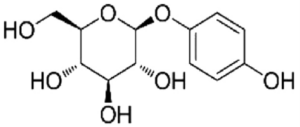
(i) Arbutin (C₁₂H₁₆O₇) – Major active glycoside (5-20% of leaf weight)
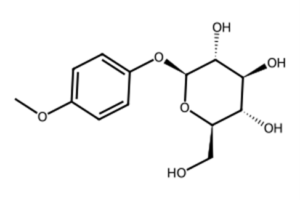
(ii) Methylarbutin (C₁₃H₁₈O₇) – Arbutin derivative
(iii) Hydroquinone (C₆H₆O₂) – Active metabolite of arbutin
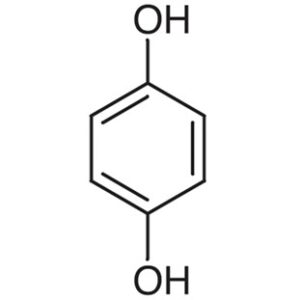
Medicinal Properties
- Antiseptic: Potent urinary tract antiseptic activity
- Astringent: Tissue-tightening and anti-inflammatory effects
- Diuretic: Increases urine production and flow
- Antimicrobial: Broad-spectrum antibacterial activity
- Tannins and Polyphenols (Supporting Compounds)
Three Most Important Compounds:
(i) Gallic Acid (C₇H₆O₅) – Hydrolysable tannin precursor
(ii) Ellagic Acid (C₁₄H₆O₈) – Polyphenolic compound
(iii) Catechin (C₁₅H₁₄O₆) – Flavanol tannins
3. Triterpenes and Sterols
Most Important Compound:
Ursolic Acid (C₃₀H₄₈O₃) – Pentacyclic triterpene
Proposed Biochemical Mechanisms for Traditional Uses
Urinary Tract Antiseptic Action (Arbutin/Hydroquinone System)
- Arbutin metabolism pathway:
- Oral arbutin → Intestinal absorption → Hepatic glucuronidation
- Urinary excretion → Alkaline urine hydrolysis → Free hydroquinone release
- Hydroquinone → Direct antimicrobial activity in urinary tract
- Antimicrobial mechanism:
- Hydroquinone → Bacterial membrane disruption
- Oxidative stress induction in pathogens
- Inhibition of bacterial enzyme systems
Astringent and Anti-inflammatory Effects (Tannins)
- Protein precipitation mechanism:
- Tannins → Protein binding → Tissue contraction
- Reduced capillary permeability → Decreased inflammation
- Enhanced wound healing through tissue tightening
- Antioxidant protection:
- Polyphenols → Free radical scavenging
- Cellular membrane protection
- Reduced oxidative tissue damage
Diuretic Action (Multiple Compounds)
Kidney function enhancement:
-
- Flavonoids → Improved renal blood flow
- Enhanced glomerular filtration
- Increased sodium and water excretion
Chemical Reactions and Molecular Interactions
Arbutin Activation Mechanism
Arbutin (in alkaline urine) → β-glucosidase → Hydroquinone + Glucose → Hydroquinone → Bacterial membrane interaction → Cell death
Arbutin → Hepatic glucuronidation → Arbutin glucuronide → Urinary excretion → Alkaline hydrolysis → Active hydroquinone
Antimicrobial Action (Hydroquinone)
Hydroquinone → Bacterial quinone reduction → Reactive oxygen species → DNA damage + Membrane lipid peroxidation → Bacterial death
Hydroquinone + O₂ → Benzoquinone + H₂O₂ → Oxidative stress → Microbial enzyme inactivation
Anti-inflammatory Mechanism (Polyphenols)
Tannins → Protein cross-linking → Tissue astringency → Reduced capillary permeability → Decreased inflammatory exudate
Ellagic acid → NF-κB pathway inhibition → ↓ Pro-inflammatory cytokines → Reduced tissue inflammation → Pain relief
Diuretic Mechanism (Flavonoids + Triterpenes)
Quercetin derivatives → Renal vasodilation → ↑ Glomerular filtration → Enhanced urine production → Increased toxin elimination
Ursolic acid → Na⁺-K⁺-ATPase modulation → Altered electrolyte balance → Increased sodium excretion → Diuretic effect
Wound Healing Acceleration (Multiple Compounds)
Tannins → Protein precipitation → Hemostasis + Tissue protection → Bacterial growth inhibition → Clean wound environment
Triterpenes → Collagen synthesis stimulation → Enhanced tissue repair → Improved wound tensile strength → Faster healing
Traditional Preparation Methods and Biochemical Optimization
Leaf Tea Preparation (Primary Traditional Method)
- Hot water extraction: Optimizes arbutin and tannin extraction
- Alkaline conditions: Natural alkalinity of some waters enhances arbutin hydrolysis
- Dosage timing: Traditional use emphasizes consumption with alkaline foods
Smoking Mixture Preparation
Traditional kinnikinnick smoking blends combine bearberry leaves with other herbs:
- Drying process: Preserves active compounds while reducing harshness
- Ceremonial context: Respiratory benefits combined with spiritual practices
- Blend ratios: Traditional knowledge optimizes therapeutic and palatability factors
Cultural and Spiritual Significance
Sacred and Social Uses
Kinnikinnick is a Native American and First Nations herbal smoking mixture made from traditional combinations of leaves or barks, with recipes varying for social, spiritual, and medicinal uses.
Traditional Ecological Knowledge
Indigenous practices emphasize:
- Sustainable harvesting: Collecting leaves without damaging the slow-growing plants
- Seasonal timing: Optimal collection periods for maximum potency
- Habitat respect: Understanding kinnikinnick’s ecological relationships
Safety Considerations and Traditional Wisdom
- Alkaline urine requirement: Traditional knowledge recognizes that effectiveness depends on urine pH
- Duration limitations: Traditional use typically limited to short-term treatments
- Preparation standards: Proper drying and storage methods preserve safety and efficacy
References
1) Elders and Community members of the Cayoose Creek Band of Sekw’el’was
2) University of Alaska Fairbanks, Alaska Native Knowledge Network. (n.d.). Uva-ursi or kinnikinnick. In Alaska’s Wilderness Medicines. http://www.ankn.uaf.edu/curriculum/books/Viereck/viereckuva.html
3) García de Arriba, S., Naser, B., & Nolte, K.-U. (2013). Risk assessment of free hydroquinone derived from Arctostaphylos uva-ursi folium herbal preparations. International Journal of Toxicology, 32(6), 442–453. https://doi.org/10.1177/1091581813507721
4) Sugier, P., Sęczyk, Ł., Sugier, D., Krawczyk, R., Wójcik, M., Czarnecka, J., Okoń, S., & Plak, A. (2021). Chemical characteristics and antioxidant activity of Arctostaphylos uva-ursi L. Spreng. at the southern border of the geographical range of the species in Europe. Molecules, 26(24), 7692. https://doi.org/10.3390/molecules26247692
5) (n.d.). Information on medicinal applications of kinnikinnick (Arctostaphylos uva-ursi) for patients and consumers. https://www.medizzine.com/en/plants/kinnikinnick.php
6) Pith and Vigor. (2024, September 22). Arctostaphylos uva-ursi – kinnikinnik: Medicinal secrets of bearberry. https://pithandvigor.com/2024/09/arctostaphylos-uva-ursi-kinnikinnik-bearberry/
7) (n.d.). Arctostaphylos uva-ursi — an overview. https://www.sciencedirect.com/topics/agricultural-and-biological-sciences/arctostaphylos-uva-ursi
8) S. Department of Agriculture, Forest Service. (n.d.). Arctostaphylos uva-ursi. Fire Effects Information System. https://www.fs.usda.gov/database/feis/plants/shrub/arcuva/all.html
9) Washington Native Plant Society. (n.d.). Arctostaphylos uva-ursi. https://www.wnps.org/native-plant-directory/43:arctostaphylos-uva-ursi
10) Wikipedia contributors. (2025, July 16). Arctostaphylos uva-ursi. Wikipedia. https://en.wikipedia.org/wiki/Arctostaphylos_uva-ursi
11) Wikipedia contributors. (2025, July 28). Kinnikinnick. Wikipedia. https://en.wikipedia.org/wiki/Kinnikinnick