43 Lemonweed
Names
Common name – Lemonweed
Scientific name – Lithospermum ruderale
Other names – Western stoneseed or Western gromwell
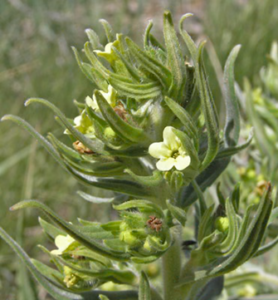
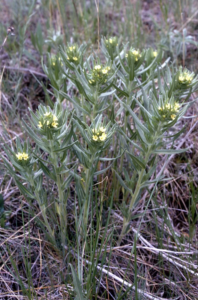
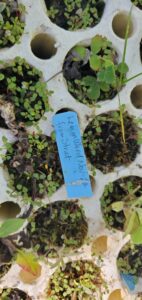
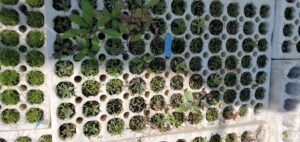
General information
Lemonweed (Lithospermum ruderale), also known as western stoneseed or western gromwell, is a perennial herbaceous flowering plant in the borage family (Boraginaceae) native to western North America. This hardy plant grows from a deep taproot and woody caudex, reaching heights of 20-50 cm (8-20 inches), with a distinctive covering of fine, stiff, upright hairs that can feel prickly or like slivers when touched. The plant produces clusters of erect leafy stems supporting lance-shaped leaves ranging from 2.5-10 cm (1-4 inches) in length. Lemonweed is easily recognized by its light yellow to greenish-yellow tubular flowers that bloom from May to August and its characteristic hard, white, shiny seeds, typically four per flower, that resemble tiny stones, giving rise to the name “stoneseed.” Lemonweed thrives in diverse habitats including prairies, open woodlands, sagebrush steppes, rocky slopes, and disturbed areas at various elevations. Indigenous peoples across its range have traditionally recognized this plant for its medicinal properties, particularly for women’s reproductive health, respiratory ailments, and as a contraceptive agent.
Traditional Indigenous Uses
Lemonweed is known as a powerful and respected medicine. Its roots were used especially by women to bring balance to the body. When brewed as a cold water infusion, the roots served as a natural contraceptive, supporting family planning and reproductive autonomy. A warm tea from the same roots was used to regulate menstruation and restore fertility when needed.
The plant also offered relief for those suffering from lung ailments. A hot decoction of the roots was prepared to ease coughing, bronchitis, and breathing difficulties. For pain in the joints, rheumatism, or arthritis, the infusion could be taken internally or applied directly to the body to calm inflammation. As a diuretic, Lemonweed tea helped the kidneys release excess water and supported the cleansing of the body.
Elders taught that Lemonweed’s gentle teas could reduce fevers and settle the stomach, aiding digestion and relieving constipation. The plant also served as an important remedy for wounds and burns — both the roots and leaves were used in poultices or washes to clean and heal the skin. A decoction of the whole plant acted as an astringent to stop bleeding and close wounds.
Beyond its physical benefits, Lemonweed was regarded as a tonic that promoted general health and vitality. Regular use was believed to protect against illness, slow aging, and even help prevent tumors and cancers. The seeds, too, held ceremonial significance and were used in spiritual practices for protection and strength.
Biochemical Compounds and Their Medicinal Properties
- Naphthoquinones (Primary Bioactive Compounds)
Three Most Important Compounds:
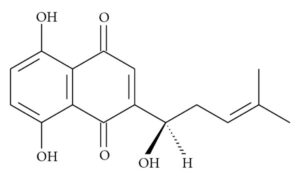
(i) Shikonin (C₁₆H₁₆O₅) – Major red pigment naphthoquinone
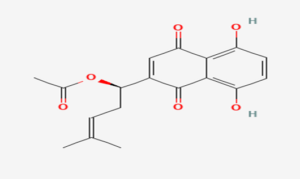
(ii) Acetylshikonin (C₁₈H₁₈O₆) – Shikonin derivative
(iii) Alkannin (C₁₆H₁₆O₅) – Shikonin enantiomer
Mirror image of shikonin
Medicinal Properties
- Anti-inflammatory: Potent inhibition of inflammatory pathways
- Antimicrobial: Broad-spectrum antibacterial and antifungal activity
- Wound healing: Enhances tissue regeneration and collagen synthesis
- Anticancer: Induces apoptosis in tumor cells
- Pyrrolizidine Alkaloids (Supporting Compounds)
Three Most Important Compounds:
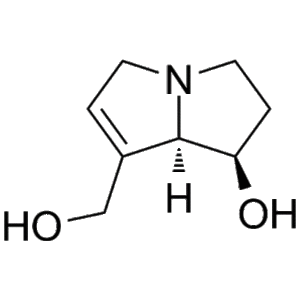
(i) Canescine (Representative structure C₁₅H₂₅NO₆)
(ii) Canescenine (Pyrrolizidine derivative)
(iii) Retronecine derivatives
- Phenolic Compounds and Flavonoids
Most Important Compound:
Rosmarinic Acid (C₁₈H₁₆O₈) – Caffeic acid ester
Proposed Biochemical Mechanisms for Traditional Uses
Contraceptive Action (Root Preparations)
- Pyrrolizidine alkaloids act through:
- Disruption of pituitary gonadotropin secretion
- Interference with estrogen receptor binding
- Modulation of reproductive hormone synthesis
- Naphthoquinones contribute:
- Antiestrogenic effects on reproductive tissues
- Modulation of uterine contractility
- Interference with implantation processes
Anti-inflammatory and Wound Healing (Topical/Internal Use)
- Shikonin and derivatives provide:
- Nuclear factor-κB (NF-κB) pathway inhibition
- Cyclooxygenase (COX) enzyme suppression
- Enhanced collagen synthesis and tissue repair
- Rosmarinic acid contributes:
- Direct free radical scavenging
- Anti-inflammatory mediator reduction
- Antimicrobial protection of wounds
Respiratory Support (Root Decoctions)
- Naphthoquinones act as:
- Bronchodilators relaxing airway smooth muscle
- Anti-inflammatory agents in respiratory tract
- Antimicrobial compounds against respiratory pathogens
- Alkaloid compounds provide:
- Expectorant effects promoting mucus clearance
- Smooth muscle relaxation in airways
- Enhanced respiratory function
Chemical Reactions and Molecular Interactions
Anti-inflammatory Mechanism (Shikonin)
Shikonin → NF-κB pathway inhibition → ↓ IκB degradation → Reduced nuclear translocation → ↓ Pro-inflammatory gene expression
Shikonin → COX-2 enzyme inhibition → ↓ Prostaglandin E₂ synthesis → Reduced inflammation and pain signaling
Antimicrobial Action (Naphthoquinones)
Shikonin → Bacterial membrane disruption → Increased permeability → ATP leakage + Enzyme inactivation → Cell death
Naphthoquinones → Reactive oxygen species generation → Oxidative stress → DNA damage + Protein oxidation → Microbial death
Wound Healing Mechanism (Multiple Compounds)
Shikonin → Fibroblast proliferation ↑ → Enhanced collagen synthesis → Improved tissue tensile strength → Faster healing
Naphthoquinones → VEGF expression ↑ → Enhanced angiogenesis → Improved blood supply → Accelerated wound closure
Anticancer Activity (Shikonin derivatives)
Shikonin → Mitochondrial dysfunction → ↑ ROS production → Cytochrome c release → Caspase activation → Apoptosis
Acetylshikonin → Cell cycle arrest → G1/S phase blockade → Inhibited tumor cell proliferation → Growth suppression
Contraceptive Mechanism (Alkaloids)
Pyrrolizidine alkaloids → Pituitary hormone disruption → ↓ FSH/LH release → Reduced ovarian stimulation → Impaired ovulation
Alkaloids → Estrogen receptor modulation → Altered uterine receptivity → Reduced implantation success → Contraceptive effect
Safety Considerations and Traditional Wisdom
Pyrrolizidine Alkaloid Caution
Traditional preparation methods emphasize safety:
- Limited duration: Traditional use typically short-term
- Proper preparation: Cold water infusions may reduce alkaloid extraction
- Dosage control: Traditional knowledge emphasizes appropriate amounts
- Liver health: Awareness of potential hepatotoxicity with prolonged use
Contraceptive Use Considerations
Indigenous knowledge includes important protocols:
- Careful dosing: Traditional recipes carefully measured
- Timing specificity: Use aligned with reproductive cycles
- Reversibility: Understanding of temporary effects
- Individual variation: Recognition of different responses
Cultural and Historical Significance
Reproductive Autonomy
Lemonweed represents Indigenous women’s traditional control over fertility:
- Family planning: Traditional methods of birth spacing
- Cultural knowledge: Women-centered botanical wisdom
- Sustainable practices: Plant-based reproductive health management
- Intergenerational teaching: Mother-to-daughter knowledge transmission
Traditional Ecological Knowledge
Indigenous practices emphasize:
- Sustainable harvesting: Careful root collection preserving populations
- Habitat recognition: Understanding optimal growing conditions
- Seasonal timing: Optimal collection periods for potency
- Respectful gathering: Spiritual and ecological protocols
References
1) Elders and Community members of the Cayoose Creek Band of Sekw’el’was
2) (2024, April 17). 5 medicinal health benefits of Lithospermum ruderale (Western stoneseed). https://agric4profits.com/5-medicinal-health-benefits-of-lithospermum-ruderale-western-stoneseed/
3) Frontiers in Pharmacology. (2022, May 30). Review of shikonin and derivatives: Isolation, chemistry, biosynthesis, pharmacology and toxicology. Frontiers in Pharmacology, 13, 905755. https://doi.org/10.3389/fphar.2022.905755
4) (2025). Lemonweed (Lithospermum ruderale). https://www.inaturalist.org/guide_taxa/618506
5) (2025). Western stoneseed (Lithospermum ruderale). https://www.inaturalist.org/taxa/77795-Lithospermum-ruderale
6) Natural Medicinal Herbs. (2025). Western gromwell (Lithospermum ruderale). https://www.naturalmedicinalherbs.net/herbs/l/lithospermum-ruderale=western-gromwell.php
7) Planet Ayurveda. (2024, May 4). What are the uses and health benefits of Western stoneseed (Lithospermum ruderale)? https://www.planetayurveda.com/western-stoneseed-lithospermum-ruderale/
8) PubMed Central. (2022, October 12). Cell-specific production and antimicrobial activity of naphthoquinones in roots of Lithospermum erythrorhizon. Frontiers in Plant Science, 12, 732117. https://doi.org/10.3389/fpls.2021.732117
9) (2006). The shikonin derivatives and pyrrolizidine alkaloids in hairy root cultures of Lithospermum canescens. Plant Cell Reports, 25(7), 653–659. https://doi.org/10.1007/s00299-006-0128-2
10) (2025). Lithospermum – an overview. In Pharmacology, toxicology and pharmaceutical science. https://www.sciencedirect.com/topics/pharmacology-toxicology-and-pharmaceutical-science/lithospermum
11) Splitrock Environmental. (2025). https://splitrockenvironmental.ca/products/lemonweed
12) (2025, April 8). Lithospermum: In-depth guide of health benefits, active compounds, properties, and uses. https://vitalibrary.com/lithospermum-herbal-benefits-guide/
13) (2025, July 18). Lithospermum ruderale. https://en.wikipedia.org/wiki/Lithospermum_ruderale