47 Nodding Onion
Names
Common Name – Nodding Onion
Scientific Name: Allium cernuum
Other Names: kwela’waúl; Lady’s Leek
General Information
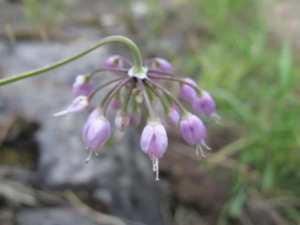
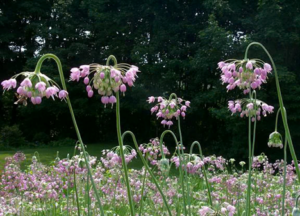
Nodding Onion (Allium cernuum) is a perennial wild onion in the amaryllis family (Amaryllidaceae, formerly Liliaceae) native to North America. This delicate herbaceous plant grows 8-24 inches tall from small, elongated bulbs, producing slender, grass-like leaves that emanate a distinctive onion scent when crushed. The plant is named for its characteristic drooping (nodding) umbels of small, bell-shaped flowers that range from white to various shades of pink and purple, blooming from June through August. Each flower cluster contains 10-40 individual flowers held on a gracefully curved scape, creating an attractive display. Like all members of the Allium genus, nodding onion contains characteristic sulfur compounds that give it its pungent aroma and flavor.
The bulbs of the nodding onion have long been consumed as a food source, either on their own or to flavor other foods. They also act as preserving agents making them valuable for times when food is not abundant.
Like many other onion and garlic species, nodding onions contain phenolic compounds, including flavonoids, non-structural carbohydrates, enzymes, vitamins and minerals such as selenium. All of these constituents provide health benefits, particularly for bone health and digestion. There has been some research to suggest that nodding onions may also have anti-cancer properties, however more research is required to make any conclusions in that regard.
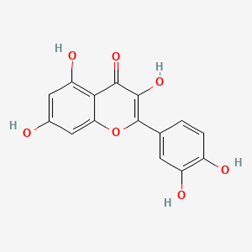 Polyphenols such as quercetin (structure shown above) function as antioxidants as well as reducing inflammation markers and inducing apoptosis in cancer cells. Other noted effects and benefits include improving cardiovascular health, decreasing cholesterol, regulating blood pressure and reducing the risk of diabetes.
Traditional Indigenous Uses
The Elders spoke of Nodding Onion as a plant of many strengths, a medicine that served the people well through the seasons. Its bulbs were known to bring relief to those suffering from chest ailments; when pounded into a poultice and placed on the chest, they helped ease croup, colds, and deep coughs. When boiled into a tea or decoction, the bulbs were taken to reduce fevers and bring comfort to those weakened by illness. The same infusion could be used to calm the stomach, soothing cramps and easing colic in small children. The fresh juice of the plant was held in special regard – it was taken to break down kidney stones, cleanse the body of excess water, and ease troubles of the urinary tract. When used as a gargle, that same juice soothed sore throats and quieted the pain of tonsillitis or pharyngitis.
For chest congestion and bronchitis, the people would dry the plant for later use, softening it again with water to make a warm poultice that opened the lungs. The bulbs and leaves could also be crushed into a healing poultice for wounds and skin infections, while teas made from the bulbs supported digestion, easing indigestion and relieving gas or diarrhea. In the colder months, Nodding Onion was often prepared in various ways to ward off the chills of influenza and the common cold. The plant’s diuretic and cleansing qualities made it valuable for removing excess fluids, while its natural antimicrobial power kept infection at bay. Those who ate it regularly found that it strengthened the body, keeping the stomach lively and the spirit clear.
Biochemical Compounds and Their Medicinal Properties
- Organosulfur Compounds (Primary Bioactive Compounds)
Three Most Important Compounds:
(i) Allicin (C₆H₁₀OS₂) – Major bioactive sulfur compound
(Diallyl thiosulfinate)

(ii) Alliin (C₆H₁₁NO₃S) – Precursor to allicin
(S-allyl-L-cysteine sulfoxide)

(iii) Diallyl Disulfide (C₆H₁₀S₂) – Stable organosulfur compound
CH₂=CH-CH₂-S-S-CH₂-CH=CH₂
Medicinal Properties
- Antimicrobial: Potent antibacterial, antiviral, and antifungal activity
- Anti-inflammatory: Reduces inflammatory mediators
- Expectorant: Promotes mucus clearance from respiratory tract
- Immune-modulating: Enhances immune system response
- Flavonoids (Supporting Compounds)
Three Most Important Compounds:
(i) Quercetin (C₁₅H₁₀O₇) – Major flavonol
(ii) Kaempferol (C₁₅H₁₀O₆) – Flavonol compound
(iii) Myricetin (C₁₅H₁₀O₈) – Highly hydroxylated flavonol
- Saponins and Other Compounds
Most Important Compound:
Steroidal Saponins (Complex glycosides)
(Spirostanol or furostanol aglycone + sugar chains)
Typical structure: C₂₇H₄₄O₃ + multiple sugar units
Proposed Biochemical Mechanisms for Traditional Uses
Respiratory Support (Bulb Poultices and Preparations)
- Allicin and organosulfur compounds act as:
- Expectorants promoting mucus secretion and clearance
- Bronchodilators relaxing airway smooth muscle
- Antimicrobials combating respiratory pathogens
- Flavonoids contribute:
- Anti-inflammatory effects reducing airway inflammation
- Antioxidant protection of respiratory tissues
- Enhanced immune response in lungs
Kidney Stone and Urinary Support (Plant Juice)
- Organosulfur compounds facilitate:
- Diuretic action increasing urine flow
- Dissolution of kidney stones through pH modulation
- Antimicrobial protection against urinary tract infections
- Flavonoids provide:
- Anti-inflammatory effects in urinary system
- Antioxidant protection of kidney cells
- Enhanced renal blood flow
Antimicrobial and Immune Support (Various Preparations)
- Allicin acts through:
- Direct bacterial membrane disruption
- Inhibition of bacterial enzyme systems
- Antiviral activity through multiple mechanisms
- Saponins contribute:
- Immune system stimulation
- Enhanced phagocytic activity
- Antimicrobial synergy with organosulfur compounds
Chemical Reactions and Molecular Interactions
Allicin Formation and Antimicrobial Action
Alliin + Alliinase enzyme → Allicin + Pyruvate + Ammonia (When plant tissue is crushed or damaged)
Allicin → Bacterial thiol-containing protein binding → Enzyme inactivation → Disrupted bacterial metabolism → Cell death
Allicin + Bacterial membrane lipids → Membrane permeabilization → ATP leakage + Ion imbalance → Cell lysis
Anti-inflammatory Mechanism (Organosulfur Compounds + Flavonoids)
Diallyl disulfide → NF-κB pathway inhibition → ↓ Pro-inflammatory cytokines → Reduced tissue inflammation → Symptom relief
Quercetin → COX-2 enzyme inhibition → ↓ Prostaglandin synthesis → Anti-inflammatory and analgesic effects
Respiratory Relief Mechanism (Multiple Compounds)
Allicin → Mucus secretion stimulation → Enhanced expectoration → Improved airway clearance → Better breathing
Organosulfur compounds → β₂-adrenergic activation → Bronchodilation → Relaxed airway smooth muscle → Improved airflow
Kidney Stone Dissolution (Organosulfur Compounds)
Allicin → Increased urine pH → Alkaline environment → Enhanced calcium oxalate solubility → Stone dissolution
Diuretic action → ↑ Urine volume → Stone flushing → Reduced stone formation → Preventive effect
Immune Enhancement (Multiple Compounds)
Allicin → Macrophage activation → ↑ Phagocytosis → Enhanced pathogen clearance → Improved immune defense
Saponins → T-cell proliferation ↑ → Enhanced cellular immunity → Improved viral and bacterial resistance
Traditional Preparation Methods and Biochemical Optimization
Poultice Preparation (Primary Respiratory Treatment)
- Fresh plant crushing: Activates alliinase enzyme to produce allicin
- Hot water addition: Optimizes extraction while preserving bioactivity
- Chest application: Allows transdermal absorption of volatile compounds
- Heat retention: Enhances penetration and therapeutic effect
Fresh Juice Extraction (Kidney Stone Treatment)
- Immediate use: Maximizes allicin content before degradation
- Sequential dosing: Taken following horsemint tea for kidney stones and dropsy
- Fresh bulb crushing: Ensures optimal enzyme activity
Cultural and Culinary Significance
Traditional Food Systems
Nodding onion served dual purposes:
- Fresh consumption: Bulbs and leaves used like cultivated onions
- Winter storage: Bulbs dried for culinary use in winter months
- Flavoring agent: Added distinctive onion flavor to traditional dishes
- Nutritional supplement: Provided vitamins and minerals year-round
Ecological Role
- Pollinator support: Attractive flowers support native bees and butterflies
- Habitat indicator: Presence indicates healthy native ecosystems
- Wildlife food: Bears and ground squirrels consume bulbs
Safety Considerations and Traditional Wisdom
Indigenous preparation methods emphasize:
- Appropriate dosing: Moderate use due to strong bioactive compounds
- Fresh preparation: Optimal potency requires recent harvest
- Proper identification: Distinguishing from toxic look-alikes
- Seasonal collection: Timing harvest for maximum effectiveness
Modern Safety Notes
- Digestive sensitivity: Strong sulfur compounds may cause upset in sensitive individuals
- Blood thinning: Organosulfur compounds have anticoagulant properties
- Odor considerations: Consumption produces characteristic body odor
- Quality assessment: Fresh plants with strong onion scent indicate potency
References
1) Elders and Community members of the Cayoose Creek Band of Sekw’el’was
2) Bright Lane Gardens. (2024, November 26). How to grow nodding wild onion (Allium cernuum). https://brightlanegardens.com/native-plants/plant-glossary/native-perennials/nodding-wild-onion-allium-cernuum/
3) Everwilde Farms. (2025). Nodding onion seeds | Nodding wild onion. https://www.everwilde.com/store/Allium-cernuum-WildFlower-Seed.html
4) Ion Exchange. (2025). Allium cernuum | Nodding onion. https://ionxchange.com/allium-cernuum-nodding-onion/
5) Natural Medicinal Herbs. (2025). Nodding onion (Allium cernuum). http://www.naturalmedicinalherbs.net/herbs/a/allium-cernuum=nodding-onion.php
6) Bayan, A., Ghazali, H. M., & Rahman, R. A. (2020). Chemical constituents and pharmacological activities of garlic (Allium sativum): A review. Molecules, 25(6), 1428. https://doi.org/10.3390/molecules25061428
7) Ankri, S., & Mirelman, D. (2021). Antibacterial properties of organosulfur compounds of garlic (Allium sativum). Microorganisms, 9(8), 1623. https://doi.org/10.3390/microorganisms9081623
8) Iciek, M., Kwiecień, I., & Włodek, L. (2019). Bioactive compounds and biological functions of garlic (Allium sativum). Nutrients, 11(7), 1611. https://doi.org/10.3390/nu11071611
9) Prairie Moon Nursery. (2025). Allium cernuum (nodding onion). https://www.prairiemoon.com/allium-cernuum-nodding-onion
10) (2025). Nodding onion (Allium cernuum) – Benefits, growing tips and uses. https://www.shrubhub.com/Shop-Plants/Others/Nodding-Onion/14020
11) University of Illinois Chicago Heritage Garden. (2025). Nodding onion (Allium cernuum). http://heritagegarden.uic.edu/nodding-onion
12) University of Wisconsin–Madison Division of Extension. (2025). Nodding onion (Allium cernuum). https://hort.extension.wisc.edu/articles/nodding-onion-allium-cernuum/
13) Splitrock Environmental [Internet]. Smooth Sumac Nodding Onion (kwela’wa úl). Lillooet (BC). [Accessed December 7th 2024]. https://splitrockenvironmental.ca/collections/plants/products/nodding-onion-kwela-wa- ul?variant=40368052076710
14) Sharifi-Rad J, Mnayer D, Tabanelli G, Stojanovic-Radic ZZ, Sharifi-Rad M, Yousaf Z, Vallone L, Setzer WN, Iriti 2016. Plants of the genus Allium as antibacterial agents: From tradition to pharmacy. Cell Mol Biol. 62(9). https://pubmed.ncbi.nlm.nih.gov/27585263/
15) Gorrepati K, Krishna R, Singh S, Shirsat DV, Soumia PS, Mahajan 2024. Harnessing the Nutraceutical and Therapeutic Potential of Allium spp: Current Insights and Future Directions. Front Nutr. 11. doi: 10.3389/fnut.2024.1497953