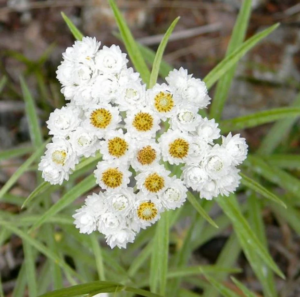
54 Pearly Everlasting
Names
Common name – Pearly Everlasting
Scientific name – Anaphalis margaritacea
Other names – Western Pearly Everlasting
 Traditional Indigenous Uses
The Elders speak of Pearly Everlasting as a gentle yet powerful healer, a plant that carried the strength of endurance, living up to its name. Its soft, silvery leaves and white blossoms were gathered and dried for medicine, especially to help those with sickness of the lungs and chest. The people would smoke the dried leaves and flowers to calm coughs, ease asthma, and clear the breathing when colds took hold. Sometimes it was brewed into a hot tea or used in steam baths to relieve the pain of rheumatism and aching joints, its warmth drawing the stiffness from the body. When the skin was wounded or burned, poultices made from the plant were laid over the sores, cooling the pain and helping the flesh to heal.
The tea was also taken to settle the stomach and treat diarrhea or dysentery, bringing relief to those weakened by sickness. For headaches, the steam from its infusion was inhaled to clear the head and soothe the mind, while a flower wash was used to cleanse irritated eyes and treat infections. Pearly Everlasting was even used in ceremonies, sometimes smoked alone or mixed with other plants as a gentle tobacco substitute, connecting breath and spirit. Its soothing nature reduced swelling and inflammation, whether taken as tea or used as a wash.
Biochemical Basis for Medicinal Properties
- Essential Oil Components
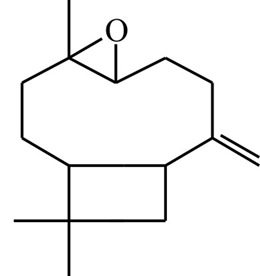
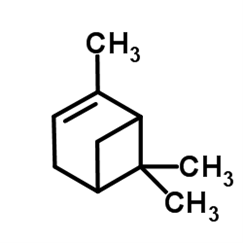
Major compounds included isocaryophyllene, caryophyllene oxide, geranyl-α-terpinene, α-pinene, γ-muurolene, δ-cadinene, humulene, and copaene.
(i) Terpenoids
Caryophyllene Oxide (C₁₅H₂₄O)
(ii) α-Pinene (C₁₀H₁₆)
- Flavonoids
General Flavonoid Structure (Quercetin-type)
- Triterpenoids
General Triterpenoid Structure
- Chlorinated Polyacetylene
(E)-5-chloro-2-(octa-2,4,6-triynylidene)-5,6-dihydro-2H-pyran – A thirteen-carbon chlorinated polyacetylene found in the roots of Anaphalis species; this compound is of particular interest due to its structural similarity to known antibacterial and antifungal compounds.
Chemical Reactions and Mechanisms
Anti-inflammatory Mechanism (Caryophyllene Oxide)
Caryophyllene Oxide + CB₂ Receptor → Anti-inflammatory cascade → Reduced prostaglandin synthesis
Antimicrobial Action (Essential Oils)
Terpene compounds + Bacterial cell membrane → Membrane disruption + Enzyme inhibition → Cell death
Expectorant Mechanism
The combination of volatile compounds stimulates mucus secretion:
α-Pinene + Respiratory epithelium → Increased ciliary action + Mucus liquefaction
Astringent Properties
Tannins and flavonoids provide astringent effects:
Flavonoid-OH + Protein → Protein precipitation + Tissue contraction
References
1) Elders and Community members of the Cayoose Creek Band of Sekw’el’was
2) Bhattarai, N. K. (1992). Folk herbal remedies for gynaecological complaints in Central Nepal. International Journal of Pharmacognosy, 30(4), 283–292. https://doi.org/10.3109/13880209209082835
3) Khatri, D., Panthi, M. P., & Shrestha, K. (2024). Essential oil composition and antimicrobial activity of Anaphalis margaritacea collected from the Himalayas. Chemistry of Natural Compounds, 60(3), 411–418. https://doi.org/10.1007/s10600-024-04031-8
4) Kim, S., Kang, S. W., & Lee, H. (2019). Antioxidant and anti-inflammatory properties of Anaphalis margaritacea extract in vitro and in vivo. Journal of Ethnopharmacology, 239, https://doi.org/10.1016/j.jep.2019.111890
5) Park, Y. J., Jang, T. S., & Lee, S. R. (2017). Identification of polyacetylenes with antibacterial and antifungal properties from Anaphalis margaritacea. Natural Product Research, 31(10), 1158–1163. https://doi.org/10.1080/14786419.2016.1263851
6) Turner, N. J., & Hebda, R. J. (1990). Contemporary use of bark for medicine by two Salishan Native elders of southeast Vancouver Island, Canada. Journal of Ethnopharmacology, 29(1), 59–72. https://doi.org/10.1016/0378-8741(90)90038-Q
7) S. Department of Agriculture, Forest Service. (2025). Plant of the week: Pearly everlasting (Anaphalis margaritacea). https://www.fs.usda.gov/wildflowers/plant-of-the-week/anaphalis_margaritacea.shtml
8) Wang, Z., Li, R., & Guo, Y. (2021). Bioactive terpenoids and flavonoids from Anaphalis margaritacea and their pharmacological properties. Frontiers in Pharmacology, 12, https://doi.org/10.3389/fphar.2021.725631