57 Red Raspberry
Names
Common name – Red Raspberry
Scientific name – Rubus idaeus R. strigosus
Other names – s7aýtskw
General Information
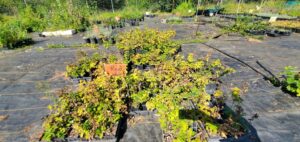
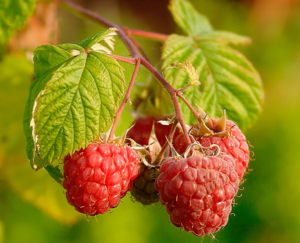
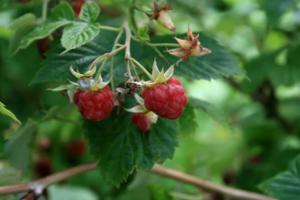
Red Raspberry (Rubus idaeus) is a perennial deciduous shrub in the rose family (Rosaceae) native to Europe and northern Asia, though it has been naturalized throughout North America. This woody-stemmed plant grows 3-6 feet tall (1-2 meters) with biennial canes that are typically thorny or prickly, though thornless varieties exist. The compound leaves consist of 3-7 pinnately arranged leaflets with serrated edges, green on top and whitish underneath due to fine hairs. The plant produces white to pale pink five-petaled flowers in spring, followed by the familiar aggregate fruit composed of numerous small drupelets that ripen to bright red in summer. Native to temperate regions, red raspberry thrives in woodland edges, clearings, and disturbed areas with moist, well-drained soil. For thousands of years, Indigenous peoples across North America, along with European and Asian cultures, have recognized red raspberry as one of the most important medicinal plants, particularly valuing the leaves for women’s reproductive health and the fruit for nutrition and medicine.
Traditional Indigenous Uses
The leaves, gathered and dried at the right time, are the most important part of this medicine. When made into a tea, they help prepare a woman’s body for childbirth, strengthening the womb and easing labor when the time comes. During birth, a stronger brew could help the muscles work together, and afterward, the same tea was used to help the womb recover and to prevent bleeding.
Women would continue to drink raspberry leaf tea regularly to maintain balance in their moon cycles, calming cramps and easing heavy flow. This same tea, when taken or used as a wash, could help with diarrhea, mouth sores, or sore throats, for its astringent nature helped to tighten and heal. It was even used to stop bleeding or soothe wounds when applied to the skin.
The tea also brought comfort during sickness, helping to bring down fevers and settle the stomach. Some would drink it daily as a tonic to keep the body strong and the digestion steady. The roots, when crushed into a poultice or wash, were used to clean and heal wounds, drawing out infection.
The berries themselves were eaten fresh or dried, serving as both food and medicine. They nourished the body, providing strength and vitamins through the long seasons.
Biochemical Compounds and Their Medicinal Properties
- Ellagitannins (Primary Bioactive Compounds)
Three Most Important Compounds:
(i) Sanguiin H-6 (C₈₂H₅₄O₅₂) – Major ellagitannin (up to 3.5% dry weight)
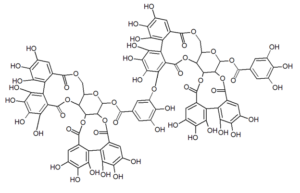
(Complex oligomeric ellagitannin structure)
Multiple galloyl and HHDP units attached to glucose core
(ii) Lambertianin C (C₁₂₃H₇₈O₇₈) – Trimeric ellagitannin
(Three sanguiin H-6 units linked together)
Extremely large polyphenolic structure
(iii) Ellagic Acid (C₁₄H₆O₈) – Ellagitannin metabolite

Medicinal Properties:
- Uterotonic: Tones and strengthens uterine smooth muscle
- Astringent: Strong protein-binding and tissue-contracting effects
- Antimicrobial: Broad-spectrum antibacterial and antiviral activity
- Antioxidant: Powerful free radical scavenging activity
- Flavonoids (Supporting Compounds)
Three Most Important Compounds:
(i) Quercetin-3-glucoside (C₂₁H₂₀O₁₂) – Major flavonoid
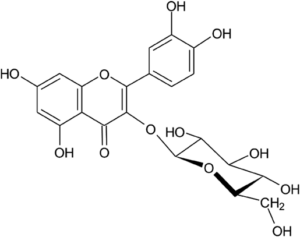
(ii) Kaempferol-3-glucoside (C₂₁H₂₀O₁₁) – Flavonoid glycoside
(iii) Tiliroside (C₃₀H₂₆O₁₃) – Acylated flavonoid
- Alkaloid Fragarine
Most Important Compound:
Fragarine (Structure not fully characterized) – Uterine alkaloid
(Proposed structure – phenolic alkaloid)
Specific structure remains partially undefined
Associated with uterine muscle effects
Proposed Biochemical Mechanisms for Traditional Uses
Uterine Toning and Pregnancy Support (Leaf Tea)
- Fragarine alkaloid acts through:
- Regulation of uterine smooth muscle tone
- Modulation of calcium channels in uterine tissue
- Coordination of myometrial contractions
- Ellagitannins contribute:
- Astringent effects strengthening uterine tissue
- Anti-inflammatory properties reducing uterine inflammation
- Antioxidant protection of reproductive tissues
Labor Facilitation and Postpartum Recovery
- Fragarine + ellagitannins facilitate:
- Enhanced uterine muscle fiber organization
- Improved blood flow to reproductive organs
- Reduced postpartum hemorrhage through vasoconstriction
- Flavonoids provide:
- Antioxidant protection during delivery stress
- Anti-inflammatory effects reducing tissue trauma
- Enhanced tissue repair mechanisms
Astringent and Antidiarrheal Effects (Leaf Preparations)
- Ellagitannins act as:
- Protein precipitating agents causing tissue contraction
- Reduction of intestinal secretions
- Antimicrobial compounds against gut pathogens
- Tannins provide:
- Protective coating of intestinal mucosa
- Reduced capillary permeability in gut
- Hemostatic effects controlling bleeding
Chemical Reactions and Molecular Interactions
Uterotonic Mechanism (Fragarine + Tannins)
Fragarine → Uterine smooth muscle calcium modulation → Enhanced contractility → Organized contractions → Improved labor efficiency
Ellagitannins → Uterine tissue strengthening → ↑ Muscle tone → Enhanced postpartum recovery → Reduced hemorrhage
Astringent Action (Ellagitannins)
Sanguiin H-6 → Protein cross-linking → Tissue contraction → Reduced capillary permeability → Decreased bleeding
Ellagitannins + Mucosa proteins → Protective barrier formation → Reduced inflammation → Healing promotion
Anti-inflammatory Mechanism (Flavonoids + Ellagic Acid)
Quercetin → NF-κB pathway inhibition → ↓ Pro-inflammatory cytokines → Reduced tissue inflammation → Pain relief
Ellagic acid → COX-2 enzyme inhibition → ↓ Prostaglandin synthesis → Anti-inflammatory and analgesic effects
Antimicrobial Activity (Ellagitannins)
Ellagitannins → Bacterial membrane disruption → Cell lysis → Increased permeability → ATP leakage → Cell death
Ellagic acid → Viral protein binding → Inhibited replication → Reduced viral load → Enhanced recovery
Antioxidant Protection (Multiple Compounds)
Ellagitannins + Flavonoids → ROS scavenging → ↓ Oxidative stress → Cellular protection → Enhanced tissue health
Ellagic acid + Fe³⁺ → Metal chelation → Prevented Fenton reactions → Reduced lipid peroxidation → Membrane protection
Traditional Preparation Methods and Biochemical Optimization
Leaf Tea (Primary Traditional Method)
- Hot water infusion: Extracts ellagitannins, flavonoids, and fragarine
- Extended steeping: 10-15 minutes optimizes tannin extraction
- Daily consumption: Third trimester use for pregnancy preparation
- Fresh or dried leaves: Both effective with slightly different profiles
Dosage Protocols
Traditional midwife recommendations:
- First trimester: Generally avoided due to potential uterine stimulation
- Second trimester: Occasional use begins
- Third trimester: Daily consumption (1-3 cups) for labor preparation
- During labor: Strong decoction for active support
- Postpartum: Continued use for 4-6 weeks for recovery
Nutritional Value
Red raspberry fruit provides essential nutrients:
- Vitamin C: 26 mg per 100g supporting immune function
- Manganese: Important for bone health and metabolism
- Fiber: Supporting digestive health
- Antioxidants: Ellagic acid and anthocyanins
Safety Considerations and Traditional Wisdom
Traditional Guidelines
Indigenous and traditional preparation emphasizes:
- Timing in pregnancy: Third trimester focus for safety
- Appropriate dosing: Moderate, consistent use
- Quality assessment: Fresh, properly dried leaves
- Individual response: Monitoring for personal tolerance
References
1) Elders and Community members of the Cayoose Creek Band of Sekw’el’was
2) Biomed Central. (2024, April 22). Raspberry leaf (Rubus idaeus) use in pregnancy: A prospective observational study. BMC Complementary Medicine and Therapies, 24(1), 4465. https://doi.org/10.1186/s12906-024-04465-7
3) Colorado School of Clinical Herbalism. (2025, April 30). Red raspberry leaf. https://clinicalherbalism.com/red-raspberry-leaf/
4) (2025). Red raspberry, Rubus idaeus, Rubus strigosus (raspberry leaf). https://reference.medscape.com/drug/red-raspberry-rubus-idaeus-raspberry-leaf-344515
5) Medical News Today. (2021, September 27). Red raspberry leaf tea: Nutrition, benefits, and how to use. https://www.medicalnewstoday.com/articles/red-raspberry-leaf-tea
6) Kula, M., Majdan, M., & Olszewska, M. A. (2015). Chemical composition and biological activity of Rubus idaeus Industrial Crops and Products, 69, 18–29. https://doi.org/10.1016/j.indcrop.2015.01.045
7) Parry, B. L., & Morgan, L. D. (2021, February 10). Biophysical effects, safety, and efficacy of raspberry leaf use in pregnancy. Phytotherapy Research, 35(4), 1961–1974. https://doi.org/10.1002/ptr.6893
8) Sadowska, B., Nowak, M., & Król, W. (2023, July 21). Raspberry leaves and extracts—Molecular mechanism of action. Frontiers in Pharmacology, 14, https://doi.org/10.3389/fphar.2023.10383074
9) Petkova, N., & Ivanova, D. (2024, May 7). The genus Rubus: An insight into phytochemicals and pharmacological studies. Pharmacia, 71(2), 124248. https://doi.org/10.3897/pharmacia.71.e124248
10) (2025). Red raspberry leaf – An overview. ScienceDirect Topics. https://www.sciencedirect.com/topics/medicine-and-dentistry/red-raspberry-leaf
11) Traditional Medicinals. (2025). Raspberry leaf – Benefits, folklore, botany, and more. https://www.traditionalmedicinals.com/blogs/herb-library/raspberry-leaf
12) (2024, April 29). Red raspberry leaf. https://en.wikipedia.org/wiki/Red_raspberry_leaf