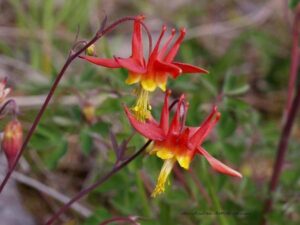
62 Sitka Columbine
Names
Common name – Sitka Columbine
Scientific name – Aquilegia formosa
Other names – Western Columbine or Crimson Columbine
Traditional Indigenous Uses
When a person’s joints ached or the body grew stiff from rheumatism, the fresh leaves were rubbed directly over the sore places, bringing relief and comfort to tired limbs. The clear sap from the plant was used to help heal cuts and wounds, sealing them and keeping infection away. When the throat grew sore or swollen, a tea made from the roots or leaves was sipped slowly or used as a gargle to ease the pain and soothe the voice. For headaches, the people prepared a decoction or placed a poultice of the roots and upper parts on the head, allowing the medicine to draw the ache away.
The aerial parts of the plant were also brewed into a tea to bring down fever, cooling the body when sickness took hold. When rashes appeared from poison ivy or other irritations, the leaves and roots were crushed and laid against the skin as a poultice or used as a gentle wash to calm the burning. The roots made a mild decoction that served as a mouth rinse to treat sores in the mouth or gums. The same tea was used to ease troubles of the kidneys and bladder, and some even took it for problems of the heart, believing that the plant carried a strength that reached deep inside the body.
Children loved the sweet nectar that dripped from the flowers, a small treat offered by the plant itself. In the spring, the young shoots and leaves were sometimes boiled and eaten as greens. The blossoms, bright and delicate, were also crushed to make a soft perfume, worn on the body for their gentle scent.
Biochemical Basis for Medicinal Properties
Major Bioactive Compounds in Aquilegia formosa
The plant contains several alkaloids (magnoflorine, berberine, etc.), triterpenoid saponins, flavonoids (quercetin, apigenin), and small amounts of cyanogenic glycosides (triglochinin, etc.).
- Benzylisoquinoline Alkaloids
The Ranunculaceae family (to which Aquilegia belongs) is known for producing benzylisoquinoline alkaloids.
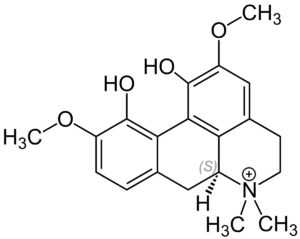
(i) Magnoflorine (C₂₀H₂₄NO₄⁺)
Magnoflorine is an aporphinoid alkaloid found in Aquilegia and is one of the most prominent alkaloid compounds in Ranunculaceae.
Molecular Structure:
- Molecular Formula: C₂₀H₂₄NO₄⁺ (quaternary ammonium compound)
- Molecular Weight: 342.41 g/mol
- Structure: Tetracyclic aporphine skeleton with a quaternary nitrogen
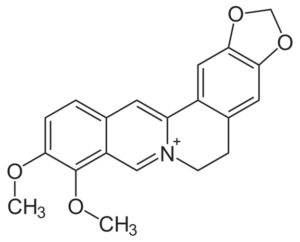
(ii) Berberine (C₂₀H₁₈NO₄⁺)
Molecular Structure:
- Molecular Weight: 336.36 g/mol
- Protoberberine alkaloid with quaternary nitrogen
- Bright yellow color
- Cyanogenic Glycosides
Triglochinin and Related Compounds
General Structure:
- Sugar moiety (typically glucose) + cyanogenic aglycone
- Chemical formula of triglochinin: C₁₄H₂₅NO₉
- Molecular weight: ~351 g/mol
Raw consumption of columbine in large quantities is dangerous – tissue damage releases enzymes that produce toxic HCN.
- Flavonoids
(i) Quercetin (C₁₅H₁₀O₇)
(ii) Apigenin (C₁₅H₁₀O₅)
- Triterpenoid Saponins
- Anthocyanins and Carotenoids (Pigments)
The red and yellow flower color is attributed to anthocyanin pigments pelargonidin and cyanidin, and carotenoids.
(i) Pelargonidin (C₁₅H₁₁O₅⁺)
- Red/orange anthocyanin
- Molecular Weight: 271.24 g/mol
- Hydroxyl group at position 4′ on B-ring
(ii) Cyanidin (C₁₅H₁₁O₆⁺)
- Red/purple anthocyanin
- Molecular Weight: 287.24 g/mol
- Two hydroxyl groups at 3′, 4′ (catechol group) on B-ring
Structure-Activity Relationships
Key Structural Features Explaining Medicinal Properties:
- Quaternary Nitrogen in Alkaloids (Magnoflorine, Berberine):
- Permanent positive charge enhances membrane interactions
- Increases affinity for anionic binding sites
- Facilitates DNA intercalation (planar structure + positive charge)
- Multiple Hydroxyl Groups (Flavonoids):
- Hydrogen bond donors for protein interactions
- Electron donors for free radical scavenging
- Sites for Phase II metabolism (glucuronidation, sulfation)
- Planar Aromatic Systems:
- π-π stacking with biological targets
- DNA intercalation capability
- Resonance stabilization of radical intermediates
- Catechol Groups (ortho-dihydroxy structure):
- Strong metal chelation (Fe³⁺, Cu²⁺)
- Enhanced antioxidant activity
- COX/LOX enzyme inhibition
- Lipophilicity:
- Cell membrane permeability
- Ability to reach intracellular targets
- Accumulation in lipid-rich tissues
- Amphipathic Character (Saponins):
- Interaction with both aqueous and lipid environments
- Membrane disruption capabilities
- Surfactant properties
References
1) Elders and Community members of the Cayoose Creek Band of Sekw’el’was
2) Foster, S., & Duke, J. A. (2000). A field guide to medicinal plants and herbs of Eastern and Central North America (2nd ed.). Houghton Mifflin Company.
3) Gleitz, J., Beile, A., & Peters, T. (1995). (+)-Magnoflorine and (−)-corydalmine, two quaternary alkaloids from Corydalis cava (Fumariaceae), block NMDA receptor channels. Planta Medica, 61(5), 451–455. https://doi.org/10.1055/s-2006-958109
4) Gunther, E. (1973). Ethnobotany of Western Washington: The knowledge and use of indigenous plants by Native Americans (Rev. ed.). University of Washington Press.
5) Imanshahidi, M., & Hosseinzadeh, H. (2008). Pharmacological and therapeutic effects of Berberis vulgaris and its active constituent, berberine. Phytotherapy Research, 22(8), 999–1012. https://doi.org/10.1002/ptr.2399
6) Khadem, S., & Marles, R. J. (2012). Chromone and flavonoid alkaloids: Occurrence and bioactivity. Molecules, 17(1), 191–206. https://doi.org/10.3390/molecules17010191
7) Kong, W., Wei, J., Abidi, P., Lin, M., Inaba, S., Li, C., … & Jiang, J. (2004). Berberine is a novel cholesterol-lowering drug working through a unique mechanism distinct from statins. Nature Medicine, 10(12), 1344–1351. https://doi.org/10.1038/nm1135
8) Kulkarni, S. K., & Dhir, A. (2008). On the mechanism of antidepressant-like action of berberine chloride. European Journal of Pharmacology, 589(1–3), 163–172. https://doi.org/10.1016/j.ejphar.2008.05.043
9) Kumar, A., Ekavali, Chopra, K., Mukherjee, M., Pottabathini, R., & Dhull, D. K. (2015). Current knowledge and pharmacological profile of berberine: An update. European Journal of Pharmacology, 761, 288–297. https://doi.org/10.1016/j.ejphar.2015.05.068
10) Middleton, E., Kandaswami, C., & Theoharides, T. C. (2000). The effects of plant flavonoids on mammalian cells: Implications for inflammation, heart disease, and cancer. Pharmacological Reviews, 52(4), 673–751. https://doi.org/10.1124/pr.52.4.673
11) Moerman, D. E. (1998). Native American ethnobotany. Timber Press.
12) Moerman, D. E. (2010). Native American food plants: An ethnobotanical dictionary. Timber Press.
13) Neilson, E. H., Goodger, J. Q., Woodrow, I. E., & Møller, B. L. (2013). Plant chemical defense: At what cost? Trends in Plant Science, 18(5), 250–258. https://doi.org/10.1016/j.tplants.2013.01.001
14) Singh, A., Duggal, S., Kaur, N., & Singh, J. (2010). Berberine: Alkaloid with wide spectrum of pharmacological activities. Journal of Natural Pharmaceuticals, 1(1), 64–75. https://doi.org/10.4103/2229-5119.73585
15) Syed, D. N., Chamcheu, J. C., Adhami, V. M., & Mukhtar, H. (2013). Pomegranate extracts and cancer prevention: Molecular and cellular activities. Anti-Cancer Agents in Medicinal Chemistry, 13(8), 1149–1161. https://doi.org/10.2174/1871520611313080008
16) Turner, N. J. (1997). Food plants of interior First Peoples. Royal British Columbia Museum; UBC Press.
17) Vetter, J. (2000). Plant cyanogenic glycosides. Toxicon, 38(1), 11–36. https://doi.org/10.1016/S0041-0101(99)00128-2
18) Xu, H. Y., Liu, C. S., Huang, C. L., Chen, L., Zheng, Y. R., Huang, S. H., & Long, X. Y. (2019). Nanoemulsion improves hypoglycemic efficacy of berberine by overcoming its gastrointestinal challenge. Colloids and Surfaces B: Biointerfaces, 181, 927–934. https://doi.org/10.1016/j.colsurfb.2019.06.005
19) Cushnie, T. P. T., & Lamb, A. J. (2005). Antimicrobial activity of flavonoids. International Journal of Antimicrobial Agents, 26(5), 343–356. https://doi.org/10.1016/j.ijantimicag.2005.09.002