72 Umber Pussytoes
Names
Common name – Umber pussytoes
Latin Name – Antennaria umbrinella
General Information
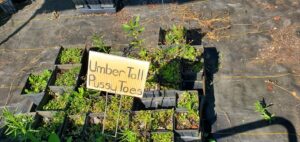
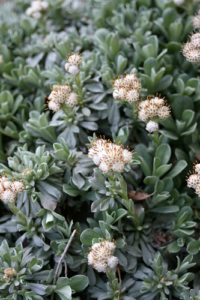
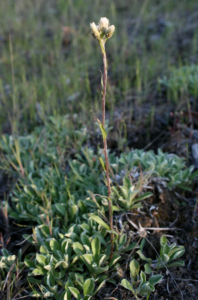
Antennaria umbrinella is a perennial herb growing erect stems to a maximum height around 16 centimeters from a woody base. Plant green to gray with matted hairs, woody base. Stolons spread out to 3 in. Basal leaves spoon-shaped to oblong; stem leaves narrower, with sharp dark tip and a small appendage. Flower heads cone-shaped. Cup woolly at base, bracts marked with brown medium spot and brown or white spot at rounded tips, flowers white to tan. The plants are dioecious (separate male and female plants) and form low mats through stoloniferous growth. The fuzzy, woolly flower heads resemble cat’s paws, hence “pussytoes.”
Traditional Indigenous Uses
When someone was troubled by a deep cough or soreness in the chest, or when the lungs felt heavy with cold, tea made from the leaves and flowers of Umber Pussytoes brought relief, while poultices were placed upon the chest to draw out the pain. The plant was used to calm the stomach. Tea brewed from its aerial parts could ease diarrhea, dysentery, or general intestinal upset, soothing the body from within.
Its soft, downy leaves served well in healing the skin; they were mashed or dried and used to cover wounds, burns, or abrasions, protecting them as they healed. Women also turned to this plant during childbirth and recovery afterward, finding gentle strength in the tea that helped the body restore balance. When eyes become inflamed or irritated, a wash made from the infusion of its leaves would clear and cool them.
Some smoked the dried leaves, either for ceremony or for medicine, calling it “Indian tobacco,” and finding in it both spiritual and physical ease. When bleeding occurred (small cut or a nosebleed) the crushed plant was applied directly to slow the flow and close the wound. Others used the tea as a general tonic, a mild stimulant that strengthened the body. Even outside of medicine, the plant gave comfort; its soft, woolly parts were gathered and used as padding for moccasins, bedding, or for infants, offering both warmth and gentleness.
Biochemical Basis for Medicinal Properties
Major Bioactive Compounds in Antennaria Species
Research Limitation: Detailed phytochemical analysis specifically of Antennaria umbrinella is not extensively published. The compounds below represent typical constituents found in Asteraceae family members and related Antennaria species based on taxonomic relationships and preliminary analyses.
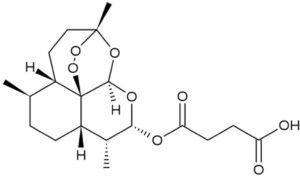
- Sesquiterpene Lactones
Common in Asteraceae family; likely present in Antennaria species.
Typical Sesquiterpene Lactone Structure:
- Flavonoids
(i) Quercetin (C₁₅H₁₀O₇)
- Molecular Weight: 302.24 g/mol
- Structure provided in previous responses
- Antioxidant and anti-inflammatory
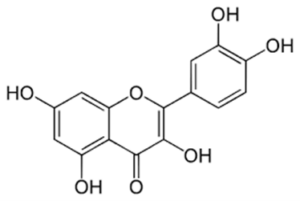
(ii) Kaempferol (C₁₅H₁₀O₆)
- Molecular Weight: 286.24 g/mol
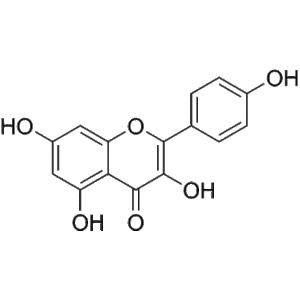
(iii) Luteolin (C₁₅H₁₀O₆)
- Molecular Weight: 286.24 g/mol
(iv) Apigenin (C₁₅H₁₀O₅)
- Molecular Weight: 270.24 g/mol
Flavonoid Glycosides:
- Quercetin-3-glucoside
- Kaempferol-3-glucoside
- Various other glycosylated forms
- Tannins (Condensed and Hydrolyzable)
Condensed Tannins (Proanthocyanidins):
- Phenolic Acids
(i) Caffeic Acid (C₉H₈O₄)
- Molecular Weight: 180.16 g/mol
- Structure provided in previous responses
(ii) Chlorogenic Acid (C₁₆H₁₈O₉)
- Ester of caffeic and quinic acid
(iii) p-Coumaric Acid (C₉H₈O₃)
- Hydroxycinnamic acid derivative
- Mucilage (Polysaccharides)
The woolly texture suggests presence of mucilaginous compounds:
- Complex polysaccharides
- Arabinogalactans
- Galacturonans
- Provide demulcent (soothing) properties
- Essential Oils (Minor Components)
Monoterpenes and Sesquiterpenes:
- α-Pinene, β-Pinene
- Limonene
- Various sesquiterpene alcohols and ketones
- Present in small quantities
- Sterols
β-Sitosterol (C₂₉H₅₀O)
- Plant sterol with anti-inflammatory properties
- Coumarins
Umbelliferone and related compounds:
- Benzopyrone derivatives
- Anti-inflammatory effects
Structure-Activity Relationships
- Lactone Ring (Sesquiterpene Lactones): Electrophilic sites enable protein alkylation; anti-inflammatory and antimicrobial
- Multiple Hydroxyl Groups (Flavonoids, Tannins): Hydrogen bonding with proteins; antioxidant electron donation; astringent effects
- Polyphenolic Structure: Protein precipitation capability; antimicrobial activity through membrane disruption
- Catechol Groups: Strong metal chelation; enhanced antioxidant activity; enzyme inhibition
- Mucilage Polysaccharides: Extensive hydroxyl groups create viscous hydrogels; physical protection of tissues
- Lipophilic Terpenoids: Membrane penetration; antimicrobial membrane disruption
Preparation and Safety Considerations
Traditional Preparation:
- Tea: 1-2 teaspoons dried aerial parts per cup; steep 10-15 minutes
- Poultice: Crush fresh leaves or moisten dried leaves; apply directly to affected area
- Chest Compress: Strong decoction applied as warm compress
- Smoking Mixture: Dried leaves (some species); ceremonial or medicinal use
Safety Notes:
- Generally considered safe based on traditional use
- Sesquiterpene lactones (if present) may cause allergic reactions in sensitive individuals (Asteraceae family allergy)
- Avoid if allergic to ragweed, chrysanthemums, marigolds, or other Asteraceae
- Pregnancy/breastfeeding: Insufficient safety data; use with caution
- No significant drug interactions documented
- External use generally safer than internal
References
1) Elders and Community members of the Cayoose Creek Band of Sekw’el’was
2) Moerman, D. E. (1998). Native American ethnobotany. Timber Press.
3) Kane, C. W. (2011). Medicinal plants of the western mountain states. Feral House.
4) Turner, N. J. (1997). Food plants of interior First Peoples. Royal British Columbia Museum; UBC Press.
5) Tilford, G. L. (1997). Edible and medicinal plants of the West. Mountain Press Publishing Company.
6) Moore, M. (2003). Medicinal plants of the mountain West (Revised and expanded ed.). Museum of New Mexico Press.
7) Flora of North America Editorial Committee. (2006). Flora of North America north of Mexico, Vols. 19–21: Magnoliophyta: Asteridae. Oxford University Press.
8) Sparg, S. G., Light, M. E., & van Staden, J. (2004). Biological activities and distribution of plant saponins. Journal of Ethnopharmacology, 94(2–3), 219–243. https://doi.org/10.1016/j.jep.2004.04.002
9) Seaman, F. C. (1982). Sesquiterpene lactones as taxonomic characters in the Asteraceae. The Botanical Review, 48(2), 121–594. https://doi.org/10.1007/BF02860531
10) Chadwick, M., Trewin, H., Gawthrop, F., & Wagstaff, C. (2013). Sesquiterpenoid lactones: Benefits to plants and people. International Journal of Molecular Sciences, 14(6), 12780–12805. https://doi.org/10.3390/ijms140612780
11) Middleton, E., Kandaswami, C., & Theoharides, T. C. (2000). The effects of plant flavonoids on mammalian cells: Implications for inflammation, heart disease, and cancer. Pharmacological Reviews, 52(4), 673–751. https://pharmrev.aspetjournals.org/content/52/4/673
12) Cushnie, T. P., & Lamb, A. J. (2005). Antimicrobial activity of flavonoids. International Journal of Antimicrobial Agents, 26(5), 343–356. https://doi.org/10.1016/j.ijantimicag.2005.09.002
13) Scalbert, A. (1991). Antimicrobial properties of tannins. Phytochemistry, 30(12), 3875–3883. https://doi.org/10.1016/0031-9422(91)83426-L
14) United States Department of Agriculture (USDA). (n.d.). Antennaria umbrinella. USDA Plants Database. https://plants.usda.gov/home/plantProfile?symbol=ANUM