7 Fir Tip Tea
Names
Common name – Fir Tip Needle
Scientific Name: Pseudotsuga menziesii
Other Names: srep7ùl, Douglas Fir, Douglas Pine, Oregon Pine, Columbian Pine
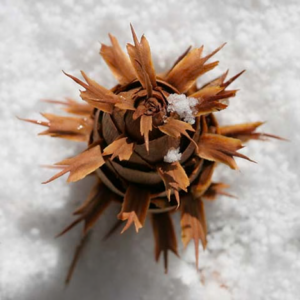
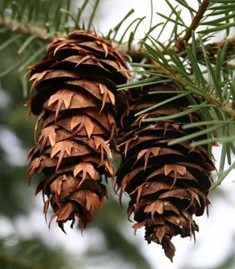 Figure 1. The distinctive cones found on the Douglas fir tree.
Image Source: https://www.nps.gov/articles/000/douglas-fir.htm
Physical Characteristics: These evergreen conifers produce soft, flat needles arranged spirally on branches. In spring (typically April-June), bright green or lime-colored new needle growth emerges from branch tips. These tender young tips are aromatic, resinous, and rich in nutrients and volatile compounds. Tree tips are packed with vitamin C and electrolytes. Spring needle tips are high in Vitamin C and may be eaten fresh or steeped as a tea.
The resin from the fir tip needle can be applied to wounds, including burns and sores to promote healing. An infusion made from the bark is through to help with excessive menstrual bleeding as well as diarrhea and intestinal issues. Topical application can help with rheumatism, and the needles can be steeped as tea to provide energy. This tree is also culturally significant for it uses in rituals, and the use of its wood to make fishing poles and nets.
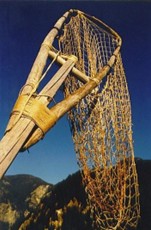
Figure 2. A net made with a douglas fir frame.
Image Source: http://digitalsqewlets.ca/sqwelqwel/belongings-possessions/harvesting- recolte/fir_sapin-eng.php
Traditional Indigenous Uses
In the cold months, when coughs and chest troubles came, people would gather the young fir tips to make a warm tea or breathe in the steam to clear the lungs and soothe sore throats. This same medicine strengthened the body through the long winters, preventing scurvy and weakness when fresh foods were scarce. The fresh green tips were chewed or steeped for their strength-giving power, bringing warmth and vitality back into tired bodies. The fir’s healing also reached the kidneys and bladder, easing ailments of the urinary tract, and its gentle teas calmed stomach pains, indigestion, and diarrhea. For wounds, burns, and sores, the thick, sticky pitch was prized, spread as a salve or poultice to draw out infection and help the skin mend.
Those who suffer from sore joints or aching muscles would bathe in water infused with fir branches or drink their tea to find relief from stiffness and rheumatism. The needles also brought down fevers, eased headaches, and soothed the eyes when used as a gentle wash. Beyond its physical gifts, the fir held deep spiritual meaning. Its branches were burned or placed in sweat baths to purify the spirit and cleanse the air, reminding the people of renewal and balance. Women used fir tea to support their bodies during menstruation, childbirth, and recovery, trusting its strength to guide them through cycles of life. The tree was also used as a tonic to restore energy and strengthen the heart, and even its resin served as a hair ointment to nourish and protect.
Additional Uses:
- Food/Beverage: Fresh tips eaten as trail snack for energy and refreshment
- Preservative: Resin used to waterproof containers and preserve food
- Adhesive: Pitch used as glue for tool-making and repairs
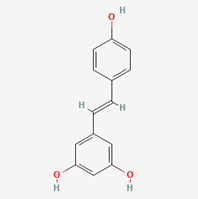
The benefits of drinking the tea made using the needles of the Douglas fir was likely due to the high Vitamin C content present in the needles. The needles and the bark have also been shown to contain a high polyphenol content, and antioxidant activity. The radical scavenging activity was shown to be higher in the needles than in the bark samples. The age and environment of a tree also affects the chemical compounds found in the bark and in the needles. Similar compounds have been found in the cones, including terpenoids which are fragrant and flavorful. Also found in cones are tannins, resin acids and stilbenoids such as resveratrol, whose structure is shown below:
Biochemical Basis for Medicinal Properties
Major Bioactive Compounds in Fir Needles
- Ascorbic Acid (Vitamin C)
Molecular Formula: C₆H₈O₆
Molecular Weight: 176.12 g/mol
Concentration: Fresh fir tips contain approximately 100-250 mg vitamin C per 100g (comparable to citrus)
Chemical Structure:

2. Terpenes (Essential Oils) – The most significant medicinal compounds in Douglas Fir are terpenes, which are responsible for many of its therapeutic properties:
α-Pinene Structure:
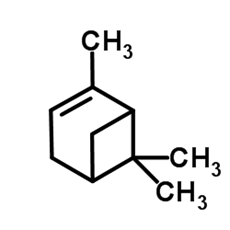
The Douglas fir terpene α-pinene was shown to inhibit the growth of a variety of bacteria and a yeast. Other terpenes of the Douglas fir, including limonene, camphene, and isobornyl acetate, were also inhibitory to Bacillus thuringiensis.
Antimicrobial Action:
- Terpenes disrupt bacterial cell membranes through lipophilic interactions
- α-Pinene → membrane disruption → bacterial cell death
- Mechanism: Terpenes increase membrane permeability, leading to leakage of cellular contents
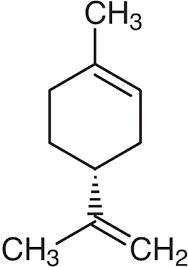
Limonene Structure:
3. Phenolic Compounds
- Structure: Aromatic rings with hydroxyl groups (-OH)
- Antioxidant properties through free radical scavenging
- Reaction: Phenolic-OH + Free radical → Phenolic radical + H₂O (neutralization)
- Flavonoids
- Structure: C₆-C₃-C₆ framework with hydroxyl groups
- Anti-inflammatory and antioxidant effects
- Mechanism: Inhibition of cyclooxygenase and lipoxygenase enzymes
- Resin Acids
- Abietane-type diterpenes
- Antimicrobial and wound-healing properties
- Structure includes multiple ring systems with carboxylic acid groups
Therapeutic Mechanisms
Respiratory Benefits:
- Terpenes act as expectorants and bronchodilators
- α-Pinene reduces inflammation in respiratory passages
- Antimicrobial action against respiratory pathogens
Wound Healing:
- Resin creates protective barrier
- Antimicrobial compounds prevent infection
- Terpenes stimulate tissue regeneration
Gastrointestinal Effects:
- Tannins provide astringent properties for bleeding
- Anti-inflammatory compounds reduce irritation
- Antimicrobial effects against GI pathogens
References
1) Elders and Community members of the Cayoose Creek Band of Sekw’el’was
2) Compton, B. D. (1993). Upper North Wakashan and Southern Tsimshian ethnobotany: The knowledge and usage of plants and fungi among the Oweekeno, Hanaksiala, Haisla and Kitasoo peoples of the central and north coasts of British Columbia (Doctoral dissertation, University of British Columbia). University of British Columbia. https://open.library.ubc.ca/media/download/full-text/831/1.0098829/0.txt
3) Moerman, D. E. (1998). Native American ethnobotany. Timber Press.
4) USDA NRCS. (2002). Douglas-fir (Pseudotsuga menziesii) Plant Guide. U.S. Department of Agriculture. https://plants.usda.gov/DocumentLibrary/plantguide/pdf/pg_psme.pdf
5) Swor, K., Roberts, C. L., & Clark, R. J. (2023). Gymnosperms of Idaho: Chemical compositions and enantiomeric distributions of essential oils of Abies lasiocarpa, Picea engelmannii, Pinus contorta, Pseudotsuga menziesii, and Thuja plicata. Molecules, 28(6), 2477. https://doi.org/10.3390/molecules28062477
6) Mitić, Z. S., Stojanović-Radić, Z., Cvetković, V. J., Jovanović, S. Č., Dimitrijević, M., Ickovski, J. D., Jovanović, N., Mihajilov-Krstev, T., & Stojanović, G. S. (2021). Pseudotsuga menziesii (Pinaceae): Volatile profiles, antimicrobial activity and toxicological evaluation of its essential oil. Chemistry & Biodiversity, 18(9), e2100424. https://doi.org/10.1002/cbdv.202100424
7) Tešević, V., Vajs, V., Todorović, S., Janaćković, P., Milosavljević, S., & Marin, P. D. (2009). Chemical composition and antifungal activity of the essential oil of Douglas fir (Pseudotsuga menziesii (Mirb.) Franco) from Serbia. Journal of the Serbian Chemical Society, 74(10), 1035–1040. https://doi.org/10.2298/JSC0910035T
8) Vîșan, D.-C., Oprea, E., Rădulescu, V., Voiculescu, I., Biriș, I.-A., Cotar, A. I., Saviuc, C., Chifiriuc, M. C., & Marinăș, I. C. (2021). Original contributions to the chemical composition, microbicidal, virulence-arresting and antibiotic-enhancing activity of essential oils from four coniferous species. Pharmaceuticals, 14(11), 1159. https://doi.org/10.3390/ph14111159
9) Salehi, B., Upadhyay, S., Orhan, I. E., Jugran, A. K., Jayaweera, S. L. D., Dias, D. A., Sharopov, F., Taheri, Y., Martins, N., Baghalpour, N., Cho, W. C., & Sharifi-Rad, J. (2019). Therapeutic potential of α- and β-pinene: A miracle gift of nature. Biomolecules, 9(11), 738. https://doi.org/10.3390/biom9110738
10) Jones (2024). Medicinal Herbs of Western Canada. First Edition. Nova Scotia. Nimbus Publishing. p58-59.
11) Splitrock Environmental [Internet]. 2025. Interior Douglas Fir (srep7ùl). Lillooet (BC). [Accessed November 7th 2024]. https://splitrockenvironmental.ca/products/interior-douglas-fir- srep7ul?variant=40347193114790
12) Popescu DI, Frum A, Dobrea CM, Cristea R, Gligor FG, Vicas LG, Ionete RE, Sutan NA, Georgescu 2023. Comparative Antioxidant and Antimicrobial Activities of Several Conifer Needles and Bark Extracts [Internet]. Pharmaceutics 16(1). [Accessed on April 20 2025]. doi: 10.3390/pharmaceutics16010052
13) Latos-Brozio M, Masek A, Chrzescijanska E, Podsedek A, Kajszcak 2021. Characteristics of the Polyphenolic Profile and Antioxidant Activity of Cone Extracts from Conifers Determines Using Electrochemical and Spectrophotometric Methods. Antioxidants 10(11). doi: 10.3390/antiox10111723