13 Sumac Tea
Names
Common Name – Sumac
Scientific Name – Rhus Glabra
Other Names – nekw’tsamúm’l, Smooth Sumac, White Sumac, Upland Sumac, Scarlet Sumac, smooth horsetail
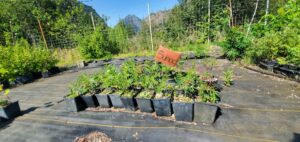
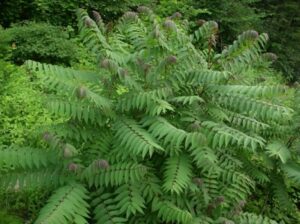
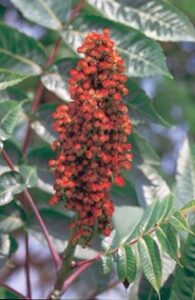
Figure 1. Berries of the smooth sumac plant.
Image Source: Splitrock environmental
Traditional Indigenous Uses
The stems were most often used, gathered and brewed into a tea to support the kidneys and bladder, helping to clear infections, ease inflammation, and flush away stones. This same tea was known to act as a diuretic, reducing swelling and water retention in the body. Those who drank the tea regularly found that it strengthened not only the kidneys but also the bones, helping them heal after injury and stay strong as they aged. The plant was also known to bring health to the hair and nails; a rinse made from its stems was used to keep the scalp healthy and to prevent hair from thinning or breaking. When the body was wounded, the people made a wash or poultice from the stems to stop bleeding and speed healing. The infusion was also used internally to control hemorrhage or heavy menstrual flow. For those with aching joints or weak tendons, a regular drink of tea helps restore flexibility and endurance. A strong brew of the plant was used to treat gonorrhea and other urinary infections, while a gentler tea calmed irritation in the bladder and eased painful urination. The wash from the stems was also applied to the skin to soothe eczema, rashes, and other inflammations. Beyond its medicinal uses, the Smooth Sumac had practical value too. The people used its rough, fibrous branches to scour pots and polish tools, keeping them clean and shining.
The berries are used to make juice by soaking them in water, and the leaves were smoked like tobacco. The roots and leaves of the nekw’tsamúm’l were used to make tea to treat diarrhea, dysentery and mouth ulcers or teething. It was also thought that smoking the leaves would help reduce the symptoms of asthma. The berries and inner bark were used to made red and yellow dyes respectively. The sprouts, roots, leaves, blossoms and fruits of the nekw’tsamúm’l can be used. The sprouts are eaten as a salad. The leaves in particular contain a number of phenolic compounds totaling to a phenolic content of 12%.
A literature review in the American Journal of Chemistry also found that Rhus glabra contain many bioactive components, primarily phenolic compounds including: flavonoids, bioflavonoids, terpenoids, xanthones and compounds such as vanillin and gallic acid.
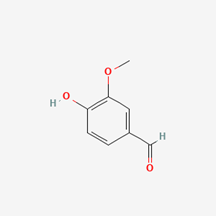
Figure 2. The chemical structure of vanillin, an aromatic compound found in the berries of smooth sumac.
Image Source: https://pubchem.ncbi.nlm.nih.gov/compound/Vanillin#section=2D-Structure
Another species of sumac, the poison sumac, is distinguishable by the different leaf shape and the berries, which are white rather than red. Figure 3 shows the leaves and berries which are readily differentiated from the smooth sumac shown in Figure 1.
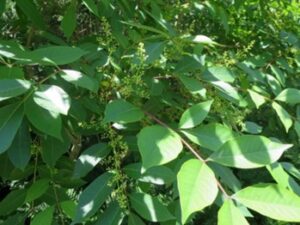
Figure 3. Poison Sumac
Image Source: https://extension.unh.edu/blog/2019/07/beware-poison-sumac-rhus-vernix
The berries of the smooth sumac remain on the branches until late fall and even into winter making them an important food source for animals and birds.
References
[1] Splitrock Environmental [Internet]. 2025. Smooth Sumac (nekw’tsamúm’l). Lillooet (BC). [Accessed November 7th 2024]. https://splitrockenvironmental.ca/collections/plants/products/smooth-sumac-nekw-tsamum- l?variant=40347085668518
[2] (USDA) United States Department of Agriculture Natural Resources Conservation Service [Internet]. 2004. Smooth Sumac: Rhus glabra L. [Accessed November 10th 2024]. https://plants.usda.gov/DocumentLibrary/plantguide/pdf/cs_rhgl.pdf
[3] Abdulladjanova NG, Mavlonov GT, Mamadrahimov AA, Rakhimov RN, Ning H, Wali A, Yili A, Abdulla R. nd. Phenolic Compounds of Rhus Glabra [Internet]. Xinjiang (China). [Accessed November 7th 2024]. https://www.jrespharm.com/uploads/pdf/pdf_MPJ_1485.pdf
[4] Opiyo SA, Njoroge PW, Ndirangu EG, Kuria KM. (2021) A Review of Biological Activities and Phytochemistry of Rhus Species [Internet]. American Journal of Chemistry 11(2). [Accessed April 20 2025]. DOI: 10.5923/j.chemistry.20211102.02