143 Snowberry
Names
Common name – Snowberry
Scientific name – Symphoricarpos albus
Other names – zekwzekwúkws, common snowberry or waxberry
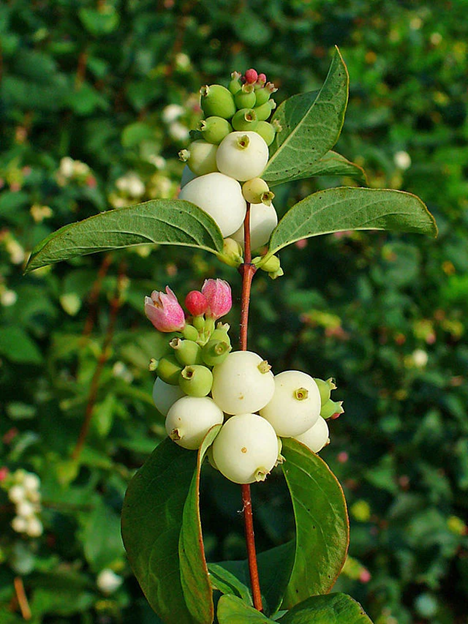
Fig 64.1: The Snowberry shrub (Symphoricarpos albus) displaying its characteristic oppositely arranged oval leaves and distinctive white berries.
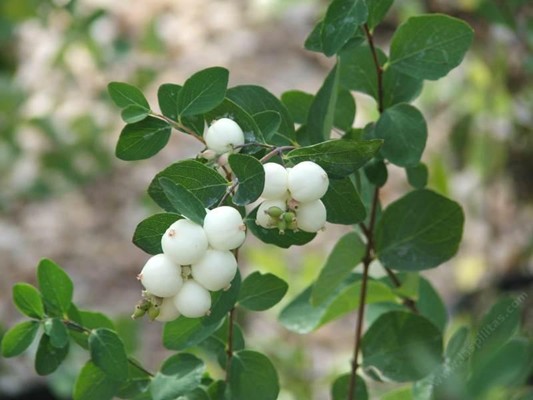
Fig 64.2: Close-up of Snowberry’s white, waxy berries which persist through winter and are an important food source for wildlife.
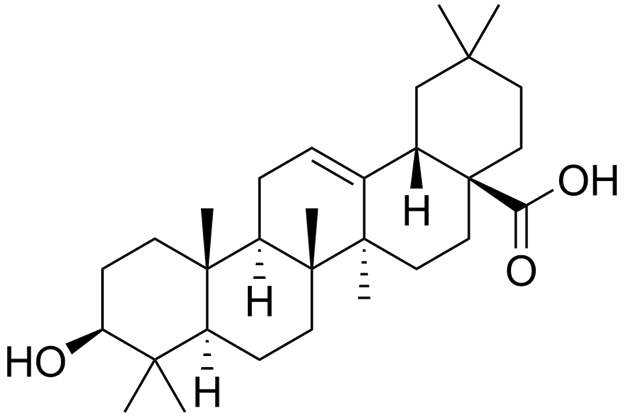
Fig 64.3: Chemical structure of Oleanolic Acid, a primary triterpenoid saponin contributing to Snowberry’s medicinal properties.
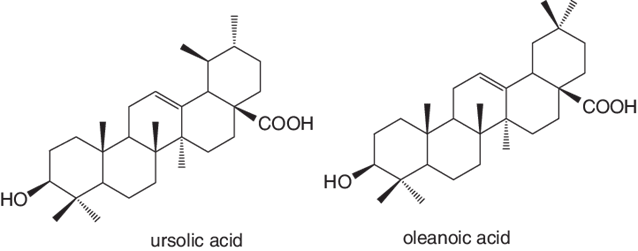
Fig 64.4: Chemical structures of ursolic acid and oleanolic acid shown side-by-side.
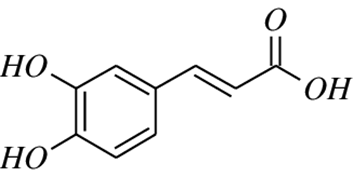
Fig 64.5: Chemical structure of Caffeic Acid, an important phenolic compound in Snowberry associated with antioxidant and COX-2 inhibition activities.
General information
Snowberry is a deciduous shrub in the honeysuckle family (Caprifoliaceae) native to North America. [4, 7, 8, 12] This hardy plant grows 1-2 meters (3.5-6.5 feet) tall, producing stiff, branching stems and often spreading through rhizomes to form dense thickets. [7, 8, 10] The leaves are oppositely arranged, generally oval, and vary in size and shape. Small, pink, bell-shaped flowers bloom in late spring to summer, attracting pollinators. [8, 10]
The most distinctive feature is the white, waxy berries that appear in late summer and persist through winter, giving the plant its common name. [2, 7, 8] These round, soft berries contain saponins and are poisonous to humans when ingested in quantity, though they were carefully used medicinally by Indigenous peoples. [1, 3, 11] The plant is highly valued by wildlife, with the berries providing winter food for birds, and the dense foliage offering shelter for small animals. [7, 8, 10]
Traditional Indigenous Uses
The crushed berries were often applied to the skin to treat burns, warts, rashes, and sores, their juices acting as a natural cleanser that soothed and purified. [1, 3, 11] The same berries, when rubbed into the hair, worked as a natural shampoo, keeping the scalp clean and healthy. [1, 9] Some people would even use them under their arms to reduce sweating and body odor. [1, 3]
When someone was cut or injured, the people chewed the leaves and placed them directly on the wound to draw out infection and speed healing. [1, 11] Tea made from the roots was taken for stomach troubles, calming pain and easing digestion. [1, 9, 11] The roots and stems, when brewed together, were used to help with urinary problems and to clear the bladder when urination was painful or difficult. [1, 11] Stronger decoction was used for more serious illnesses such as tuberculosis and venereal diseases, helping to cleanse the body from within and fight infection. [1, 11]
Tea made from twigs helped bring down fever and soothe toothache, while a light infusion of the plant could be used to wash the eyes when they were sore or red. [1, 3, 11] For babies and small children, the diluted berry juice served as a gentle cleanser for their delicate skin. [1] Even when the people struggled with lice or other body parasites, the Snowberry was used externally to remove them, leaving the skin refreshed and clean. [1, 3]
Biochemical Compounds and Their Medicinal Properties
1. Triterpenoid Saponins (Primary Bioactive Compounds)
Three Most Important Compounds:
(i) Oleanolic Acid Saponins (C₃₀H₄₈O₃ + sugar moieties) [6]
(ii) Ursolic Acid Derivatives (C₃₀H₄₈O₃ + sugars) [6]
(iii) Betulinic Acid Glycosides (C₃₀H₄₈O₃ + sugars) [6]
Medicinal Properties
- Surfactant/Cleansing: Natural soap-like foaming properties [6]
- Anti-inflammatory: Reduces inflammatory mediators [5, 6]
- Antimicrobial: Broad-spectrum antibacterial and antifungal activity [6]
- Anti-carcinogenic: Potential cancer-fighting properties [6]
2. Phenolic Compounds (Supporting Compounds)
Three Most Important Compounds:
(i) Caffeic Acid (C₉H₈O₄) [5]
(ii) Chlorogenic Acid (C₁₆H₁₈O₉) [5]
(iii) Flavonoids (Quercetin derivatives) [5]
Proposed Biochemical Mechanisms for Traditional Uses
Skin Cleansing and Healing (Crushed Berry Applications)
- Triterpenoid saponins act as: [6]
-
- Natural surfactants creating foam for cleansing
- Antimicrobial agents preventing infection
- Anti-inflammatory compounds reducing skin irritation
- Phenolic compounds provide: [5]
-
- Antioxidant protection of skin cells
- Enhanced wound healing through collagen synthesis
- Antimicrobial synergy with saponins
Shampoo and Scalp Health (Berry Applications)
- Saponins provide: [6]
-
- Natural cleansing through surfactant action
- Antimicrobial protection against scalp infections
- Mild astringent effects improving scalp health
- Amphiphilic structure allows oil and dirt removal
- Gentle enough for regular use without harsh chemicals
Digestive Support (Root Tea)
- Triterpenoid saponins act through: [6]
-
- Stimulation of digestive secretions
- Anti-inflammatory effects on gut mucosa
- Antimicrobial activity against pathogens
- Phenolic acids contribute: [5]
-
- Antioxidant protection of digestive tissues
- Enhanced gut barrier function
- Reduced inflammation
Wound Healing (Leaf Poultices)
- Saponins facilitate: [6]
-
- Antimicrobial protection preventing infection
- Enhanced blood flow to wound site
- Reduced inflammation promoting healing
- Phenolic compounds provide: [5]
-
- Antioxidant protection of healing tissues
- Enhanced collagen synthesis
- Improved tissue repair
Chemical Reactions and Molecular Interactions
Surfactant/Cleansing Action (Saponins)
Saponin → Amphiphilic structure → Micelle formation ↓Oil/dirt solubilization → Cleansing effect Hydrophilic (sugar) head + Hydrophobic (triterpene) tail ↓Emulsification → Removal of sebum and impurities [6]
Anti-inflammatory Mechanism (Saponins + Phenolics)
Triterpenoid saponins → NF-κB pathway inhibition → ↓ Pro-inflammatory cytokines ↓Reduced tissue inflammation → Symptom relief [6] Caffeic acid → COX-2 enzyme inhibition → ↓ Prostaglandin synthesis ↓Anti-inflammatory and analgesic effects [5]
Antimicrobial Activity (Saponins)
Saponins → Bacterial membrane disruption → Cell lysis ↓Cholesterol binding → Membrane destabilization → Cell death Saponins → Fungal cell wall interaction → Ergosterol binding ↓Increased membrane permeability → Growth inhibition [6]
Wound Healing Enhancement (Multiple Compounds)
Saponins → Fibroblast proliferation ↑ → Enhanced collagen synthesis ↓Improved tissue tensile strength → Faster healing [6] Phenolic compounds → VEGF expression ↑ → Enhanced angiogenesis ↓Improved blood supply → Accelerated wound closure [5]
Antiperspirant Action (Saponins)
Saponins → Astringent effects → Pore constriction ↓Reduced sweat secretion → Odor control Antimicrobial action → Bacterial growth inhibition ↓Reduced odor-causing bacteria → Deodorant effect [6]
Safety Considerations
- Berries poisonous when ingested in quantity (can cause vomiting, dizziness) [3, 8, 11]
- Traditional external uses generally safe [1, 3]
- Internal use should be cautious and under supervision [1, 11]
Traditional Preparation Methods
Crushed Berry Preparation (Primary External Use)
- Fresh berry crushing: Releases saponins for immediate use [1]
- Direct skin application: Maximum bioactive compound contact [1]
- Gentle rubbing: Activates foaming properties [1]
- Multiple applications: Daily use for cleansing [1]
Root and Stem Decoction
- Extended boiling: Extracts water-soluble saponins and phenolics [1]
- Moderate concentration: Balances efficacy with safety [1]
- Internal use cautious: Traditional knowledge respects toxicity [1]
Ecological Significance
- Erosion control: Rhizomatous growth stabilizes soil [8, 10]
- Wildlife habitat: Dense thickets provide shelter [7, 8]
- Nitrogen fixation: Some species improve soil quality [4]
- Native landscaping: Hardy ornamental for gardens [5, 8]
References
- Elders and Community members of the Cayoose Creek Band of Sekw’el’was. (n.d.). Traditional knowledge of Indigenous medicines.
- Greg App. (2024, March 20). Symbolism and benefits of the common snowberry. https://greg.app/common-snowberry-benefits/
- Health Benefits Times. (2020, December 4). Uses and benefits of snowberry. https://www.healthbenefitstimes.com/snowberry/
- iNaturalist. (2025). Snowberry (plants of the Middle Rio Grande Bosque). https://www.inaturalist.org/guide_taxa/355794
- Kang, N. J., Lee, K. W., Shin, B. I., Chen, T. R., Surh, Y. J., Dong, Z., & Lee, H. J. (2009). Caffeic acid, a phenolic phytochemical in coffee, directly inhibits Fyn kinase activity and UVB-induced COX-2 expression. Carcinogenesis, 30 (2), 321–330. https://doi.org/10.1093/carcin/bgn282
- Kaushik, N., & Gupta, G. (2023). Saponins of selected triterpenoids as potential therapeutic agents. Molecules, 28 (6), 2590. https://doi.org/10.3390/ph16030386
- National Park Service. (2025). Common snowberry. https://www.nps.gov/articles/000/common-snowberry.htm
- Native Plants PNW. (2025). Common snowberry (Symphoricarpos albus). http://nativeplantspnw.com/common-snowberry-symphoricarpos-albus/
- Natural Medicinal Herbs. (2025). Snowberry (Symphoricarpos albus laevigatus). https://www.naturalmedicinalherbs.net/herbs/s/symphoricarpos-albus-laevigatus=snowberry.php
- University of Washington Bothell. (2023, July 12). Snowberry – North Creek Wetland. https://www.uwb.edu/wetland/plants/symphoricarpos-albus
- White Rabbit Institute of Healing. (2025, March 26). Snowberry. https://www.whiterabbitinstituteofhealing.com/herbs/snowberry/
- Wikipedia. (2025). Symphoricarpos. https://en.wikipedia.org/wiki/Symphoricarpos